Carry On: Alums Share First-Class Insights on the Airline Business
February 9, 2026
- Author
- Mark Johnson
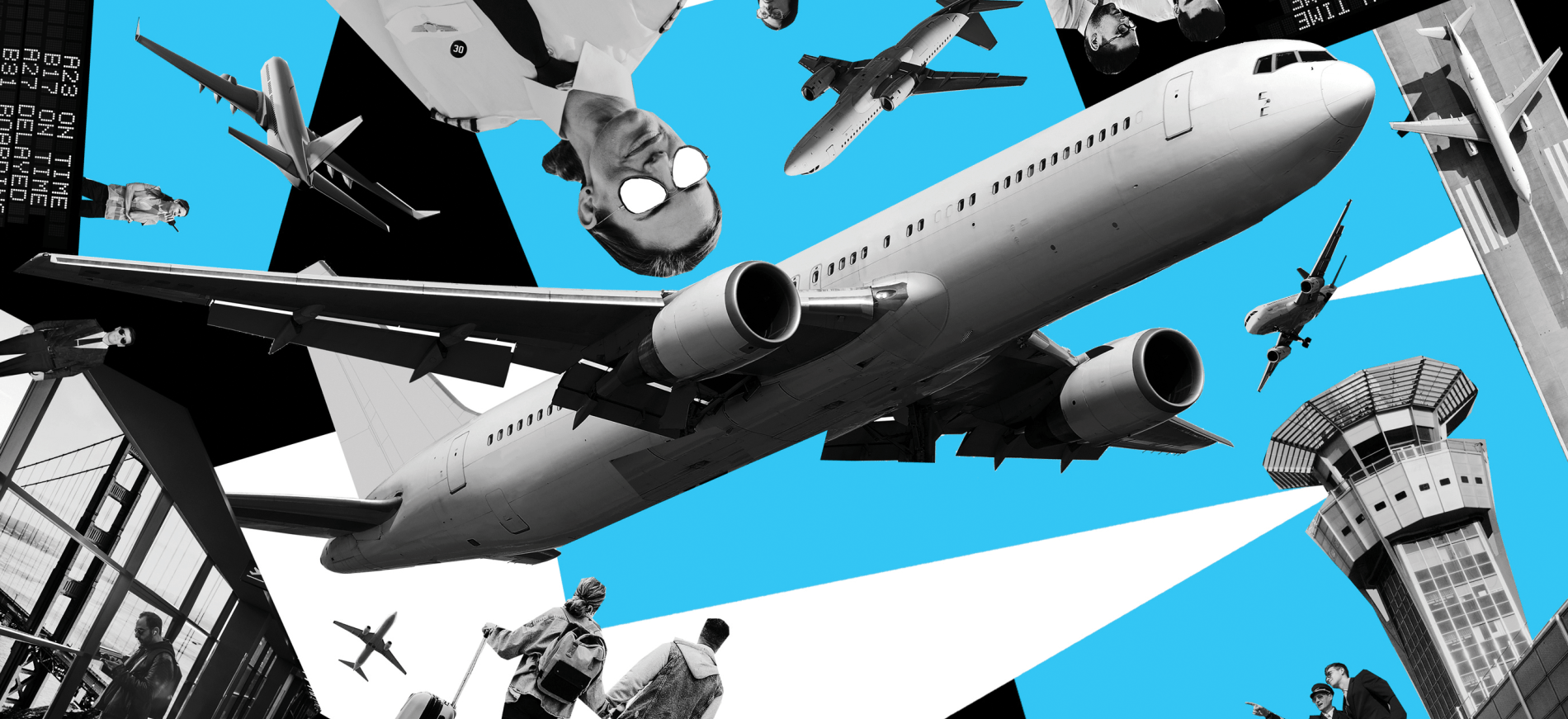
They help create indelible experiences every day for passengers riding in a chair in the sky or with their feet firmly planted on the ground.
These six Davidson College alums work in the airline industry, and their jobs touch nearly everyone.
They buy planes, craft policy, move millions of dollars, build community partnerships, develop rewards for loyal customers and ensure a partner airline can get passengers to Istanbul or Johannesburg.
And they, like the nation, are deeply polarized: window v. aisle. They help put together a vast, complex puzzle a thousand times a day. They are among the first to feel the crush of a slowing economy, or a government shutdown, and among the last to recover. They hear loudly and quickly when something goes wrong, and they appreciate when they can help the bluegrass band Nickel Creek recover a mandolin lost in the labyrinth of checked luggage.
They work across sharply different parts of three of the nation’s four largest airlines. The complexity and volatility of their industry creates enormous stress and pushes them into unpredictable challenges daily. They’re never bored. And they credit Davidson College for the agility to move among unrelated problems, connect and reframe them. Their days as Wildcats cultivated the empathy to thrive within a workforce that includes baggage handlers to engineers and with customers seeking bargains and creature comforts that border on science fiction.
The Davidson Journal gathered them on Zoom to share insights—and travel tips—from a business that spans continents and connects far-flung communities.

Gavin Sweitzer ’10, Director of Aircraft Transactions for Delta Air Lines; Kirk Willingham ’01, Davidson College Trustee and Managing Director of Financial Reporting at Delta Air Lines; Alan Rosselot ’91, Associate General Counsel and Assistant Secretary for Delta Air Lines
Davidson doesn’t offer an aviation program. How did you get into the airline industry?
Gavin Sweitzer ’10: When I started traveling to Davidson, I thought, “Flying is exciting, and traveling’s fun.” And I started looking at the airline industry, and I thought, “Wow, what a mess this industry is.” And I think I was really sparked by the challenge. You had noted the sort of importance that the airline industry holds, really, for the whole world. At Davidson, I started to try to figure out how to get an internship at an airline, which was quite an uphill battle, since nobody really knew anything about airlines. I was sitting at a campus event and I overheard BJ [Youngerman ’10] say—I’ll never forget it—something about a Republic Airways [Embraer] E170 [regional jet aircraft]. And I thought, “Who on earth just said that?” Because I would not have expected anyone on this campus to have any idea what that is. And I turned to him and introduced myself and said, “We need to talk.”
Sweitzer got an internship at JetBlue Airways. Youngerman snared one at U.S. Airways, via Davidson alums, opportunities normally awarded to students with technical majors.
Rob Heppenstall ’08 was intrigued by data analysis: I was interested in studying customers and people from a data perspective... Travel was interesting because of the connections it created.

...there are people who are going to see family... there are people who are going to their dream destination. It’s the human side that makes aviation a bit of a different industry.
United Airlines
There is routine to any job, but are there ‘wow’ moments from being part of helping thousands of people fly through the air?
Elizabeth Sasser ’19 (daughter of retired United pilot Jim Sasser ’82): It’s a bit of an overused word, but I do think it’s a bit magical. I, myself, am very much a window seat person, and every single time, I do find myself looking out the window for a large portion of the trip. I don’t think that’s ever lost on me, and it’s something I always appreciate when I’m flying.
BJ Youngerman ’10: I was in the Philippines, boarding a United flight in Cebu, and just thinking, “Wow, this is amazing. I’m in a really far corner of the globe away from everything else and yet I get to see the company I work for right here helping connect the world.” And there are not many jobs and industries where you have that scope and impact. That we’re truly touching all different parts of the world—to me, that, at its core, is what makes me proud and excited to continue to be in the industry. We’re also doing this work during an interesting time. As a Davidson student, you learn about your place in the world, and what it means to be a global citizen. We’re living that now in a time that makes that focus and responsibility even more critical.
Sweitzer, whose office is next to the runways at the Atlanta airport: Sometimes on my most challenging days, when I say to myself, “What on earth is going on? And what have I gotten myself into?,” I may be over at the airport going somewhere, and I look out the window, and I say, “Oh, I bought that [airplane]. That’s cool... I know that story.” And then, all of a sudden, it’s, “Yeah, this is still really fun 15 years later.” All of us here work on this incredible puzzle that comes together thousands of times a day, over and over again, and it’s hard not to think that’s cool.
Kirk Willingham ’01: I had a high school friend reach out to me a couple of years ago, and she said, “I’ve got a friend who’s the manager for the band Nickel Creek, and Nickel Creek is flying from JFK to LA to prepare for their tour, and they lost a mandolin. Can you help track it down?” I mean, I’m sitting in an office in Atlanta, there’s very little I can do. I do know a couple people who work for Delta in New York, so I sent a message. And, long story short, that message got passed along to enough of the right people. They eventually tracked it down, found the mandolin, got it delivered to the band in time for the opening show of their tour. And they were so appreciative that they told my friend that we could join them backstage at any other concerts they were performing later that year. So, a friend of mine from high school and I got to reconnect. We had not seen each other in several years, and we got to enjoy a night of music and then hang out with the band backstage. You never know where your role in the airline industry will lead you.
Also, I got to help with the delivery of a new aircraft, and there is a new airplane smell, just like a car.

Elizabeth Sasser ’19, Principal in Commercial Alliances and Analytics at United Airlines, works with partner airlines around the world to take United passengers to more destinations
You work for a consumer service company, like Starbucks or Verizon. How is your industry different, other than transporting people at 30,000 feet and 600 mph?
Heppenstall: You think about it every day (but you don’t fly every day). You might go to Starbucks and buy a coffee every day, and so that’s top of mind for you. But people’s travel aspirations and dreams of the next vacation, or the next trip to go see family, is just as quotidian as maybe getting that cup of coffee. And so, for us, it’s really interesting to think through the daily relevance paired with the less frequent travel engagement of folks. For me, that’s been a really fun and interesting challenge—how do you stay relevant and engaged with customers and your members on a day-to-day basis. Yeah, there are some people who travel every week, but the vast majority are either every other year, or every year, or a few times a year.
Sasser: There’s a lot of business travel out there, but there are also people who are going to see family. There are people who are going to their dream destination. I think it’s really that sort of human side that makes aviation a bit of a different industry.
Alan Rosselot ’91: I have spent a lot of time understanding the different aspects of the business so I can evaluate how we describe it and talk about it, and that, to me, sort of pulls a lot of those different areas together... The complexity of our operations, our fundamental focus on safety, plus financial, plus government affairs and so much more. Different perspectives get applied to the airline industry, because we’re such a public industry. We have to anticipate how our public disclosures will be perceived internally and a wide range of external audiences. It’s both a challenging and a very rewarding place to be.
Constant Evolution
All six alums highlighted a transformation in the industry over the past three decades, accelerated by a post-pandemic “life is short” view by consumers. Airlines have soared and plummeted, from the lows of 9/11 and bankruptcies and the 2008 recession, up to the low fuel prices and full planes of 10 years ago, back down to the post-COVID doldrums and, now, high demand for premium products. They have moved from a bargain-battle commodity of selling a ticket to a service that still provides historically affordable travel but also sells more, pricey, lie-flat seats, urges lounge membership and offers credit cards. Sweitzer described a “race to the bottom” price approach when he started to, now, courting a brand loyalty generation.
Heppenstall: I just saw the new [Boeing 787] Dream-liner Premium. It has more premium economy and business class seats than a 777-300. So, we’ve got a plane that is smaller, but has more [premium] seats, than the biggest in our fleet.
There are legions of passengers trying to game every possible perk out of airlines. You get pulled into that, right?
Sasser: Some of the best secrets are just having done the research and kind of knowing where to look for those specific deals. It’s just how much time you want to invest.
Heppenstall: You’re standing on the sidelines at a kid’s soccer game, and people find out what you do, and then all of a sudden, they’re asking for every tip in the book on how to earn loyalty points, or how to get the most out of your miles and status benefits. And it’s a real passion point for a whole lot of people. Thanksgiving dinner table for all of us is probably different from most. I don’t think any of us escape without a family member regaling us about their airline trip.

Rob Heppenstall ’08, Director of AAdvantage™ Business™ Design and Delivery at American Airlines, directs the airline’s loyalty program for small-to-midsize businesses.

BJ Youngerman ’10, Managing Director of Community and Market Impact at United Airlines, develops and manages community partnerships in United’s hub cities and across the globe.
The airline industry feels the economy’s nosedive (sorry) early and is slow to rebound. How is your blood pressure?
Sweitzer: 2015 was a particularly good year for the airline industry, and the CFO at JetBlue, who [was retiring], had been in the industry for 40 years looked at me one night, and he said, “I can’t begin to tell you how unbelievably easy this is right now.” And he said, “I’m gone, but just hold on to something, because a bunch of stuff’s going to happen. I just don’t know what’s going to happen and when. Just be ready.” March of 2020 [and the COVID pandemic], I thought, “Hmmm. Mark was right. Better hold on.”
Sasser: You know, you’re always sort of reacting and balancing what’s happening in the world with what you’re doing, either in the short term or the long term, which certainly is exciting. But, definitely, to your point, it may be stressful.
Rosselot: You have to have an iron stomach. And I don’t mean for flying.
Willingham: It’s been a rare day that I have come in and known exactly how my day was going to play out, and inevitably, there is some phone call or some email that shows up during the day that totally changes the course of what I work on for the next day, two weeks or six months.
That unpredictability has you veering into a lot of other lanes in your airline. What helps you manage that?
Youngerman: Part of what we learned at Davidson and captured through the liberal arts experience was how to be responsive to a lot of different situations. You learn how to critically think and solve problems in challenging situations. You also learn how to communicate and, man, those are the core skills. All of us [on this Zoom call] work in very different parts of the business, and yet, for each one of us that sentiment resonates. Because of the constant changing nature of the industry, and since you don’t know what’s going to get dropped on your plate at any given time, it’s so important to have that general “athlete” skillset. You can be put into almost any scenario, and you’re going to be able to figure it out. That’s something I really enjoy about the industry, because, to Kirk’s point, you’re not walking into the same thing every day. We all have friends and colleagues who work in other industries who know what their 9-to-5 is going to look like, and that’s just not what I would want. That’s what makes it particularly special to be in the industry, especially as a Davidson alum.
How did your Davidson College experience prepare you for what you do?
Heppenstall: Our customers, or our employees, every day at work are doing similar things—supporting people who are attending funerals, or flying to weddings, or traveling somewhere new for the first time, and are experiencing these life things. Joining people in that journey and approaching it from a perspective of care and humility is really important, and I think Davidson does a great job of equipping us for purpose-driven lives.
Sasser: Davidson prepared me in teaching me how to learn quickly and effectively solve problems.
Sweitzer: I’ve had several instances where somebody came up to me and needed something, and I’m like, “Okay, I don’t exactly know how to solve this. But I’m incredibly invested in the problem, and I’m going to go figure this out.” And, then, I’m going to find another Delta employee who’s going to help figure this out. It’s incredibly awesome to watch teamwork come together to solve complex problems. Davidson offered great training for that.
Rosselot: Davidson gave me the foundational skills I need to analyze and think about the legal challenges we tackle, and to keep the people we serve at the heart of what we do every day.
Any travel advice for our readers?
Everyone: Join the loyalty program. Your saved profile makes things easier. You board earlier. It’s free. Get the credit card.
Almost everyone: Don’t check a bag.
Willingham: Pack your patience. Expect the unexpected. Be prepared to deviate from the plan.
Sweitzer: There are so many touch points on the travel ribbon... human touch points. Remember that the flight attendants and the agents and the pilots, whatever’s going wrong with your trip, that could happen to them hundreds of times. Just taking a moment to, frankly, just be nice. Say “hello” to the agent, “How was your day?”
The big question – window or aisle?
Window (the view): Sasser, Youngerman, Rosselot
Aisle (access and legroom): Heppenstall, Sweitzer, Willingham
This article was originally published in the Fall/Winter 2025 print issue of the Davidson Journal Magazine; for more, please see the Davidson Journal section of our website.