My Davidson | A Student Blog Where the Wounds Still Breathe: One Student’s Trip to South Africa
January 27, 2026
About the Author
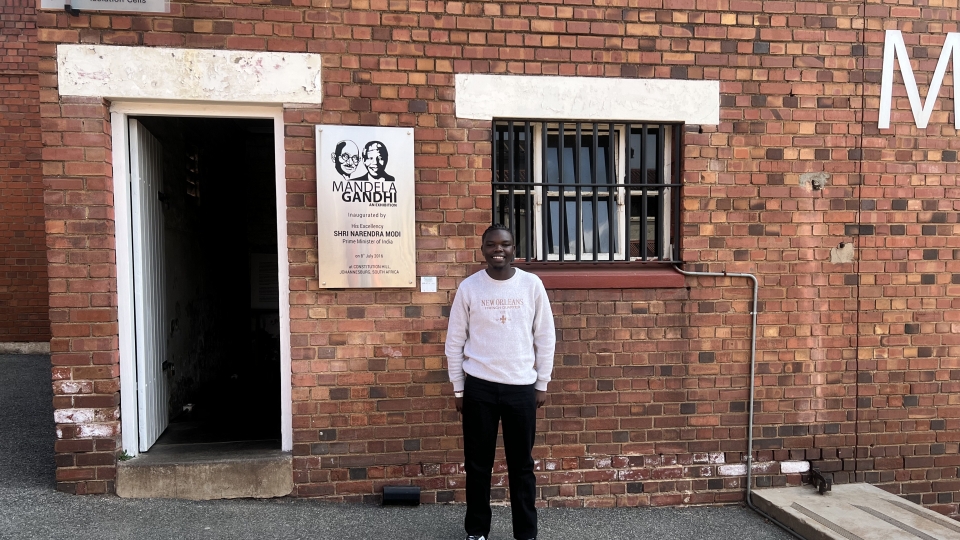
Branton Onsongo Mogeni ’28 (he/him) is an economics major and data science minor from Eldoret, Kenya.
“I have a passion for structural justice. I use quantitative analysis and economic inquiry to explore how inequality, history and policy shape contemporary African societies.”
My trip to South Africa was never intended to be a sightseeing trip. I went with questions in my pocket and unease in my chest.
As someone who studies African history, I thought I knew apartheid well—its dates, laws, and key figures. But walking through the places where it unfolded made history heavier. It wasn’t just knowledge anymore; it was something I could feel pressing on me.
Soweto was my first lesson. The streets felt like they carried the weight of those who marched, fought, and died. Awe and sadness mixed in my body as I stood at the Hector Pieterson Memorial. I’ve seen that photograph in books so many times, but in front of me it was unbearable. His small body, the grief on his face—history became a sensation, not information. It made me wonder how people live under the shadow of memory without being swallowed by it.
District Six added another layer. The museum walls were full of stories of forced removals: houses erased, lives rearranged. Walking through that space, I felt anger—quiet, simmering. Whom did erasure serve? Who benefits when a community is uprooted? Even today, restitution is complicated. Some former residents still hover between belonging and memory. It reminded me that apartheid was never just a policy; it was architecture, zoning, bodies mapped and controlled.
Yet survival lived there too. Guides spoke about resilience with pride. Listening to them, I thought about my own position. I’m Kenyan—a child of colonial history as well—but South Africa’s wounds feel so raw, so exposed. Watching skyscrapers rise beside informal settlements made it painfully clear that democracy did not erase inequality. Freedom came, but justice is still crawling behind it.
At the Apartheid Museum, the design of the place forced me to confront how racism was lived. Randomly assigned “White” or “Non-White” tickets, visitors are split into separate entrances. It was unsettling. Apartheid wasn’t just about where you could live; it trained people how to think, how to believe in hierarchies. South Africa today is constitutional and democratic, but inequality remains among the worst in the world. It left me wondering: Is freedom enough without economic justice?


I often thought about memory. Some guides worried that younger people were moving on, forgetting. A former resident of District Six told me, “If we don’t tell it, it will die.” That line stayed with me. History isn’t only archived—it’s performed through testimony. Silence becomes a second erasure.
I also couldn’t help comparing it to home. Kenya has its own unfinished histories: land, ethnicity, exile. I found myself wondering how we remember, how we forget, and who carries the stories. What would an “Apartheid Museum” look like in Nairobi? Not to reopen wounds, but to name them.
Art helped answer that question. Murals, songs, poems—all marking resistance. Decolonization, I realized, isn’t only laws; it’s narration. It’s who tells the story and who listens.


By the end, I held both hope and unease. Hope because remembering is a form of defiance. Unease because remembering alone does not feed children or redistribute land.
One guide told me, “Liberty is young, but inequality is old.” I can’t shake that sentence.
I left South Africa lighter in knowledge but heavier in responsibility. My trip wasn’t tourism. It was a witness. And I carry that with me now: a reminder that history is not behind us. It breathes, it insists, and it asks what we will do.
Mogeni's self-exploratory and reflective learning experience was made possible through a Dean Rusk International Travel Grant. He is also a recipient of the J. Cecil Lawrence Scholarship.