My Davidson | A Student Blog Public Health in Action: Confronting Black Maternal Health Disparities
December 9, 2025
About the Author
Jennifer Vo ’27 (she/her) is a Chemistry major and Public Health minor from Gilbert, Arizona. Outside of the classroom, she is involved with the National Organizing Team at Feminist Generation, the Bonner Scholars, the Civic Engagement Council, and the Rock Climbing Club. Jennifer is also a recipient of the John M. Belk Scholarship.
“I chose Davidson because of its tight-knit community, where students and professors genuinely connect. It’s a place that continuously challenges and inspires me to pursue my passions. The support and resources I’ve received from peers, staff, and faculty have truly empowered me, and it’s become a second family.”
Women’s health and public health have always been important to me.
So, when Prof. Butts offered her “PBH 375: Disparities in Maternal Health” class, I knew I had to take it. I had not heard about the maternal mortality issue before, and this class opened my eyes to just how severe this problem is in the United States, especially for Black women.
Despite spending more on healthcare than any other nation, the U.S. has the highest maternal mortality rate of any high-income country. Even more shocking, Black women are three-and-a-half times more likely to die from pregnancy-related causes than white women. This was a wake-up call for me, and I knew I needed to learn more.

What is a “Respectful Maternity Simulation”?
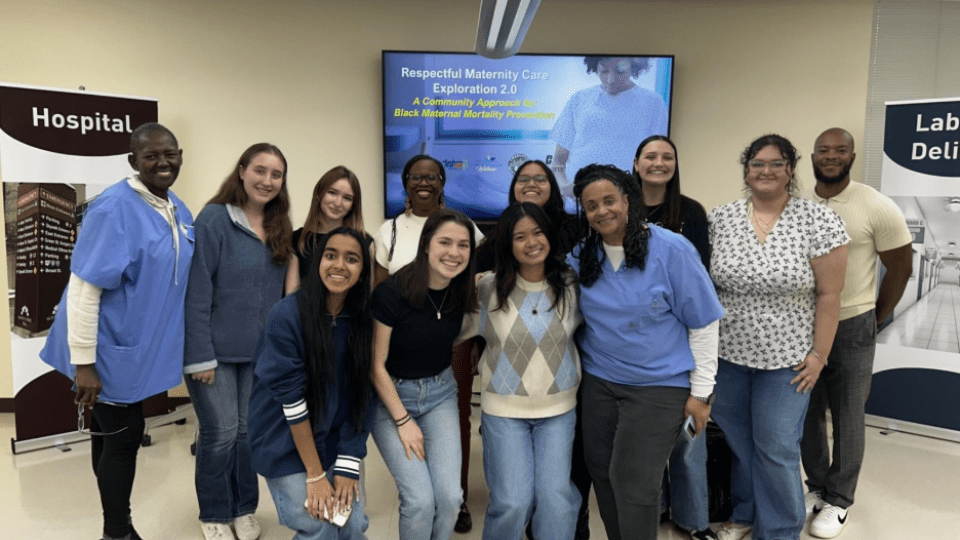
When Prof. Butts invited students to attend the Respectful Maternity Care Simulation at the University of North Carolina Charlotte (UNCC), I jumped at the chance. The event was hosted by UNCC’s Learning Resource Center, UNCC’s Department of Epidemiology and Community Health, and Danette McLaurin Glass, of First Team America, LLC. It was a community-wide event that focused on how patient-provider relationships directly impact Black maternal health.
During the simulation, participants assumed the roles of patient, family member, patient advocate, or a healthcare provider (doctor or nurse). Each scenario was based on real-life experiences of Black women in the American healthcare system. Being in the shoes of those women was emotional, uncomfortable and powerful. Experiencing the healthcare process through those different lenses, especially the feeling of not being listened to, clarified for me just how deeply patient-provider interactions shape a patient’s outcome.
One of the most impactful moments from this simulation was the story of the patient I portrayed. She had gone to multiple providers complaining about shortness of breath, but each time she was dismissed and told that she was experiencing “normal postpartum” symptoms. Later, while breastfeeding at home, her lips and nails turned blue. When EMTs arrived, they forced her to walk to the ambulance, and she collapsed before reaching the door. This struck me because she should have been carried to the ambulance and assisted immediately. She tragically passed away. Situations like these are preventable and occur way too often.

Photo Credit: UNC Charlotte College of Health and Human Services
I came away from the event learning that care isn’t just about what happens in the exam room. It extends to every touchpoint in the healthcare system: the ambulance, the reception desk, the nurses and the doctors. At each of these moments, there is an opportunity to treat patients with dignity and respect, or to perpetuate a culture of neglect and bias.
Attending this event really changed me. I left with a deeper understanding of how racism operates in our healthcare system and developed a clearer vision of the type of professional I want to become: someone who notices, advocates, empowers and listens to a patient's experiences. This simulation also taught me about the importance of empathy, cultural biases and the willingness to challenge biases in us and in others to improve patient experiences. As I continue my studies at Davidson and think about my future in healthcare, I want to work towards helping create a healthcare system where every individual receives the respect, care and dignity they deserve.