‘Nobody Expects Revolutions Until They Happen’: Prof. Silvana Toska on Iran’s Unprecedented Unrest
January 30, 2026
- Author
- Jay Pfeifer
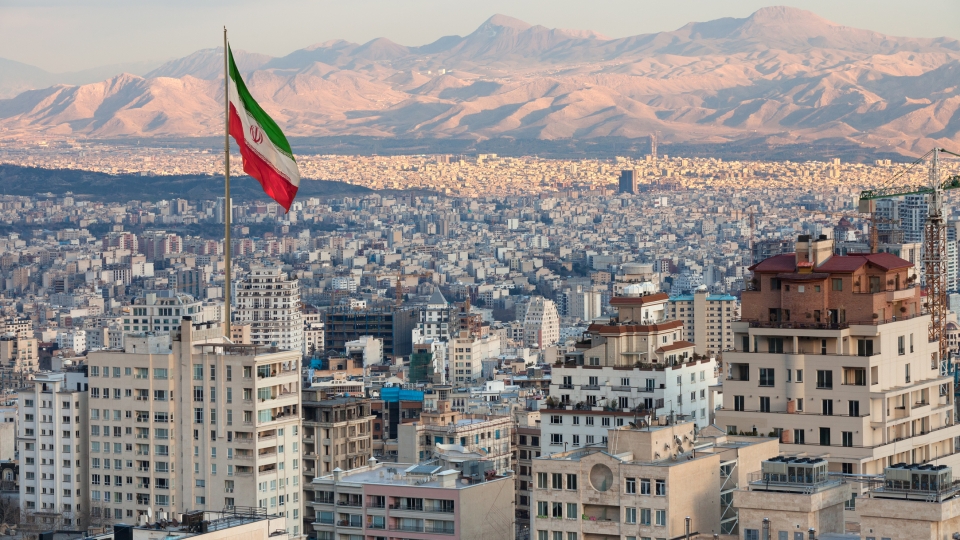
When Iran blocked the country’s internet access in early January, they cut off the world from the most widespread protests in decades.
While we do not know for certain the scale of repression, according to Middle East expert and Political Science Professor Silvana Toska, as many as 20,000 protesters may have been killed as the leadership attempts to stamp out the unrest.
Iran has done this before – crushing protests in 2009 and 2022. They have learned from experience that extreme repression is their best bet. But this time may be different. Iran is facing a host of challenges that may be out of the regime’s control. The economy has collapsed, with inflation at 48%. Its most important regional actor – Hezbollah in Lebanon, a paramilitary organization connected to Iran – has been crushed in the wake of the Oct. 7 attacks on Israel. Severe drought and climate change threaten the country’s water supply. A humiliating response to an Israeli and American military campaign past summer, and Iran’s inability to shore up even basic air defenses, further delegitimized the regime.
“It’s hard to say what will happen in Iran but conditions are ripe for major change,” Toska said. “Does that mean that protests will pick up again and the regime will fall? We do not know that. Sometimes repression does work, such as the famous example of Tiananmen Square and previous waves of revolt in Iran. But sometimes protesters redouble their efforts after repression, as they did in 1978-79 during the Iranian revolution. Everyone thinks of revolutions as improbable until they happen.”
Iran has a history of major protests and of revolution. How do the recent protests compare to previous unrest?
These were the largest protests Iran has seen since 1979. They were larger than the protests in 2009 and larger than the “Women, Life, Freedom” protests in 2022. The most recent protests spread across all 31 provinces in Iran and comprised people of all ethnicities, social and economic status, and religions.
The protests were so large that the government had to change its strategy from its usual method of protest management to securitization. As protests became too large to manage through regular means, the regime swiftly moved its rhetoric by calling protesters terrorists engaged in a hybrid war, supported by Israel and the U.S. This gave them justification for the military crackdown and widespread murders. The regime moved incredibly quickly to commit these murders. To put this in context, it took the brutal Civil War in Syria months to reach this number of murdered protesters, and it took the Iranian government a few days to get there.
Economic conditions have contributed to this instability. Why did the Iranian economy collapse so quickly?
Iran has been under sanctions for so long that they've had to adjust and readjust their economic policies in order to make up for it. It is also an incredibly corrupt regime. Sanctions have caused severe pain in the population, but actors within the regime – especially the Revolutionary Guard – have been able to benefit from the situation.
In December, the Iranian riyal fell further against the dollar, which made rampant inflation even worse. The Iranian regime provided subsidies for basic goods but, as the riyal fell, they removed those subsidies. The pain of this action was immediate. Poverty in Iran has been increasing exponentially for years. According to conservative estimates by the World Bank, in 2023 about 40% of Iranians were under the poverty line, but by early 2025 that was more than 50%. Again, these are conservative estimates, and they do not capture the effect of the economic collapse of the last few months.
The government, however, finds itself in a “Catch 22” situation: it cannot make rapid changes without also potentially weakening itself. President Pezeshkian stated that the government is catastrophically stuck, with crises raining on them. The bottom, basically, just fell out.
What does a destabilized Iran mean to the region?
Everyone is very nervous about instability in the region. Even Israel, who wants the Iranian regime to fall, helped persuade the U.S. not to exacerbate the situation by bombing Iran in January. (Israel is short on missile interceptors and didn’t want the cornered Iranian regime to launch more missiles.)
The Gulf countries, too, are concerned about regional instability that a conflict would cause. They are worried about disruptions on energy trade, potential retaliation from Iran, and flow of refugees. Moreover, relations between the Gulf states and Iran are better than they have been in a while. It is fair to say that Israel has replaced Iran as the most concerning, expansionist, power in the region. Without Iran, there is a concern in the Gulf that Israel has free rein to expand, which could cause greater instability in Syria, Lebanon and Jordan, none of which is in anyone's interests. Turkey, meanwhile, is concerned about the Iranian Kurdish population asking for greater autonomy – or worse, independence – which would be a serious threat to its own government’s stability.
How do President Trump’s threats to bomb Iran affect the area?
U.S. military intervention could not solve the problem. While some protesters named streets after President Trump and were hoping for an intervention, there are serious limits to what an intervention can achieve – or whether President Trump has the requisite attention on the issue to make it a success.
First, it’s not clear that military intervention would protect the civilian population. Basij paramilitary forces can easily embed with protesters, which would likely increase civilian death.
But there are other things the U.S. could have done to support protestors. Cyber attacks are a covert option. The U.S. could threaten to end nuclear negotiations with Iran, which is extremely valuable to Iran right now as they try to improve their economic situation from stifling sanctions. Greater economic sanctions, on the other hand, and asking allies to cut diplomatic ties with Iran are options as well. The U.S. could threaten to bomb military assets and use those as a deterrent against regime repression. These are things that are options, not that they should all be used. There are very few interventions that have been successful historically, and those have occurred in unique circumstances and prolonged military engagement, and hence they would not translate to Iran.
In fact, any visible intervention could easily backfire. It could be used by the regime to demobilize protestors and increase violence. The regime still has the support of the military and the elite – even elites who want reform, usually want to do so from within. The structure of the Iranian military, including the Revolutionary Guard, is such that it makes wholesale defection difficult. The Guard has various sections within it that take orders directly from the Supreme Leader – it is not as unified in structure as it is portrayed. This structural issue, together with its embeddedness with the regime, makes a potential defection unlikely. Hence, any attack on the regime may serve to unite it further.
Additionally, we ought to be extremely concerned about normalizing this kind of episodic military action on the part of the U.S. Such intervention would not necessarily have a legal justification and is selective (why Iran but not Sudan, for example). As a result, it is problematic in and of itself.
What do you expect to happen in the short term?
It is very difficult to predict. As a scholar of revolution, it’s important to note that we almost never accurately predict major political change. So, I want to be careful about predictions.
I think the Iranian administration has effectively suppressed the protests in the short term. But leadership is aging and it’s not clear who would succeed Supreme Leader Khamenei. Likewise, the military leadership has been hollowed out because they fired a host of top generals in a bid to purge Israeli infiltration. The Israeli attacks last summer completely humiliated the Iranian military and de-legitimized the regime’s claims that they could stand up to Israel.
The economic issues – unemployment and the collapse of the currency – only add pressure. I don’t know how Iran can solve these problems without significant change and whether the repression will be sufficient to keep things quiet. It’s hard to make any clear predictions, but long-term stability is also hard to envision.