Reaching Out, Drawing In: Spencer-Weinstein Award Winners Lead by Building Connections and Expanding Access
May 15, 2026
- Author
- Caroline Roy '20
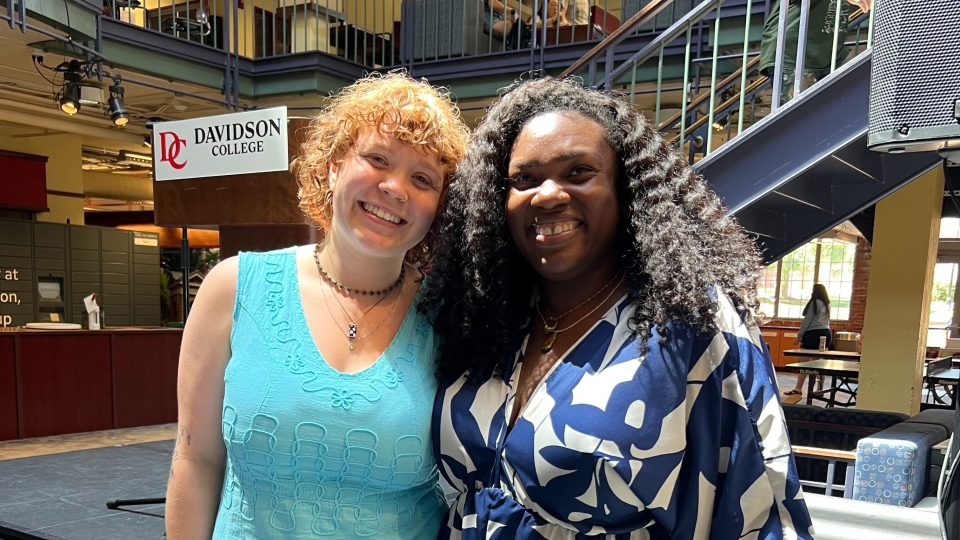
Spencer-Weinstein Award Winners Nora Fenn Gilman ’26 and Jasmine Peters
Davidson College recently recognized one student and one staff member with the Spencer-Weinstein Prize for Community and Justice, honoring their legacies of commitment to community, connection and well-being. The annual award was created by close friends of the college, Carole and Marcus Weinstein.
The 2025-2026 recipients are sociology and education scholar Nora Fenn Gilman ’26, for her efforts to research and boost early childhood literacy and strengthen community connections beyond the college, and counselor Jasmine Peters, for her dedication to LGBTQIA+ student health and well-being and for nurturing crucial partnerships across campus.
Nora Fenn Gilman ’26: Literacy, Leadership and Creating More Equitable Classrooms
As a student leader, Nora Fenn Gilman ’26 has learned that creating real change requires building relationships outside of your bubble, listening to your community and encouraging solidarity between people and organizations.
Gilman came to Davidson with a passion for education and a desire to learn more through research and hands-on teaching experiences. As a Mulliss Center for Civic Engagement Nonprofit Leadership Fellow, she spent the summer after her sophomore year working with Smart Start of Mecklenburg County, a nonprofit focused on early childhood literacy.
She collected data from Smart Start’s partners, tracking access to books and identifying the zip codes with the highest levels of need.
“Literacy is more than just words,” she said. “It’s being able to describe a story through pictures and put together a narrative. The more books a child under five has around them, the more likely they are to enter Kindergarten with critical reading skills.”
She worked through the Mulliss Center for Civic Engagement the following summer, too, this time as a teacher for Freedom Schools and their summer enrichment program.
“It helped solidify my desire to teach elementary school,” she said. “It’s a really special age where kids are beginning to understand their own experiences and engage in difficult conversations. You watch them grow so much in just a short period of time.”
Gilman recently defended her senior honors thesis, which examined restorative justice practices in schools across her home of Montgomery County, Maryland. She interviewed educators and administrators across the county about the ways they approach discipline and conflict in the classroom and gathered data on disparities between schools in the region.
After graduating, Gilman will spend one final summer working at Freedom Schools. She hopes to apply what she’s learned in the classroom and on the ground to help teachers with classroom management and learning strategies.
“I was surprised to receive this award because everything I’ve done here feels like such a normal Davidson experience,” she said. “So many students here do incredible community work, and I’m really happy to be recognized as a part of that.”
Jasmine Peters: Forging New Pathways for Mental Health Support on Campus
Jasmine Peters joined the Center for Student Health and Well-Being in 2020. She joined a team of counselors and brought with her an expertise in LGBTQIA+ mental health concerns. Since then, she has endeavored to expand the reach of mental health resources for all students on campus.
“I highly value building relationships with faculty and campus partners,” she said. “Every new connection gives me a creative way to meet with students who might not otherwise come in for an appointment.”
Peters understands areas of need on campus through her connections with faculty, staff and student leaders.
In 2021, Peters led the first Restorative Justice Experience, taking a group of students to New Orleans over spring break. They visited historical sites, studied examples of restorative justice and ultimately planned to implement what they’d learned back on campus. To her surprise and excitement, what began as a one-off trip has blossomed into a years-long program.
“Each cohort has picked up on something different,” Peters said. “At the end of the semester, we hold a round table with the students to discuss how they’ve used restorative justice in their lives. It’s really cool to see how they are engaging with the community and changing the way they tackle issues on campus.”
Peters helps run a workshop series led by graduate-level counseling interns that hosts group events with organizations across campus, and as she continues to amplify the work of the Center for Student Health and Well-Being, Peters is excited to keep counseling students from all areas of campus through some of their most formative, challenging and rewarding times. Supporting them holistically is her favorite way to contribute to the college’s larger mission.
“Over half of my students are part of the LGBTQIA+ community,” she said. “I have so much gratitude to Davidson for making this role possible and visible on campus. I’m proud to be at an institution that values this work and shows it.”