From Charlotte’s Urban Ministry Center to New York City and now nationwide, SSUSA parks are changing the landscape and lives.
Pitch Perfect Street Soccer USA Teams up With the World Cup for Maximum Impact
June 11, 2026
- Author
- Anna Katherine (Clemmons) Clay ’01
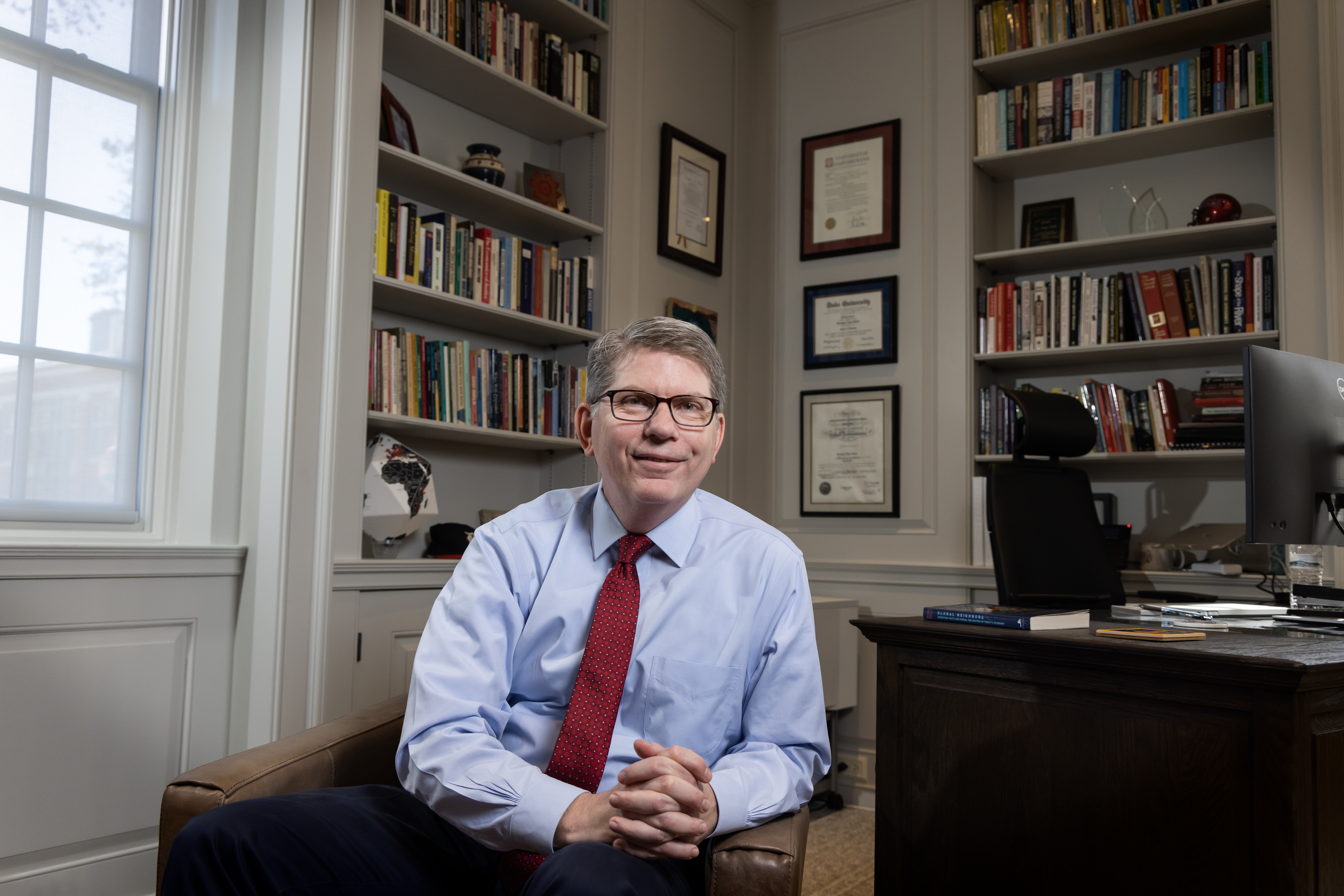
Lawrence Cann has guided Street Soccer USA from early days in Charlotte, North Carolina, to national impact, and now to a place on the world stage.
Lawrence Cann built his first soccer pitch without a manicured lawn or a million-dollar drainage system.
He used tires, pavement and a perimeter of chili pepper plants.
In 2009, Cann sought to give Charlotte’s unhoused something more than a meal or a bed—he created the opportunity for community.
What began as a makeshift project at Charlotte’s Urban Ministry Center has evolved into Street Soccer USA (SSUSA), a national powerhouse of social impact. Now, with the 2026 FIFA World Cup on the horizon, Cann ’00 and a dream team of fellow Davidson soccer alumni are racing against the clock to pull off their most audacious goal yet: building 26 professional-grade street soccer parks across America. It is a collective effort to turn the momentum of the world’s biggest sporting event into a permanent ecosystem of hardware, heart and opportunity for the kids and adults who need it most.
Cann started working at UMC as a volunteer in 2005; he was hired as the non-profit’s outreach coordinator in 2006. His work at UMC had been inspired, in large part, by several Davidson classmates, including Liz Clasen-Kelly ’00, who worked at UMC and had volunteered throughout their undergraduate years.
“I saw these fellow classmates who had this ethic of service and that impressed me so much,” Cann says. “It made me feel like I should be like them—I wanted to embody that same ethic.”
One of the programs he founded at UMC, Art Works, used art to engage the homeless community; while it was effective, Cann noticed that a lot of the 18-20-year-old men he worked with needed a physical outlet. “Art was fine for them, but sports was obvious,” Cann says.
Cann called one of his friends, an architecture professor at UNC Charlotte, and they designed a makeshift pitch. They bought used tires, filled them with soil and turned them into planters seeded with chili peppers. The tires formed a wall around the “field.” Then, they created a six-by-two-foot grid inside the walls and handed participants paint to create the field lines. But the pitch itself wasn’t turf or grass—it was the UMC parking lot.
“It took off from day one,” Cann says. “It was too small, but it was very creative and beautiful.”
Over the next 15 years, as Cann turned his efforts into an official organization—Street Soccer USA (SSUSA)—and relocated to New York City, he focused on programming. He built several moveable, temporary single sport court fields, made of plastic tiling, polyethylene walls and futsal surfaces, which were housed in several low-income neighborhoods around the five boroughs. When SSUSA hosted clinics or Cups in Manhattan, Cann rented a 26-foot Penske box truck, loaded the parts and transported them. Then he’d return them to the neighborhoods.
In 2023, SSUSA built an official street soccer park in the Bronx, one of only three permanent physical parks SSUSA had constructed, even as they expanded programming nationwide.
The next summer, Cann began brainstorming about the arrival of the 2026 World Cup across North America, which would be the first World Cup held in the U.S. in over 30 years. How could Street Soccer capitalize on the momentum of soccer’s biggest stage?
Held every four years, the FIFA World Cup is soccer’s marquee global event, widely considered the most popular sporting event in the world. The two-stage format pits teams from 48 countries against each other in a round-robin group stage followed by a single-elimination knockout stage that determines the eventual champion. Around five billion people watched some part of the 2022 World Cup; the final match was viewed by 1.5 billion, more than 10 times the Super Bowl audience.

Rohan Allen

During a brainstorming session with his Board that fall, Cann shared his vision: to build 26 Street Soccer parks (26 for 2026) in the 11 U.S. cities where World Cup games would take place, as well as in nine additional cities—20 cities total.
Supported by funding from corporate partners, SSUSA would provide not only the infrastructure—FIFA-grade, professional-level turf fields and learning centers—but the sustainable ecosystem of programming, community building and youth development, a collective impact model designed to continue long after the World Cup’s final game.
A central question loomed: could they pull it off?
“Goal setting was always a core part of our curriculum and programs,” Cann says. “But I think no one expected we would actually complete the parks by the end of 2026.”

By providing programs aimed at youth and families living below the poverty line, SSUSA seeks to eliminate the gap between those who can pay to play and those who can’t.
Space to Grow
Cann moved from Charlotte to New York City in 2010. He hadn’t established chapters outside of New York City yet, but “we named ourselves Street Soccer USA because we wanted to be national in scope,” Cann says. “We wanted to design a solution for the bottom of the pyramid that could scale.”
Cann expanded programming—which had centered on adults experiencing homelessness—to youth and teens in high-need, high-poverty neighborhoods. He hired staff and grew programs into other cities. Permanent physical parks, however, weren’t a focus.
“It seemed expensive, and a waste of time and resources,” Cann says.
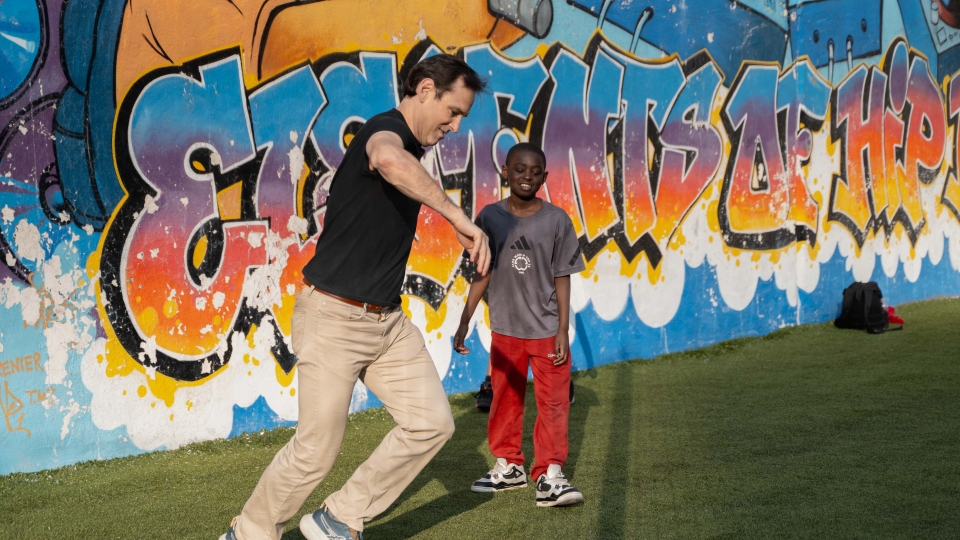
Rohan Allen began coaching with Street Soccer in the Bronx in 2017. He led clinics out of a local public school gym; he held practices in a community dog park. A couple dozen kids would show up in the afternoon as dog owners wandered through. Sometimes, the kids were afraid of the dogs and would stop playing. Other times, the dogs would relieve themselves during play.
“It got a bit messy,” Allen says. The park also had a steep hill, which, while not ideal for soccer games, served as the sprint training hill. Practice was held from 3-5 p.m.; but without lights, once the sun set around 4:15 p.m. in the fall, they’d have trouble playing.
Over several months in 2022, Allen, Cann and Fernand Grisales—the Brooklyn Street Soccer site manager—built the Teddy van Beuren Street Soccer Park & Learning Center (this time, with official equipment—no tires). The park was named for Teddy van Beuren, a former Princeton soccer player who had joined SSUSA’s Board in 2016. Van Beuren, who worked in finance, was very passionate about Street Soccer and very involved, attending practices and raising money. In 2021, he died in a car accident at age 38, after having recently been named Board chair.
Allen saw the park’s impact immediately. Kids from four to 19 years old showed up daily, particularly on Saturdays. SSUSA provides all the equipment—cleats, shin guards, gloves, balls—and organizes practices, scrimmages and games, all free of cost.
Initially, the park averaged about 20 kids per week. Today, Allen says, that number has grown to more than 100. Many of the participants had rarely been outside of the Bronx before joining SSUSA, which organizes competitions across the five boroughs. Almost all had never played competitive soccer, due to the high costs of the pay-for-play structure of youth sports today.
“You’ve got 11 million kids [nationwide] living at the poverty line or below,” Cann says. “And you’ve got 3.5 million registered youth soccer players. The overlap between those two groups is very small, so we want to make sure that those 11 million have access not just to playing soccer, but that they can be part of a team.”
Programming wasn’t restricted to soccer-only training. Allen often begins practice with an overarching lesson. For example, building a triangle. On the pitch, players build a triangle to pass to teammates and support each other.
“What does [building a triangle] look like in your life?,” Allen asks.
“Our goal is to positively impact the trajectory of the lives of everybody that enters the street soccer world, wherever they enter it, and for however long they’re there,” Tim Helfrich ’00, SSUSA’s chief leadership officer and Cann’s former Davidson teammate, says.
Haroune Bilal was one of Allen’s first youth participants. Born in Brooklyn, Bilal’s parents sent him to live in Africa until he was 12, when he returned to New York and lived in the Bronx. He loved soccer, but he had nowhere to play, and his parents couldn’t afford club league fees. Often, he’d kick a basketball inside his school.
One day, the school janitor told Bilal about a new soccer event after school.
“I was there for one of the first events—and I’ve been going ever since,” Bilal, now 22, says. “It was an exciting moment for me to actually do what I want to do.”
Playing alongside 18-20 players, most of whom were younger than him, Bilal showed up daily. Street Soccer practices were held either inside the school or at the dog park. Coaches handed out shirts to all the participants and provided soccer balls and nets.
While he credited the program for “keeping me out of trouble,” Bilal says Street Soccer also taught him life skills that have helped shape him as an adult. “Praise great play—in life,” Bilal says. “When you see somebody do something nice, congratulate them. Show up.”
Bilal is enrolled in a mechanical engineering program at City Tech college. He now coaches a Street Soccer youth team.
In addition to offering great on-site programming, the Teddy van Beuren Park and Learning Center also became a safe hub for the community.
“We saw the power of [infrastructure],” Cann says. “There are a lot of people building fields, and then they figure out how to program it. For us to have the program expertise, and for that to inform the design and then for us to package those two things together was a unique value proposition.”
The increase in parks also led to an expansion of staff and the Board—including other Davidson soccer alumni, some of whom had been involved with the organization for years. In October of 2025, Cann hired Helfrich, an entrepreneur and executive leadership coach. Dan Guill ’98, CEO of Athletico Physical Therapy, started volunteering with the organization in San Francisco over a decade ago and now serves on the SSUSA National Board. Chris Murray ’01 was a volunteer head coach for one of the New York City teams for several years; Dan Ford ’00 participated in many SSUSA Times Square World Cups. Dane Erickson ’01 is the volunteer Denver Street Soccer park lead and a National Board member. All played soccer with Cann at Davidson.
Each SSUSA Street Soccer park costs, on average, $1 million dollars—$500,000 for programming, $500,000 for the park construction. The jump from three parks to 26 is an audacious $26 million moonshot.
Cann has turned to major corporate donors to fund the build out, including (but not limited to): VISA, Bank of America, UNIQLO, the Laurie Tisch Illumination Fund and the Adam R. Scripps Foundation.
Whether he’s taking a train to Boston or flying to Miami, Cann visits each city before construction to scout an ideal location, meeting with school and city officials, housing authority residents and others to try to determine the areas of the greatest need that intersect with appropriate physical spaces. Once the location is confirmed, a German manufacturer ships the park’s structural build parts, which take about a month to arrive in the U.S.
The park design typically consists of two fields and a learning center. The learning center is two double-wide trailers with recessed lighting, fake wood flooring, an elevated video screen and big open windows on either side, “like an office classroom,” Cann says. Tables bulk ordered from Wayfair and benches that open like trunks serve as the desks. A broom sits next to the trailer entrance to sweep away turf field crumbs tracked in from the players’ cleats. Equipment is typically kept in an adjacent shed or, if the park is on school property, within the school’s building.
Even if the park parts arrive on schedule, challenges arise. The Houston Street Soccer Park was scheduled to open in March of 2026. But approvals from the city and confirming the original owner of the land held up the permits. Miami had been pushed back for several months as well. Still, Cann pushed forward.
“Lawrence is a little bit of a tour de force,” Guill says. “He and his brother [Rob—co-founder and SSUSA Chief Impact Officer] have been brute force going through this. One of their strengths has been the power of the vision—where they’re going, and people’s passion around this. It’s kind of kept it going.”

A Second Home
On a warm mid-March Wednesday evening in San Diego’s City Heights neighborhood, over a dozen Latino eight-and nine-year-olds from Ramona, 45 minutes away, run onto one of the fields at the SSUSA park. Community players ranging from middle school to men in their mid-50s scrimmage on the other field. Other players wait in a single-file line by the field’s side wall, subbing in after several minutes of play. Several teenagers hang out on the narrow stretch of turf between the two fields, dribbling the ball, watching videos on their phones, and laughing.
“You guys want a water break?” Gilbert Lopez, the coach for the U9 Latino team, yells. “No!” several players respond, celebrating after a teammate scores. A toddler runs onto the turf and through her older sibling’s legs, giggling as her mother gives chase. Parents in attendance walk onto the turf toward the end of practice for an informal parents versus kids match-up. The next day, NWSL San Diego Wave goalie Leah Freeman stops by during after school practice, offering goalie tutorials to the youth teams and chatting with a small group of female players.
San Diego managing director Reed Fox, 32, grew up two hours north of New York City. Katie Sanderson ’99, a friend of Cann’s, had told Fox’s family about SSUSA. When he was 15, Fox’s father drove him to Ward’s Island, a section of Randall’s Island in Manhattan, every Tuesday after school to volunteer-coach inside the homeless shelters as a part of SSUSA. “I’d never seen a homeless person before,” Fox says. “I was kind of scared in the shelter. But then they’re all high fiving you, hugging, having fun, celebrating goals. It was like, ‘what do I have to complain about?’ It changed my outlook on life.”
Fox was recruited to play soccer at UMass; after graduating and living for a year in Tanzania, he continued working for Street Soccer; seven years in Manhattan, followed by three years in Sacramento. Fox wanted to start something new and Cann said there might be an opportunity in San Diego. So Fox asked if he could start a chapter there. He spent a year building relationships with partner organizations, finding donors and organizing programming—all without an official park. City Heights is one of the city’s poorest—and least safe—neighborhoods. Fox pointed out a house down the block from the park, where a teenager had shot his mother a month prior.
The park itself sits on the middle school’s property, across the street from the high school. Teens often come straight to the park after school and stay past sunset. Fox has developed a robust programming schedule—four after school programs, including one at a nearby school for unhoused youth. He also runs a military base program for veterans and active-duty service members, and a program inside the nearby prison for inmates. Community pick-up games take place frequently at the park, alongside practices for various teams in the region.
“The service that we bring to the communities is just amazing,” Ziham Ascencio, program director for SSUSA, says. “It’s magical. You meet kids and families who are looking for a place to … they want to be part of something. Street Soccer opens doors and gives them that space.”
Jesse Loera Martinez, the head coach for Chivas Select San Diego, began coaching a trio of young kids several years ago. He didn’t have field space, and finding permits was too costly and time consuming. Martinez wanted to keep the experience extremely low cost, knowing the families of his participants couldn’t afford field and equipment expenses. He’d try rec centers, but the team—which had grown in numbers due to interest—was often kicked out in lieu of a team who’d paid to rent the space.
Martinez met Fox through a mutual friend and, when the San Diego Street Soccer Park opened in January, asked if he could utilize the fields at no cost. Now, his team practices at the SSUSA field every Monday and Thursday evening.
“This park is a second home for them,” Martinez says. “Around this area, there’s a lot of drugs, addiction, all those things. But they can be here [at the park] and they’re staying out of trouble. I wish we had five of these in this area. Because it’s saving lives.”
Erickson has helped grow the Denver park, which was built in Denver’s downtown in late July. Over 4,300 participants have played there, and 50 free events have been held already. One weeknight is women and girl’s night; another is co-ed rec play. Unhoused participants living nearby regularly join in community pick-up games. Some players have driven from as far as Fort Collins and Colorado Springs to play.
On average, each Street Soccer Park serves around 3,500 youth a year. Over 10 years, that’s 35,000 people. Multiply that by 26 Parks, and SSUSA aims to reach close to a million youth in the next decade.
“Our real vision is to be an institution, like the Scouts of America,” Cann says. The NYC Department of Education hopes for SSUSA to have eight operating parks in New York City alone by the end of 2026. SSUSA has also been working with the US Soccer Federation and FIFA on several long-term expansion ideas.
But first, Cann says, Street Soccer is still on track to have all 26 World Cup city parks completed by December of 2026.

College student and coach Haroune Bilal attended one of Street Soccer’s first events in the Bronx as a middle-schooler and never stopped playing.

Program Director Ziham Ascencio

The parks often become more than a place to play soccer—they become places where community is built in areas that lack safe spaces for young people to simply hang out together.
Grit & Greater Good
The 1998 Davidson men’s soccer team finished with a 5-16 record. Cell phones weren’t ubiquitous yet, so Davidson had a phone messaging system where students could call and leave voicemails for others’ message boxes.
Mid-season, after another loss, Cann, whose high school team had been undefeated and whose club team was a seven-time state champion, left a message for the team.
“I still believe in us, and I think we can do it,” Cann said. “I’m not going to rest until we do. This is not what I am made of—or what this team is made of!”
“It was a little bit aggressive—but it was also what we needed,” Erickson says. “Among the Davidson crew, we all tend to be really nice, right? The Davidson culture of, we’re very polite and we’re very humble. And that’s our superpower. But sometimes, we need to push into something to make a difference in the world.”
Erickson responded with a follow-up message: “Let’s do this! Who’s with us?”
“And nobody followed up those messages,” Erickson says, laughing at the memory. “But what I mean [by this] is, Lawrence was really gritty. He was a hard worker, and he was a dreamer. And he was very thoughtful about it.”
For his part, Cann points to the Davidson community for cultivating those personal attributes toward the greater good. He watched friends like Anna Judy ’00 and Clasen-Kelly volunteering and serving their communities, even after graduation.
“I think Davidson grows that mindset in its students,” Cann says. “I credit the Davidson experience and the people I met there.”
Cann also points to Elizabeth Mills, professor emerita of English, and Professor of Hispanic Studies Magdalena Maiz-Pena for inspiring him.
“In every interaction I had with a person at UMC back in the day, or any kid I talk to today, I want them to feel that I believe in them the way those professors made me feel I was capable of anything,” Cann says. “They listened to you and cared about who you became.”
That care now extends throughout the country. Cann reflects on how far the organization has come, from the Urban Ministry Center’s cracked pavement lot to the biggest soccer stadium event in the world.
He’ll be watching this July when the players step onto the pitch for the World Cup final to the roar of 82,000 fans in New Jersey’s Met Life Stadium. Those soccer superstars won’t be alone—they’ll walk out hand in hand with youth from Street Soccer USA.
Anna Katherine Clemmons Clay is a freelance writer and an assistant professor of practice in the Department of Media Studies at the University of Virginia. She spent a decade as a writer, reporter and producer for ESPN, and has written for publications including the New York Times and Glamour Magazine.
McNair Evans is a photographer based in Richmond, Virginia, whose photographs appear in numerous publications and exhibition settings.
This article was originally published in the Spring/Summer 2026 print issue of the Davidson Journal Magazine; for more, please see the Davidson Journal section of our website.