This summer, a team of seven students joined their professor on the front lines of the high-stakes battle between antibiotics and bacteria.
Since the first dose of penicillin was administered in the 1940s, humans have been fighting to maintain antibiotics’ effectiveness. Bacteria evolve quickly, often developing resistance to the medications that have saved so many lives. If nothing changes, antibiotics will eventually lose their life-saving power. A 2024 study in The Lancet predicts that by 2050, almost two million people will die every year from drug-resistant infections, an increase of about 70% from 2021 levels.
“There are two things we can do about it,” Biology Professor Bryan Thurtle-Schmidt said. “We can try to preserve our most powerful antibiotics by not using them frequently. That way, bacteria don't have the opportunity to develop resistance.
“Or we can try to create new ones, which is hard. It can take at least 20 years for an R&D pipeline to develop a new drug.”
Thurtle-Schmidt’s team is working on a third way. Instead of developing a chemical that can kill bacteria, they (and a host of researchers across the world) hope to transform viruses into targeted weapons.
“If you get sick and there aren't antibiotics that will cure you, how great would it be if we have a cocktail of viruses that will search and destroy the bacteria that are making you sick?,” he said. “I think one day we could get there, but in the meantime, we need people, including the researchers in my lab, studying the interactions between viruses and bacteria.”
It starts with a class of viruses called “phages.” Phages infect only bacteria; they present no infection threat to human cells. And when phages, which Thurtle-Schmidt said look like “alien robots,” inject their genetic material into bacteria, they mass-produce copies of themselves until they kill and break out of the bacteria.
Bacteria have developed defenses against phages and that resistance is the focus of Thurtle-Schmidt’s lab. Understanding the interaction between phages and the proteins in the bacteria membranes that fight them off is the key to turning the tide against bacteria.
“I care a lot about the structure of these molecules because the thing we say in biology all the time is that ‘structure determines function.’ The more we understand about what a molecule looks like, the more we can rationalize what it does,” Thurtle-Schmidt said.
His research is promising enough that the National Institutes of Health awarded him a three-year, $400,790 grant in 2024.
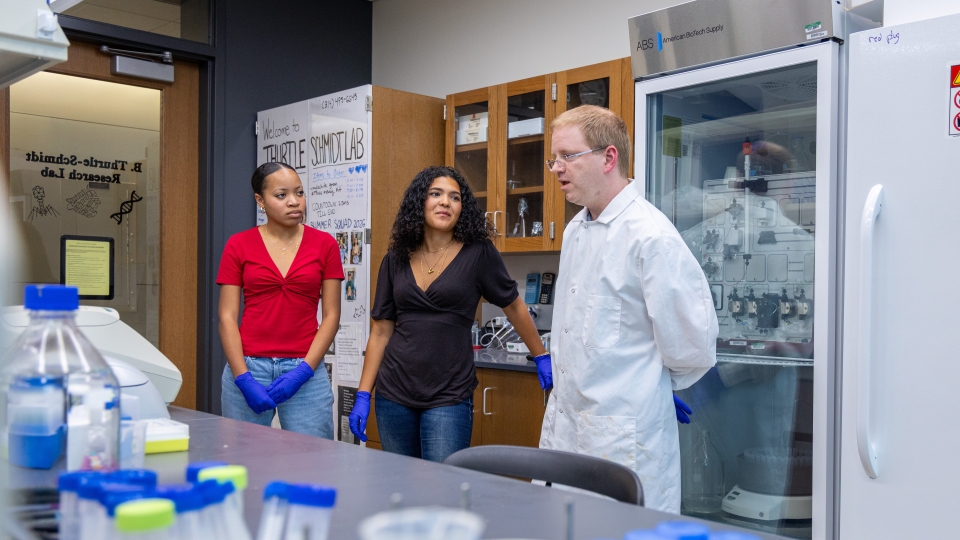
The seven students — they called themselves the “Summer Squad” — worked in Thurtle-Schmidt’s lab on the third floor of the E. Craig Wall Jr. Academic Center. They covered a whiteboard in the corner with photos of each student clutching a plush prairie dog. (The stuffed animals are gifts from the lab supply company for frequent customers, like Thurtle-Schmidt, and they have become the unofficial mascot of his lab.)
The students came for different reasons — a career they could already see, or a corner of biology they wanted to try out.
“There are a lot of implications down the road with this research,” said junior Sahaana Rajagopalan, who plans to attend medical school to become a physician.
“This therapy could be used to combat this never-ending arms race,” she said. “I'll be able to use this with my future profession.”
“I know that I want to study biology, but I've really been trying to explore what it is within biology, and the field of cell and molecular biology specifically, that I enjoy doing,” Kian Sarkar ’28 said. “This is more directly working with the kinds of things that are involved in the mechanisms of infection and pathogenesis.”


The students split into two teams, each taking one side of the same problem. One group asked what the bacteria's defense proteins actually do, purifying them and testing their activity in the lab. The other asked whether candidate genes actually provide defense for the bacteria against phages, switching them on in E. coli and turning a collection of viruses loose.
Rebecca Polgar is a junior biology major with a Hispanic Studies minor who spent her summer focused on the bacteria’s viral defenses. Polgar is studying in Panama this fall but, like most of her fellow researchers, she hopes to return to the lab in the spring.
“I work on a specific type of protein to mechanistically say, ‘Okay, this is how the protein is in charge of defending the bacteria against the phages,’” Polgar said. “The way it defends against phages in the cell is by cleaving or cutting the phage DNA. So how does the salt concentration of the solution the bacteria and phages are in affect how my protein cuts DNA?”
“When you're cooking in the kitchen and you’re like, ‘Wow, that meal was really good. What was the secret ingredient?’ It might be the cumin, or, it might be the salt,” Polgar said. “But, in the lab, just like any meal, it's the combination of ingredients and how they interact with each other.”
By August, Polgar and her colleagues had developed a few of the ingredients.
Valentina Cova ’28 produced one of the summer's most striking results: her research hints at how a cell senses an incoming virus and triggers a defensive reaction. Polgar and Rajagopalan came at the same pair of genes from opposite directions, biochemical and genetic, and their findings fit together. Reyna Mehta ’29 showed that a protein the lab had only studied genetically can cut DNA. Gabrielle Shelton ’28 confirmed that a poorly understood gene provides defense; Charlie Price ’29 confirmed that a new, previously uncharacterized gene did not defend against viruses. Sarkar built software to hunt phage genomes for proteins that disable those defenses.
Members of the Summer Squad will present their findings at the Summer Research Symposium at 7 p.m. on Tuesday, Sept. 15 in the Alvarez College Union.
The summer changed how the students see themselves.
“On the first day, I was scared to use the autoclave because it looked like this big machine. I was so overwhelmed,” Rajagopalan said. “But now I feel like all those things are second nature.”

Their technical skills have grown but they’ve also learned about the challenges of research.
“Things might not always work out and things take time,” Rajagopalan said. “I've run so many experiments, and I've had to repeat things and change things, and I think that, in general, the persistence I’ve learned will be super-important because medical school is a long road.”
They’ve also grown together: “I didn't know many of my fellow researchers coming into the lab,” Sarkar said. “But now I have made several great friends. You get to meet a lot of new people and gain valuable experience.”
“This summer was like diving into the deep end,” Polgar said. “I was wondering, ‘Do I like research? Is this what I want to do for the rest of my life?’ And it turns out that yes, it is. I've been falling in love with research, which is so cheesy, but it's true. Bryan has my dream job.”