Jessie Ball duPont Fund Grant Deepens College’s Work With Descendant Community and Catawba Nation
November 4, 2026
- Author
- Lisa Patterson
Join Us Nov. 6 for a Candlelight Vigil
The college will host a candlelight vigil at 5 p.m., Friday, Nov. 6, at the With These Hands: A Memorial to the Enslaved and Exploited site to commemorate the enslaved and exploited individuals who helped build Davidson and to read newly identified names. All are welcome.
Learn more about Davidson’s reconciliation and education work.
Davidson College has received a $175,000 grant from the Jessie Ball duPont Fund to strengthen its relationships with the descendants of people enslaved and exploited by the college and with the Catawba Nation, on whose ancestral homeland Davidson stands.
The two-year grant supports the next phase of Davidson’s reconciliation and education work. These efforts are rooted in the findings of the Commission on Race and Slavery, established in 2017 to investigate the college’s historical ties to slavery and participation in unjust practices during the Jim Crow era.
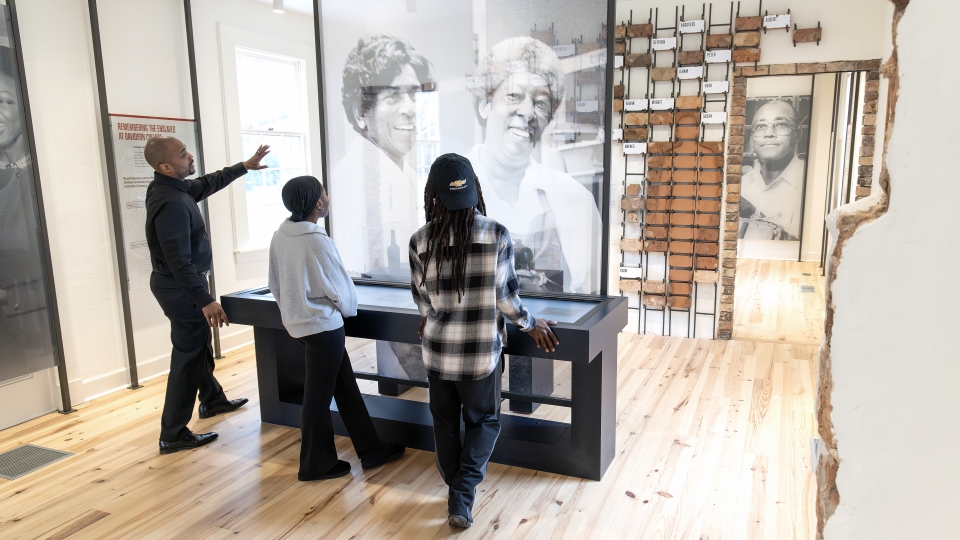
In August 2020, the commission released its final report. The college acknowledged and apologized for participating in and profiting from slavery, and for perpetuating Jim Crow policies that employed Black workers in service jobs while denying educational and professional opportunities to others. In October 2025, Davidson dedicated With These Hands: A Memorial to the Enslaved and Exploited, along with Oak Row, an original dormitory built of bricks made by enslaved people. Oak Row now serves as an exhibition and museum space.

With These Hands Dedication Ceremony

Oak Row Museum
To design the physical spaces and develop the narratives that serve to recognize and bring those previously excluded members of the community into the Davidson College story, students, professors and archivists poured over public records, letters, diaries, college ledgers and year books, visited cemeteries, and talked to families to learn more about the lives of the enslaved and exploited workers.
“Since the release of the final commission report, I and others have spent many hours scouring the archives to identify and recover the experiences of the people who were previously unrecognized for their contributions to the college,” said Hilary Green, James B. Duke Professor of Africana Studies. We are now able to develop brief biographical sketches on the over 500 individuals and expand institutional narratives on them.
While the research remains ongoing, the college has begun to build relationships with the families and descendants of those whose names were uncovered.

Now it’s important for us to build and strengthen those connections, and make a genuine effort to not only be in community with those individuals and their descendants, but also to include their legacy in telling the full story of the history of Davidson College.
Building Trust, Ongoing Commitment
The Davidson project focuses on fostering authentic human connection: establishing a structured partnership model through a descendant community council, institutionalizing collaborative programming, and creating shared research frameworks. By connecting our academic inquiry to communal repair, Poston said, the college seeks to position those most affected by institutional legacies as empowered partners who are actively engaged in Davidson’s future.
The grant centers on events and projects planned together with descendants and Catawba citizens, so that research priorities and changes to college policy, grounds and curriculum are shaped through shared decision-making.
With descendants, the college has formed a Descendant Community Council and committed to at least two gatherings each year: a commemorative event in the fall and a community celebration in the spring. Descendants gathered on campus in spring 2026 for a community picnic, the first of these events.

Unshadowed Land by Nicholas Galanin

Roo George-Warren of Catawba Nation
Davidson’s relationship with the Catawba Nation began in 2019 with Unshadowed Land, an art installation that explored the history of exploitation and erasure, and was formalized through a memorandum of agreement in 2023. The grant will grow the annual series of events co-organized with the Catawba Cultural Center, which includes workshops and lectures from Indigenous scholars, artists, and authors, as well as harvest meal celebrations with Indigenous chefs.
It also will advance the rematriation of kus, a Catawba corn variety lost for about a century due to land dispossession. After four years of growing kus on the Davidson College Farm and Catawba’s Black Snake Farm and replenishing the seed bank, Davidson and the Catawba Cultural Center will begin processing the corn into grits and meal for distribution to the Catawba community.
“Many of the founding families and donors of Davidson College participated in the dismantling of the Catawba homelands,” Susana Wadgymar, associate professor of biology, said. “It is important to us to recognize our shared history while also building a renewed, collaborative and reciprocally beneficial future. This grant enables us to celebrate and learn from Indigenous scholars and practitioners.”

Susana Wadgymar, Associate Professor of Biology

Rose Stremlau, Charles A. Dana Professor of History

Hilary Green, James B. Duke Professor of Africana Studies

Daniel Heath, Associate Chaplain and Director of Descendant Community Outreach
The grant also funds work to digitize the college’s research on slavery and land dispossession and to build a digital humanities tool for scholars and the public. Visitors to Oak Row will find new oral histories, biographies and an interactive touch-table where they can access stories of individuals connected to the college.
The project team includes Wadgymar; Green; Rose Stremlau, Charles A. Dana Professor of History; and the Rev. Daniel Heath, associate chaplain and director of descendant community outreach.
The grant will supplement, rather than replace, Davidson’s own support. The college continues to fund the majority of this work, which is a pillar of the strategic plan the Board of Trustees approved in 2024.
“Davidson is unique in our commitment,” Poston said. “The college demonstrates its ongoing commitment through the creation of a board committee that’s permanent, our creation of a museum in addition to the memorial site, and our pledge to continue the research at an institutional scale.”
About the Fund
The Jessie Ball duPont Fund is a private foundation that works to expand access to economic opportunity and create vibrant places for the people, organizations and communities that Jessie Ball duPont knew and loved. While with her philanthropy, the duPont Fund’s namesake Jessie Ball duPont sought to strengthen the institutions and places she knew and loved, the fund’s trustees and leadership team acknowledge and disavow her lifelong support of racial segregation. In current practice, the fund uses its grantmaking, investments, research and partnerships to build stronger communities where all voices are heard and valued.