Veteran, Gold Star Spouse, Scientist: Tracey Koehlmoos ’91 Turns Service Into Safer Medicine
November 10, 2026
- Author
- Mark Johnson
“Last Week Tonight” host John Oliver dispenses humor for more than laughs. He uses it to break down complex issues. He has, for example, scrutinized health insurance algorithms that deny claims and skewered FIFA for extracting billions from impoverished nations for the World Cup. A few weeks ago, he presented disturbing research on the safety and quality of generic drugs, which make up 90% of what’s in Americans’ pill bottles.
That’s when he quoted Tracey Koehlmoos’s work.
Oliver highlighted that, when the Pentagon tested the military’s most critical drugs, 15% of all they examined ranked as “red,” which signals major quality concerns. One-third of the samples showed up red when they looked at tacrolimus, a drug that suppresses the immune system for transplant patients so that the body doesn’t reject the new organ. When the military researchers tested fluoxetine, the generic version of Prozac, 71% registered as red.
Koehlmoos ’91 (pronounced KOHL-muss) never talked with John Oliver or his team. Her mission was aimed elsewhere. She heads the Center for Health Services Research at the Uniformed Services University, the federal government’s health science university. Since 2023, she has been the principal investigator on the Department of War’s two major studies on the safety of the pharmaceutical supply chain. The purpose is to ensure that the military, the people who maintain the nation’s security in war or other crises, have the medications they need to do their job.
And the public gains a huge benefit.
“Improving the safety of the supply chain for pharmaceuticals,” Koehlmoos said, “benefits everyone who gets a prescription filled.”
Her path to a position that delivers this kind of impact is a trail that traverses the globe, in and out of uniform, and filled with heartbreak and faith.


Camouflage on the Cross-Country Course
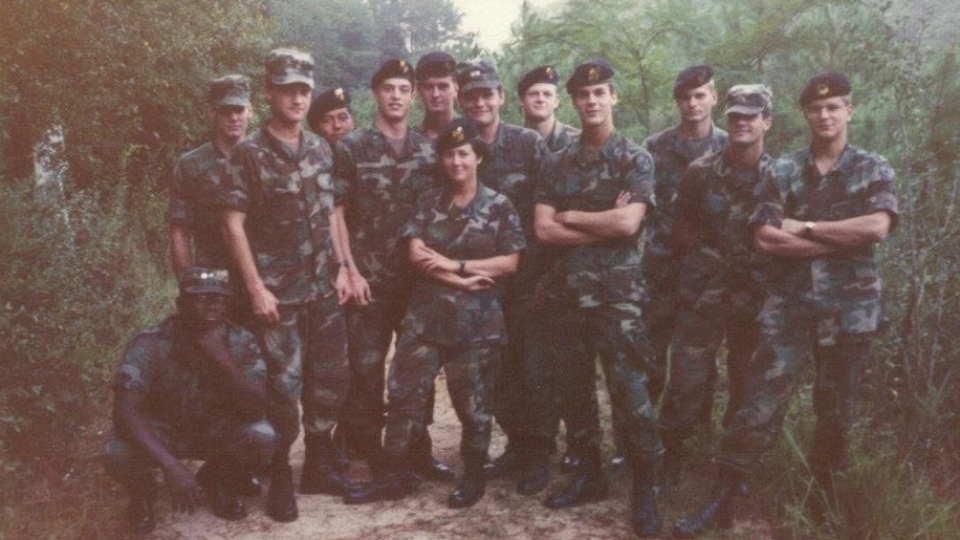
The dirt trail of Davidson College’s 5-kilometer cross country trail winds through a swath of woods behind the Baker Sports Complex replete with deer sightings and, a few years ago, even a small black bear. It’s a suburban oasis of thick trees and brush. Every so often in the late 1980s and early 1990s, Tracey Koehlmoos, then Tracey Perez, and a few other camo-clad ROTC cadets snuck around with harmless weapons to ambush other cadets in combat exercises.
Koehlmoos grew up in Montgomery Village, Maryland, outside Washington, D.C. A friend signed up for ROTC at Davidson, and it sounded idyllic, she said. The campus and surrounding town were less connected to Charlotte, then, giving her the small town feel and challenging academics that she sought. ROTC provided college money she needed.
She was the only woman among the cadets and, at 5-feet-1-inch tall, the smallest. It seemed she always had to make more of an effort, said Grier Martin ’91, classmate and fellow cadet who went on to serve in Afghanistan and as North Carolina’s secretary of military and veterans affairs.
“On the obstacle course, she had to reach a little higher,” Martin said. “That effort always stood out to me. Not just the effort, but the positive attitude. She taught me that just because you’re going through something unpleasant doesn’t mean you can’t smile through it. One of my first memories of her is crawling through the mud and her smiling at the rest of us.”
Koehlmoos is immersed in science and data now, but, at Davidson, she majored in English.
“It’s about learning critical appraisal, how to read, how to write,” Koehlmoos said. “If you are a scientist…a big part of my job is writing.”
She avoided biology and chemistry — “not my jam” — but calculus helped her get a doctoral degree years later.
On commencement weekend, she and the other graduating cadets were commissioned as second lieutenants. The Army dispatched Koehlmoos to an air defense artillery battery, one of the few types of combat units where women could serve at the time. She was a fire control officer and tactical director for a Patriot missile battery sent to Saudi Arabia toward the end of the first Gulf War.
She completed her four-year commitment at Ft. Bliss, in Texas, where then-fellow Lt. Scott Nestler said Koehlmoos figured out the role quicker than most.
“People who are very intelligent, smart, serious and focused tend not to be the most people-focused,” said Nestler, who now teaches at the University of Florida. But Koehlmoos could be empathetic and easily hang out with her fellow lieutenants. “She could balance things. That’s hard to do, especially in what was and, to some degree still is, a male dominated field.”
Koehlmoos met Randall “Moose” Koehlmoos during ROTC summer training at Ft Bragg, North Carolina. They married a year after graduation. In 1992, she followed him on his deployment to Germany and left the Army to begin life as a mom to three children. The family moved many times, including to Washington, D.C., Pakistan, Hawaii, Florida, and Nepal. She fell into volunteer work and, while in Florida, started on master’s and doctoral degrees at the University of South Florida’s College of Public Health. She finished while overseas and flew from Katmandu to Tampa to defend her dissertation.
Meaning and Honor
Koehlmoos was recruited back to work during a tennis court conversation in Bangladesh. The wife of the executive director of an international health research organization there interested her in helping research and guide health care systems in developing countries. Randall Koehlmoos completed a deployment to Afghanistan and the family was reunited with his new posting in Indonesia, as chief of the office of defense cooperation at the U.S. embassy in Jakarta. Their children were ages 11, 13 and 15.
Randall Koehlmoos was, then, a full colonel whose resume was packed with combat deployments and foreign affairs expertise. He had joined the Nebraska National Guard at age 16, ultimately earned a Bronze Star and other commendations, was fluent in four languages and authored published research in foreign relations. On Aug. 27, 2011, Col. Randall Koehlmoos became a proof point in his spouse’s research. A husband, father and soldier who survived combat deployments in Iraq and Afghanistan, he was killed in a traffic accident in Jakarta.

Rand Koehlmoos in Afghanistan
“My whole life was about making a nice home,” Tracey Koehlmoos said. “I was dedicated to supporting my husband and our family. Everything I believed was wrapped up in him and his career. I was heartbroken and completely lost. I didn’t know where we would live on the planet, no clue what sort of job I might get to support our family or what schools my children might go to. I had no plan and felt stuck on the bottom of the world with three boys, two dogs and a cat, and 19,000 pounds of furniture spread across three places on the planet.”
Koehlmoos and her family moved back to Washington at the end of the school year, and she began job hunting. A friend forwarded a job posting for special assistant and community health liaison for the Commandant of the Marine Corps, noting: “Wouldn’t this be fun.” The role was advising on health systems policy, and the rivalry between branches of the armed forces posed no impediment.
“I’m bilingual,” said Perez. “I speak Army and Marine.”
She ended up touring all of the military medical facilities in Afghanistan. Multiple times she found herself offering the same recommendation: more health systems research. That’s a central element of what she now is doing at the Uniformed Services University, where she directs the doctoral programs in public health in addition to leading the Center for Health Services Research. And it seems to be her jam.
“It’s people and ideas and data,” Koehlmoos said. “My research regularly informs decision making. I’m so grateful to do work that has meaning and honors my husband’s service.”
Her assessments of Ukraine’s health and trauma systems since the Russian invasion have informed efforts to redesign battlefield medicine in the U.S. military and for NATO allies as they prepare for large scale combat operations.
Koehlmoos’s Davidson experience threads through her life and career.
“I always come back to the Honor Code, best exemplified by self-scheduled exams,” she said, emphasizing the accountability and reliability required of a scientist and a military officer. “A transparency to every task in our lives and to expect that of the men and women around us.”
Her ROTC class gathers at reunions and when they can, such as the Army Ten-Miler run in Washington or at the Pentagon, where they honor classmate Major David Taylor ’91, killed in 2006 in Baghdad.
She can add shaping health policy and systems around the world to her long list of descriptors: veteran, Gold Star Spouse, scientist and mom, with two West Point graduates among her three children.
“I have walked in faith and things have fallen in place,” Koehlmoos said. “I truly believe the Lord has lit the path before me one step at a time. I certainly have had skill and drive to work hard when provided opportunities to serve our Great Nation and our community, for which I am overwhelmingly grateful.”