To Ban or Not to Ban: Honor Councils Grapple With Academic Integrity in the Age of AI
November 9, 2026
- Author
- Emily Drew ’04
Two students are assigned a take-home test. AI use is banned.
Student 1 follows the ban and earns a B.
Student 2 cheats by using AI and earns an A.
Who does the ban protect?
At the 3rd Annual Convening of Honor Councils this weekend at Davidson College, internationally renowned academic-integrity expert Tricia Bertram Gallant argued neither student is protected — nor is the professor and institution.
“Society is not saying you must ban AI,” said Bertram Gallant, director of the Academic Integrity Office & Triton Testing Center at the University of California, San Diego. “What it’s saying is, ‘Hey, you should teach your students about AI, you should teach them how to use it in their discipline, and we want people who are honorable.’”
It’s a tall order, but she argued that honor councils are uniquely positioned to guide new approaches to AI and academic integrity in classrooms.
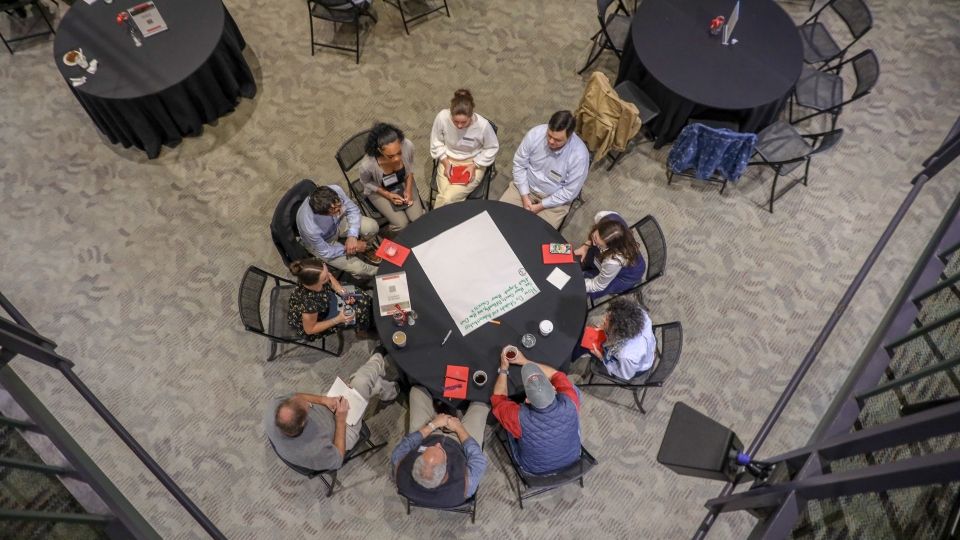
Thirty-nine students and 26 faculty, staff and other guests from 14 schools grappled with these issues at this year’s honor council convening, made possible by a grant from Wake Forest University’s Educating Character Initiative, and hosted by the Neely and Jack Purcell Program on Ethics, Honor, and Leadership, one of five program areas of the D.G. and Harriet Wall Martin Institute for Public Good.
Hugh Lee ’89 — Boone Family Director of the Purcell Program — coordinated the convening, which also included a talk by P. Anand Rao, founding director of the Center for AI and the Liberal Arts at the University of Mary Washington.
“Understanding how best to cultivate student learning and development in a world infused with AI is a central challenge of this moment,” Lee said. “Honor councils want to protect those who work hard in the community, but they’re also trying to create a community that is engaged in values — and then to ask what happens when our culture of honor is transferred out into the world.”
The convening brings together student leaders, faculty and staff from leading liberal arts institutions to learn and think about character and honor on campus, and wrestle with AI, ethical issues, and campus cultures.
Participants were invited to share AI-related experiences and build a community of shared practice across campuses, what President Doug Hicks ’90 called, “One of the most powerful things about our national convenings.”
He asked guests to consider: “How do we think about what leads people to act with integrity, or the opposite: to break those standards? And what can we do as a community to signal and frame and shape habits?”
Bertram Gallant suggested some possibilities in her keynote address.
“In the age of AI,” she said, “the Honor Council should clarify, respond, and teach.”
Depending on the school, this could involve:
- clarifying with faculty and students how AI policies can be better defined on syllabi;
- responding to honor code violations in ways that build ethical skills instead of simply punishing;
- and teaching the basics of responsible use of AI.
Bertram Gallant said Honor Councils could focus on building skills of ethical decision-making by challenging students to identify their own justifications for cheating, and teaching students how to speak up to professors about unrealistic rules on AI use.
One specific policy she discussed was the provocative “Banning the Ban” of AI on assignments when students are unobserved. AI bans on proctored testing would still be allowed, but not on unproctored work and take-home assignments, in which some students might use AI despite a ban, and others might feel more pressure to cheat or feel that cheating students had an unfair advantage.
“There’s just no point in banning something that you can’t follow through on,” she said. “We also don’t want to have a performance paradox where students think they actually can do something they can’t do — an illusion of competence.”

While honor councils might need to adjust their procedures or find new ways to communicate expectations among students and faculty in the AI age, students at the convening felt their core mission was still intact.
“Our goal isn’t to punish anybody,” said Vice Chair of Davidson’s Honor Council, Charlotte Frampton ’27. “It's to help them as people, and to help them create community at Davidson. Our goal is to create a community between faculty and students that involves trust.”

The Bryn Mawr delegation from L-R: Julia Kotes ’27; Dani Crowl, Director of Student Integrity and Community Standards; Audrey Hollenbeck, Bryn Mawr ’28

Claudia Ribeiro and Isis Williams, representing Rhodes College, with Charlotte Frampton '27 of Davidson College

The Sewanee delegation from L-R: Gabriel Fernandes '29, Vivian Boyd '28, Winnie Alfrod '29
Audrey Hollenbeck, Bryn Mawr ’28 agreed.
“I think the core of honor is trusting your community and being authentic and transparent,” she said, “and I think ultimately, AI can coexist with it.”