At Memorial’s First Anniversary, 51 More Names Are Spoken Aloud
November 9, 2026
- Author
- Jay Pfeifer
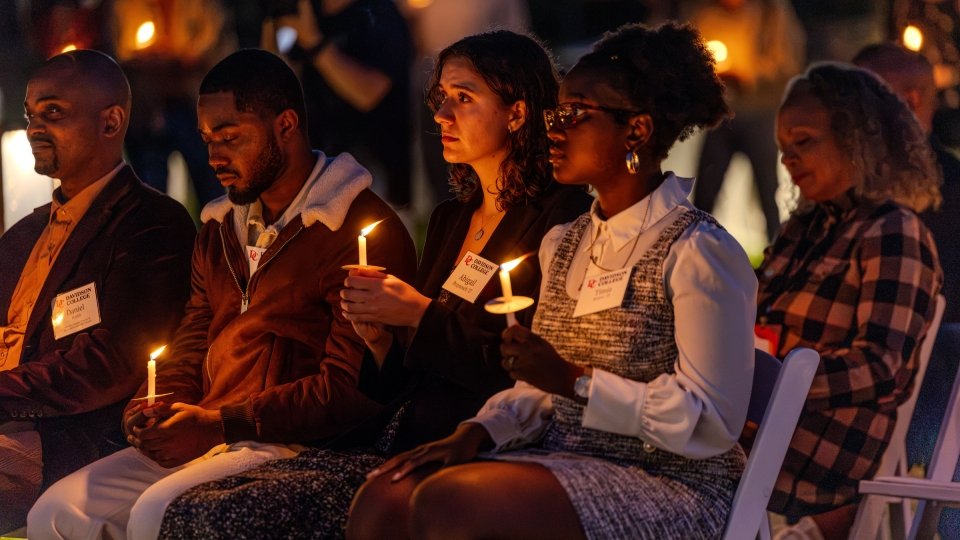
One year after the Davidson community dedicated With These Hands: A Memorial to the Enslaved and Exploited, a crowd gathered for a candlelight vigil to observe the anniversary and mark the expansion of the college’s history.
As the sky turned purple and candlelight glinted off the sculpture’s bronze hands, three students read 51 names, drawn from the 187 that Hilary Green, James B. Duke Professor of Africana Studies, and her students have uncovered over the past year. All 51 were people who contributed to the college during the enslavement and Jim Crow eras. Green and her students continue to sift through the college archives, reading old letters, books and ledgers.

The vigil marked more than the events of 12 months ago; it showed that the work that began in 2017, with the creation of the Commission on Race and Slavery, continues.
President Doug Hicks ’90 said that a year ago, the college wondered what the memorial would mean for “building relationships and for doing the ongoing work of reconciliation.”


Instead of being just “an aesthetic or an artistic project that looked backwards,” he said, the memorial “has been like a light that has spread into relationship building, into historical work, into further research.”
Nearby, Oak Row has become a hub of research and reconnection, welcoming thousands of visitors since it opened in October 2025.

“Every name we recover represents more than an entry in a historical record. Every name represents a person. Every name represents a life,” said the Rev. Daniel Heath, an associate chaplain who recently became director of community descendant outreach and leads the newly created Descendant Community Council.
Sophomore Timia Bruton read 11 of the names. She has been eager to get involved at Oak Row since, as a first-year student, she participated in an immersive restorative justice training in Louisiana. With classmates, she visited Angola Prison and the Whitney Plantation, which centers its history on the experience of enslaved people.
“That experience made me interested in the way that Davidson is acknowledging its history,” she said, “acknowledging its past and honoring the people who were enslaved on this campus.”
Before the reading began, Heath asked the crowd to hold their candles as an act of remembrance:
“For the names we know, we give thanks. For the names we have yet to discover, we remain committed. For the lives represented by them all, we let our light shine.”