Humane Instincts Across the Lines: Luka Chikhladze ’27 Launches Youth Dialogue for Peace in Georgia
November 20, 2026
- Author
- Caroline Roy ’20
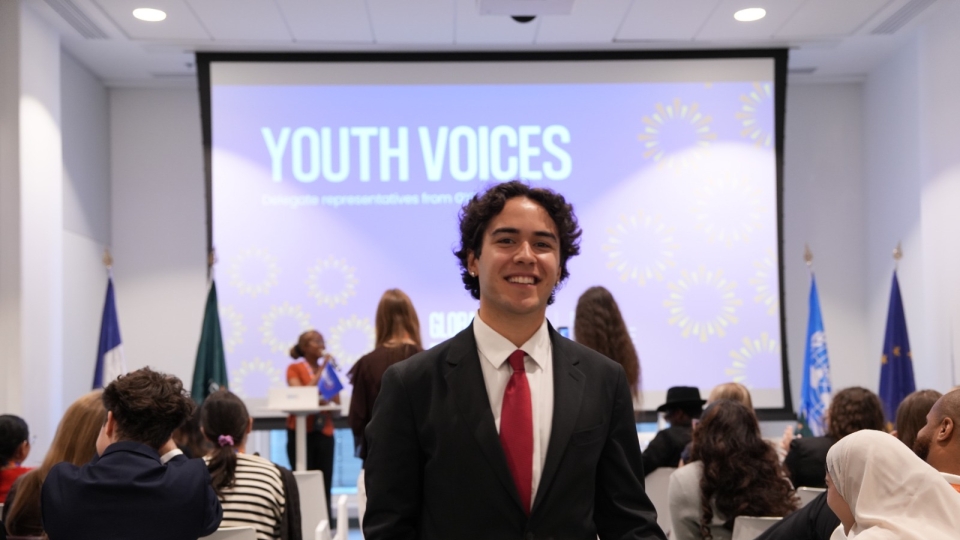
Growing up in Tbilisi, in the Republic of Georgia, in the wake of the 2008 Russo-Georgian War, Luka Chikhladze ’27 spent his youth, like many others from the region, witnessing the lasting effects of war.
In 2019, 14-year-old Chikhladze attended a youth dialogue hosted by Georgian Peace Educator Bella Kopaliani. For the first time, he spoke face to face with youth on the other side of the conflict. Their conversations about politics, war and memory changed the trajectory of his life.
“Political tension, conflict and isolation keep Georgians estranged from ethnic minority groups in Abkhazia and South Ossetia,” he said. “But when young people come together across dividing lines, we can see past those barriers and imagine a shared future.”

Chikladze and Bella Kopaliani
This summer, with support from the Kathryn W. Davis Projects for Peace Grant, Chikhladze returned to his home city of Tbilisi to host his own three-day peace-building initiative, Across the Lines, hoping to inspire a new group of students to imagine a more connected and humane future.
For Chikhladze, the project was a culmination of his research, peace-building efforts and the rippling effects of war on his own life. When he was just three years old, his father was killed while working as a civilian journalist in the conflict zone.
“This project brought me back to a reality that shaped my childhood,” he said. “Our entire generation has grown up amid restricted movement, political isolation, and very limited opportunities to know one another personally. We created 30 points of human connection across that reality.”
Thirty university-aged participants came together in Tbilisi at the end of August to participate in conflict resolution training, hold facilitated dialogues and design collaborative projects they could implement at home.
To help guide the program, Chikhladze partnered with Grigol Robakidze University in Tbilisi. He reconnected with Kopaliani, who served as lead expert, along with three Ph.D.-level facilitators.
Students came from different ethnic groups, occupied regions and displaced populations. What followed was a humane dialogue between young adults, each with a deeply personal connection to an inherited and ongoing conflict.
Informal Ambassador
A Charles A. Dana and Shelby Davis Scholar, Chikhladze attended high school at United World Colleges (UWC) in Dilijan, Armenia. He found Davidson through other UWC students and alums and was immediately drawn to the college’s strong academic community, commitment to civic engagement and opportunities for international learning.
His Davidson experience is a unique one, defined as much by time abroad as in on-campus classrooms. He’s spent two semesters studying political science in France and Argentina, a summer in Tokyo through the Davidson in East Asia Grant, another summer at a think tank in Senegal and, this past winter break, in an immersive Arabic language program in Jordan.
This fall, he’s studying in Rome.
I’ve been fortunate to explore the liberal arts both on campus and abroad. Davidson has given me opportunities to learn in ways I never imagined. I’m grateful for those experiences and hope to encourage other students to explore what’s available to them.
Chikhladze considers himself an informal ambassador for Davidson wherever he goes. After spending much of his time studying and working abroad, he’s looking forward to spending a final semester on campus in the spring. He plans to continue his work with the William F. and Betty G. Mulliss Center for Civic Engagement at the D.G. and Harriet Wall Martin Institute for Public Good and the Dean Rusk Global Corps, where he engages students and raises awareness on international issues.
After graduating, he plans to pursue a career in diplomacy and continue working on conflict resolution across the globe.
He hopes Across the Lines will be the beginning of a much larger story for the students involved. Over the course of three days, he watched participants let down their guards, connect more informally and get excited about working together in the future.
On the final day, the group took a tour of the city of Tbilisi. The students ate meals together, took pictures, laughed and exchanged phone numbers.
“After days of discussion, it was rewarding to see that level of connection,” he said. “As members of Gen Z, we are all more similar than we are different.”