My Davidson | A Student Blog From Döner to Drama: My Spring Break Trip to Berlin
April 6, 2026
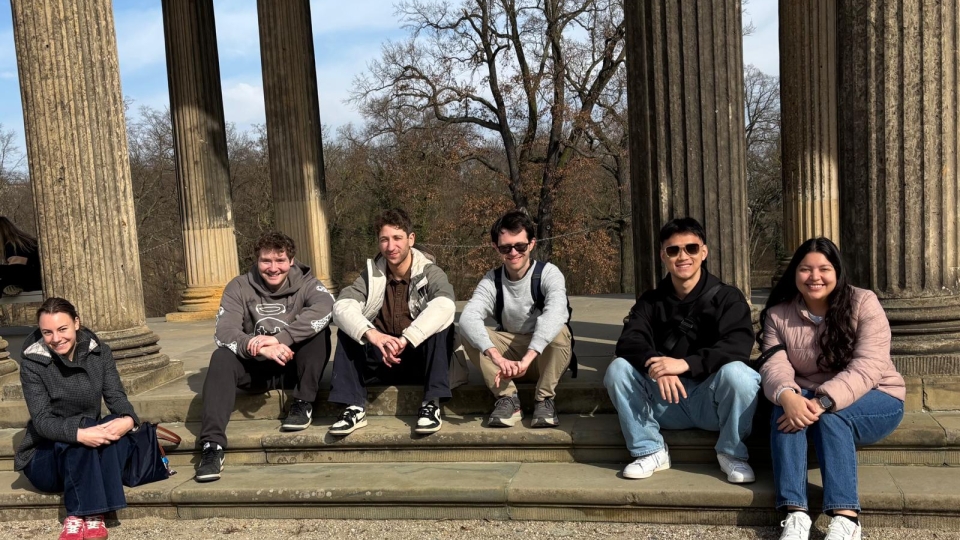
We toured Sanssouci Palace in Potsdam and learned about the history and architectural design of this former royal residence. Pictured L-R is Mary Molloy Blackstock, Trai Holland, Irakli Begiashvili, Blaise DeLeon, Ian Lin and me (Rosa Ramirez).
During spring break 2026, six Davidson College students from the German Studies Department traveled to Berlin with Maggie McCarthy, professor of German Studies and Humanities, for a week of independent research connected to our senior projects.
About the Author
Rosa Ramirez ’26 (she/her) is a German Studies and Political Science double major from Houston, Texas.
Outside of the classroom, she is involved with Catholic Campus Ministry, QuestBridge Scholars Network, Turner Eating House and Davidson’s Student Initiative for Academic Diversity (SIAD).
“I chose Davidson for its small community and the opportunity to interact closely with my professors.”
After months of reading, writing and discussing our topics on campus, this trip offered a chance to step into the physical spaces behind our research and experience German language and culture beyond the classroom.
Our days were quickly filled with activity. We attended plays and readings, explored museums and palaces, wandered through local markets and bookstores, and participated in a walking tour that traced the presence of Walter Benjamin. One evening, we watched a silent film accompanied by a live orchestra. Between events, we shared countless memorable meals and conversations, gradually becoming more comfortable navigating the city.

Mary Molloy Blackstock, Trai Holland, Irakli Begiashvili, Blaise DeLeon, Ian Lin and Rosa Ramirez at the Sanssouci Palace in Potsdam.

We attended a silent film accompanied by a live orchestra at the Zwölf-Apostel-Kirchengemeinde, and saw a play at the Theater am Schiffbauerdamm.

Among the many experiences that will stay with me were visits to both the former East and West Berlin zoos. Moving between the two spaces made the city’s past visible in a new way. What I had previously understood as historical division became something I could observe in the design, organization and popularity of the institutions themselves. Seeing these differences in person made the legacy of the Berlin Wall tangible in ways that reading alone cannot capture.


The Tierpark Berlin, opened in 1955, was established as East Berlin’s counterpart to the Berlin Zoological Garden (opened in 1844).
For my own research, exploring the Pankow neighborhood was especially meaningful. Since the novel Das Narrenschiff, which my thesis analyzes, is set in Berlin, walking through the area felt strangely familiar. I began to recognize street names and landmarks I had encountered countless times on the page, and the setting of the novel started to feel less abstract and more like a lived environment. Standing in those spaces helped me better understand the social world that shapes the narrative and allowed me to approach my thesis from a new perspective.

The Pankow neighborhood was once home to many East German government officials (including the characters Das Narrenschiff).

Seeing the original artwork that later became the cover of Das Narrenschiff was a highlight of the trip.

We explored bookstores across Berlin, discovering everything from a massive chain retailer to a small local shop tucked beneath a train station.

We celebrated Blaise’s birthday together at a local schnitzel restaurant!
Throughout the week, I was reminded that language learning and cultural understanding are inseparable. Navigating Berlin in German by ordering food or discussing politics made the language feel more immediate and practical. At the same time, encountering the city’s history in museums, architecture and graffiti deepened my understanding of the historical context behind my research.

My research took me to the DDR Museum depot, where I viewed their collection of more than 100 motorbikes.

We tried out a pub that had an innovative and confusing menu system.

We enjoyed döner while sitting on street barriers in a pedestrian zone.
The trip transformed my research from something confined to books and notes into an experience connected to real places and communities. I’m grateful for the departmental funding and for Prof. McCarthy’s careful planning that made this trip possible.