Davidson College Gathers 24 Colleges and Universities to Launch National Deliberative Citizenship Network
August 24, 2026
- Author
- Jay Pfeifer

Professors from two dozen higher education institutions gathered at Davidson College last week to help their home campuses do something that’s become less common across the country: talk about topics that usually end conversations.
They belonged to the first cohort of the Deliberative Citizenship Network, a new national initiative led by Davidson and funded by a $4 million grant from the U.S. Department of Education. The network will operate out of Davidson’s D.G. and Harriet Wall Martin Institute for Public Good. Over the next four years, the DCN will expand to as many as 100 colleges and universities working to strengthen civil discourse, civic learning and democratic engagement on their campuses.


The group spanned the nation and higher education, from major research universities, such as the University of Pittsburgh and the University of Arkansas, to historically Black Delaware State University and Maryland’s Carroll Community College. Small liberal arts colleges, such as Washington and Lee, are working alongside large private universities, such as Tufts and DePaul.
Their classrooms differ in size and student profile but present the same challenge: helping college students learn to engage with one another in an era of polarization and fragmentation.
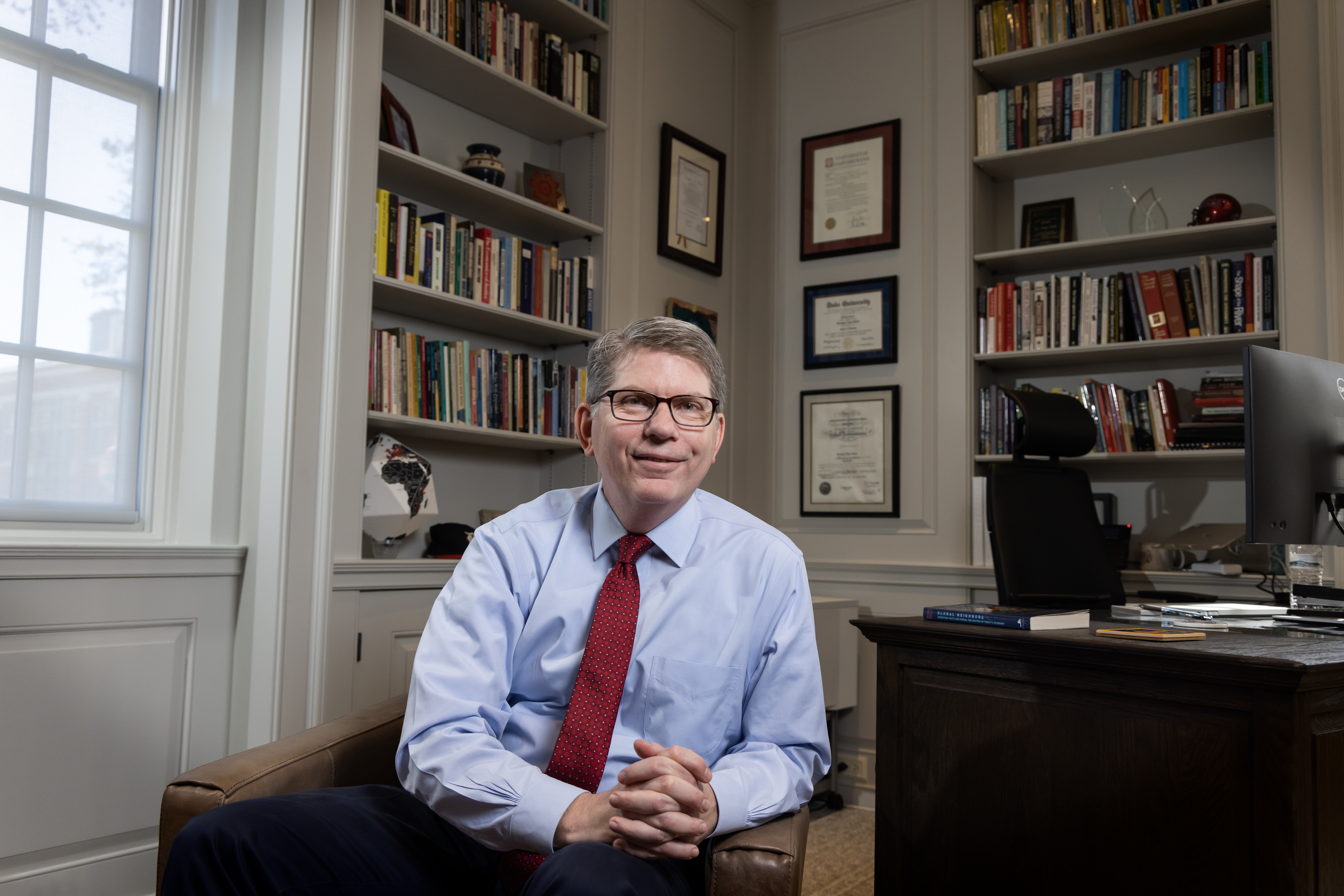
“In a society of people of many backgrounds and beliefs, it seems far easier to reinforce divisions instead of building areas of shared agreement,” Davidson President Doug Hicks ’90 said in his opening remarks. “The Deliberative Citizenship Network is bringing faculty members and colleges and universities together to help students develop capacities to contribute to the public good.”
Graham Bullock organized and facilitated the two-day deliberative pedagogy workshop with support from several new grant-funded staff members. Bullock is a political science professor and founding director of the Deliberative Citizenship Initiative (DCI), on which the national network is based. Bullock has led the DCI at Davidson over the past six years and wrote the application that secured the federal grant for the network.
The sessions at Davidson aimed to help professors integrate deliberation into their courses so students can verbally and productively wrestle with challenging material and contentious topics. Deliberative teaching methods help students deepen their understanding of course topics by listening curiously, speaking candidly, weighing competing arguments and evidence, and reasoning through difficult questions with others.

Early on the first day, Bullock split the faculty into small groups, each assigned to adopt and defend a different model of deliberation — deliberation as philosophical argument, participatory decision-making, psychological process or pedagogical approach — before reorganizing into mixed groups for rapid-fire rounds of disagreement. The exercise was designed to help faculty both examine the different models and learn how to design a real exchange of ideas in the few minutes that even a packed syllabus can include.
“Building courses around meaningful disagreement can enliven learning and allow faculty to pull public issues into the classroom,” Bullock told the attendees. “It also encourages students to use these skills in their lives — modeling the listening, the ethical arguments and reasoning that empowers them to be engaged citizens after they graduate.”
Those skills are exactly what drew Sarah Star, a philosophy and humanities professor at Carroll Community College, to the DCN.
“My students are anxious. They’re hesitant to embrace their roles in society,” she said. “My main goal is to prepare them to be citizens. I want to help them think about who they are, what they value and where they can contribute to leaving the world a better place than they found it.
“I’m hopeful the DCN framework will help them better understand the systems of citizenship and learn how to more effectively communicate with one another.”


These conversations aren't confined to classes that touch on the obviously political. Some of the hardest ones show up in fields so technical that most people can't even follow the disagreement, let alone take a side.
“There’s still a lot we don’t understand about quantum mechanics,” said Heidi Hendrickson, a chemistry professor at Pennsylvania’s Lafayette College. “And it turns out many physicists disagree about how we describe the quantum world at a philosophical level.”
She plans to incorporate deliberation into her first-year seminar: “Quantum Revolutions, Past and Present.”
“Students can come in with the notion that scientific theories are more like doctrines,” she said. “But we are still figuring out the science. We are on the cusp of a scientific revolution, and I want students to realize they have the capability to make the next big discovery.”
The workshop was just the beginning. The faculty in the room will continue learning together through the year ahead, meeting virtually and sharing lessons learned as they take the new techniques home. As the DCN grows toward its goal of 100 campuses, this first cohort will adapt the model that Bullock and the DCI have pioneered to their own campuses, helping extend civil discourse at colleges across the country.