Prof. Ann Fox on Judy Heumann, the 504 sit-in and the new Apple film
November 4, 2026
- Author
- Jay Pfeifer
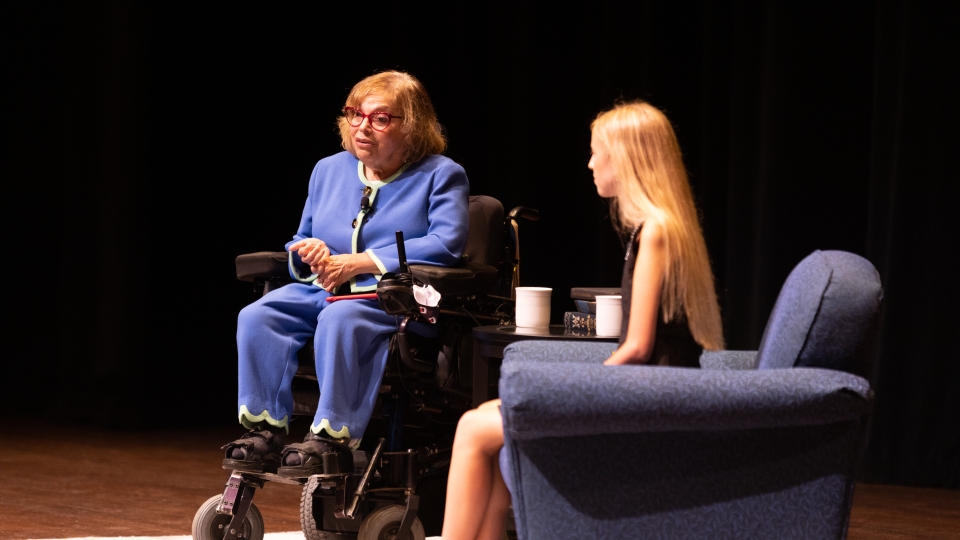
Judy Heumman delivered Davidson College's Reynolds Lecture in September 2022.
Ann Fox, professor of English and a disability studies scholar who teaches Judy Heumann’s memoir, is eagerly awaiting Being Heumann, the Apple Studios film based on the disability rights pioneer’s memoir, Being Heumann: An Unrepentant Memoir of a Disability Rights Activist. Directed by Siân Heder (CODA) and starring Ruth Madeley as Heumann, it opens in select theaters Nov. 6 and arrives on Apple TV Nov. 13.
Heumann is often called the mother of the disability rights movement. She contracted polio as a toddler, was barred from school as a child and later sued after being denied a New York teaching license because of her wheelchair, becoming the city’s first wheelchair-using teacher. She led the 1977 Section 504 sit-in, a 28-day occupation of a federal building in San Francisco, and helped shape landmark laws including the Individuals with Disabilities Education Act and the Americans with Disabilities Act. Heumann, who died in 2023, delivered Davidson’s Reynolds Lecture on Sept. 7, 2022. Read her Q&A from ahead of that visit.
For Fox, the case for knowing her is simple: “If you want to know civil rights history, you have to know about Judy Heumann.” Here, Fox shares context on the film and Heumann’s legacy.
For someone who doesn’t know anything about her, why is Judy Heumann so important?
She’s often described as the mother of the disability rights movement. She literally helped transform the landscape for disabled people in ways that I think maybe we take for granted today. We take for granted that people don’t automatically get institutionalized if they have a disability.
She’s best known for leading the 504 sit-ins in 1977, when protesters occupied the San Francisco offices of the Department of Health, Education and Welfare (HEW) for nearly four weeks to demand the immediate signing and enforcement of Section 504 of the Rehabilitation Act of 1973. Section 504 prohibited discrimination against people with disabilities in any federally funded program — and only needed to be signed by Secretary of Health, Education and Welfare Joseph Califano to become law.
The sit-in Heumann led eventually forced Califano to sign, and that really set the stage for things like the 1990 Americans with Disabilities Act.
Heumann emphasized allyship. Part of the reason the 504 sit-in was so successful is because she and her fellow activists had shown up for other communities, like the Black community. The Black Panthers became a huge ally during those sit-ins and brought food every day.
It’s also important to note that her work is particularly relevant today because disability rights are in danger. In September, after a joint motion from the Department of Health and Human Services and five states, a federal judge removed regulations from Section 504 that explicitly required federally funded programs to provide services to people with disabilities in the “most integrated setting.” This decision threatens to send disabled people back to the age of institutionalization.
The 504 sit-in seems to be the spine of the movie. Can you place that moment in context?
The sit-in is important on its own because you have a community of people who have been defined as sick, unable. Just as Rosa Parks taking her seat was about claiming dignity and humanity, the activists of 504 refusing to be ignored is a moment where they say, “We demand access and accommodation, not as charity, but as our right.”
A number of occupations happened across the country, but pretty much all of them folded in short order except for San Francisco. That sit-in became the embodiment of a flourishing of disability culture and community.
It also showed disability creativity. They rigged refrigerators for people’s medicine by enclosing air-conditioning units. When phone lines were cut and activists had no way to telephone the outside world, Deaf people in the occupation signed to interpreters outside, and that’s how they were able to communicate. There was always a workaround and always a way to figure things out.
Did the sit-in elevate Heumann to a figure of national stature?
Yes. She was covered in the national news, and it continued to lead to more activist work on her part, which then continued to raise her profile. But I think the great thing about Judy is she wanted to use her voice also to promote other disabled people. She acknowledges in her memoir it doesn’t just take one person, it takes a lot of people.
How significant is it that the film cast Ruth Madeley, who is disabled and uses a wheelchair, to portray Heumann?
It is a big deal. For many years it has been one of the battles within disability activism to get more disabled actors cast in disabled roles. I think members of the community deserve to play Heumann and honor her legacy through that. It pushes back against old ways of casting, old ways of telling stories about disability in movies. Nondisabled people do not know the disability experience better than disabled people.
What will you be looking for when you watch the film? What are you hoping for?
I’m hoping that some of the things that Judy would have wanted us to know get communicated. Yes, it’s about her story, but her story is a means to make us understand the importance of community for disabled people, of access, of allyship and the importance of disabled joy.
I hope people who watch it come away feeling fired up. One of the really cool things about teaching disability studies is we all have somebody who’s disabled in our lives, and we all could become disabled at any moment. If we live long enough, we’re going to age into disability. So I hope they see a fellow traveler and a kindred spirit in Judy because we all live in contingent bodies.