Why are French Students in the Streets? A Q&A with Professor Ninon Vessier
October 27, 2026
- Author
- Jay Pfeifer
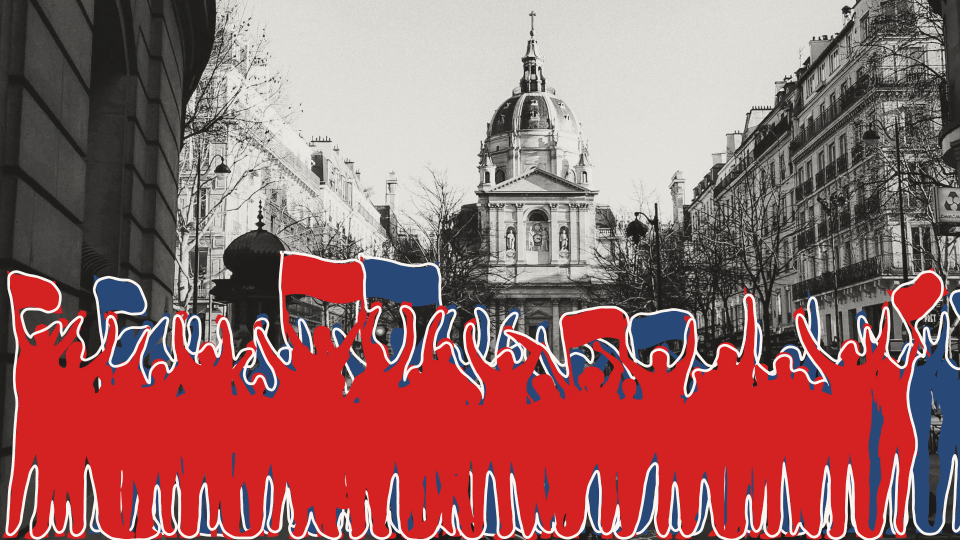
Since mid-September, a protest that began at one high school in a Paris suburb has grown into a nationwide movement, closing schools, drawing in unions and putting pressure on French President Emmanuel Macron’s government as the 2027 presidential election approaches.
To help make sense of it, we turned to Professor Ninon Vessier, who will teach FRE 230: “France in the Headlines” this spring.
The course traces the major social protests in France from 1945 to the present, using literature, film, music and the press. It follows current debates in France as they unfold, including the May 2027 presidential election. Vessier says the students’ protests will have a place on the syllabus. “It is the kind of course with a fluid syllabus designed to adapt in real time to current events,” she said.
Below, Vessier discusses the roots of the unrest, how it echoes earlier movements, and what it might bring in 2027.
Students have mobilized before, in 1990, 2005 and 2018, and each time the government eventually backed down. Is this wave following that pattern, or does it feel different?
There is definitely a genealogy of these protests because the youth have often been the starting point of protests. I would even add the May 1968 revolution to this list, because students at Nanterre started the movement before it spread to the whole country. In 1990, high schoolers protested against deteriorating conditions in public secondary schools. The uprising in the banlieues (low-income, high-density suburbs with public housing) started in fall 2005 after two teenagers were electrocuted when they hid in a power substation while fleeing a police check. That set off three weeks of urban unrest rooted in deep-seated anger over police brutality and systemic racism in the banlieues. There is definitely a pattern, and resentment and frustration are building.
Have these protests actually resulted in change?
The current revolts are part of a wider discontent toward the French educational system that stems from the 2018 protests, which targeted education reforms that introduced, among other things, “Parcoursup.” Parcoursup was a radical shift in higher education: For the first time, public universities were granted the power to review, rank, and select high school applicants based on grades and attendance. Many people saw in Parcoursup a mechanism that created anxiety, a lack of transparency because of the algorithm's complexity, and institutional bias against students from working-class suburban high schools—particularly from the banlieues. The 2018 riots culminated when police forced 151 high school students to kneel on the ground in rows, hands behind their heads or tied, facing a wall for hours.
This time, however, the context is different. France’s economy is saddled by debt, the National Assembly is fragmented and the administration of President Emmanuel Macron faces a decade of accumulated political fatigue. The violence of the police response is also unprecedented. So far, 215 students and teenagers have been injured. Young people suffered severe injuries from explosive weapons during clashes with riot police, including a notable incident where a 15-year-old boy in Lens lost his hand. In Saint-Étienne, a 17-year-old lost a hand to a grenade, while another teen in Mulhouse lost an eye . Afterward, the government suspended the police use of stun grenades during high school and student protests.
It’s important to note that the massive Oct.17 unrest came 65 years to the day after the “Paris Massacre” of Oct. 17, 1961, when thousands of Algerians marched peacefully through Paris to protest a discriminatory night-time curfew imposed exclusively on “French Muslims from Algeria.” Between 100 and 400 Algerians were killed, and thousands were arrested. Some protest placards have referenced this date, showing how today’s young people place their grievances within a lineage of institutional neglect, police violence and tension with the state.
France has a long tradition of rebellion, and protest often pays off. Why do protests carry so much political weight there, and what does it say about trust in institutions?
In French culture, direct action is seen as a fundamental civic right and a legitimate expression of popular sovereignty.
It is hard not to hear echoes of the 1789 French Revolution and its founding myth of popular sovereignty. The revolutions of 1830 and 1848 and the Paris Commune of 1871 also cast long shadows. More recently, we saw the effects of taking to the streets (or the roads, in that case) with the yellow vest (gilets jaunes) movement, which began in rural areas in 2018.
Macron’s presidency has endured the most social unrest in the Fifth Republic, with the gilets jaunes, the 2023 pension demonstrations and the current high school students’ protests. This highlights a growing distrust of his administration, in particular among young people who feel increasingly unheard and abandoned.
How might this unrest, along with fatigue after a decade of Macron, shape the 2027 presidential race? Who stands to benefit?
We can already see how far-right candidate Marine Le Pen, leader of the National Rally (Le Rassemblement National or RN), might gain significant momentum from the unrest. In the media, Le Pen directly targets Macron’s handling of the crisis, and every incident of property damage or clash with police allows her to associate the broader left with the riots. Meanwhile, the government and some parties like the Rassemblement National have accused the left-wing La France Insoumise of encouraging the revolts. In fact, the President of the Sénat has said that the question of banning La France Insoumise can be raised. It will be interesting to see how other left-wing parties (Le Parti Socialiste, Les Ecologistes, etc) will respond to the unrest. The disagreements between left parties allow far-right parties to win elections, as seen in the 2024 European Parliament election in France, when the RN secured 31% of the vote.