A Loving Death: Aditi Sethi '02 Founded a Sanctuary Where Those Who Are Dying Find Peace, Comfort and Community
January 15, 2026
- Author
- Mary Elizabeth DeAngelis
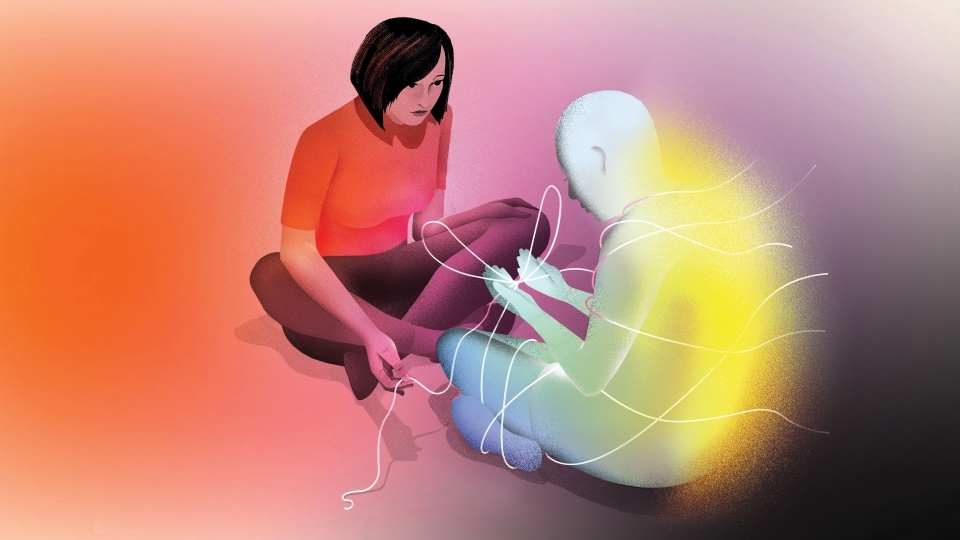
A frail young man lying in bed opens his eyes as Aditi Sethi gently puts balm on his lips. She checks his hands and feet, and caresses his forehead.
A malignant brain tumor brought him to this, his death bed. The setting is not a hospital, but the living room at a home overlooking North Carolina’s Blue Ridge mountains. Candles cast a soft glow and music plays in the background.
Sethi leans an ear close to his face to hear his raspy whisper.
“I want to go with the flow of the body,” he tells her, “in the most loving way possible.”
Sethi’s tearful voice falters as she reassures him: “You are, Ethan, you are doing just that.”
Ethan Sisser died a few days later.

Serving as a death doula to Ethan Sisser inspired Aditi Sethi to create the Center for Conscious Living and Dying (CCLD).
The two weeks Sethi spent as his death doula became the subject of a newly released PBS documentary, The Last Ecstatic Days, which followed Sisser’s journey from a lonely hospital bed to a home where a community rallied to make his final days special and meaningful.
It also led her to create a community that gathers to support those dying and their families, offering a peaceful and loving experience as they leave the world.
We are an aging population, with the first Baby Boomers turning 80. Mortality—whether from old age, illness or sudden death—is the great equalizer. Most of us hope to die in familiar spaces, surrounded by people who bring us comfort. Just as birth doulas support families welcoming new life, death doulas help people through their final days. Sethi believes that when we have such options and treat death as a sacred part of life, we—and those we leave behind—are more likely to find peace when that time comes.
Her comfort with death began as a hospice volunteer during her years at Davidson College, which steered her to a medical career in end-of-life care. As a physician, she saw too many people dying alone and unprepared in hospitals and wished for a gentler, more supportive ending.
Sisser’s 2021 death propelled her to start the Center for Conscious Living and Dying (CCLD), a non-profit that offers end-of-life care and also serves as a space for community gatherings, workshops, classes, retreats and musical events.
As founder and executive director, she leads a small staff and more than 300 volunteers—including medical professionals, ministers, musicians, educators, administrators, therapists and artists. Their sanctuary is a picturesque 5,500-square-foot home near Asheville, North Carolina.
Some volunteers are trained death doulas; others support grieving and often weary caregivers. And others help with everything from maintaining the property to tending the fire that burns while a guest transitions from life to death.
“I love living, but I’m dying,” says Jake, an Asheville land surveyor with advanced cancer. “I love this center, it’s teaching me so much about myself. These people showed me that there’s so much love in the world. Each one has a deep well of love and care for others. They’re giving me more than I can ever give in return.”

Sethi with Jake, whose terminal cancer recently brought him to the Center.
Embodied, Empowered, Ecstatic
Sisser felt that same love.
He was 36 when diagnosed with terminal brain cancer, and wanted to share his story on social media. He inspired a large online community of supporters, and planned to continue filming until his life ended. But the hospice facility where he’d landed wouldn’t allow it.
Sethi heard about his situation from a friend, arranged for his transfer out of the hospice center, and agreed to be his doula. Another friend of hers offered Sisser a room in his home. Then more volunteers, spanning multiple faiths, generations and backgrounds, gathered around him. They sat with him, listened, sang, prayed, chanted, and made him as comfortable as possible.
“I am embodied, I am empowered, I am ecstatic,” Sisser repeated as his mantra. “I’m going to keep a smile in my heart.”
Sisser’s new friends included Brent Skidmore, a UNC-Asheville art professor who’s now a CCLD volunteer. He’d met Sisser in 2020, and a few months later, got a call from Sethi, who he didn’t know then.
“Ethan wanted to live his last days in a community, and little did I know that I would meet this angel Aditi, who had dreamed about offering this,” Skidmore says. “I learned from her, Ethan and other friends that I can be part of a love someone has never felt.
“She has a belief, a vision of something that’s well beyond her. It’s all about service. She knows the system and she was brave and courageous and wanted something better.”
In the years since Sisser’s passing, Sethi has acted on that vision.
“It was one of the most transformative experiences of my life,” she says. “As he took his last breath, I knew that I had to leave my career as I knew it.”
She scaled back to a part-time job as a hospice and palliative care facility physician and turned vision into reality. The center officially opened last year, though it accepted some guests before.
“That was so unlike me, to leave a steady career and take this journey into the unknown,” she says. “It didn’t come without fear, but I put that fear in its place.”

An Old Soul
If you believe in destiny, Sethi has spent a lifetime following hers.
Born in northern India, she was three years old when her family moved to Augusta, Georgia. Her parents, both neurologists, created a secure, suburban life.
When their patients died, they spoke openly about it with Aditi and her two brothers, helping the children understand death rather than fear it.
Her family also maintained deep ties to India. On visits, she saw barefoot children begging for food on the streets and wondered why she’d been born into such comfort, when others suffered.
“I was always deeply seeking answers to these big questions,” she says. “How did I have my life and not theirs? What is my purpose?”
At the same time, India offered joy—music, food, art and communal rituals. Illness and death drew people together, not only to grieve, but to celebrate the passage of a loved one.
“Watching the community come together in those moments was beautiful,” she says. “You didn’t want to run away from those precious times.”

Sethi and her husband, musician Jay Brown, often perform at shows together.
As a first-year Davidson student, she gravitated toward the Hospice of Charlotte booth at a volunteer event and signed up.
She spent time in a public housing project helping a man living with AIDS. She visited a young mom dying of cancer and became a companion for her children, listening, playing and taking them out for ice cream.
Hospice work eased teenage insecurities about her shyness and academic load—impending death gave her a new perspective on parties and exams.
She majored in religious studies and medical humanities. Bill Mahony recalls a deep thinker with wisdom beyond her years. Sethi had a strong interest in his classes, and how different cultures viewed life, divinity and the passage from life through death.
“We talked about meditation, mindfulness, poetry, music, rituals, and the way they help people direct and orient themselves in life and times of transition,” Mahony says. “Aditi was very attentive.”
Mahony, Charles A. Dana professor emeritus of religious studies, remembers teaching a Buddhist text intended to help free departing souls from sorrow and suffering.
“She found it fascinating, not morose or macabre,” Mahony says. “She wanted to learn more, and how to be mindful of one’s body, thoughts, hopes and fears, and engage graciously, gratefully and compassionately in each other’s lives.”
To Ruth Pittard, a retired Davidson assistant dean of community service, Sethi as a student emulated empathy, compassion and genuineness. Pittard, who lives in Black Mountain, is a CCLD member and supporter.
“I don’t remember ever having a conversation with Aditi that wasn’t meaningful,” Pittard says. “It’s been a privilege to see her grow; I consider her a true gift to my life. She brings knowledge, creativity, talent and beauty into everything she does.
“She is always grounded in the sacred of what she’s doing.”

The Center for Conscious Living and Dying

A memorial table at the Center
Intuition
Sethi trusts her intuition, even when it seems impractical. When she took a research job in Birmingham, Alabama, between college and medical school, a Realtor encouraged her to find a place nearby. But she answered an ad for a rural basement apartment nearly an hour away and rented it because she liked the homeowner’s jovial spirit and Brooklyn accent. She became friends with him, his wife and their neighbors, the Browns.
Paula Brown couldn’t wait to introduce “this totally amazing person,” to her musician son when he returned from traveling in West Africa. As Jay Brown played his parents’ piano one day, he almost missed Sethi knocking on their door. He opened it and felt an instant “old friend” connection. They played music, watched a movie, Monsoon Wedding, and began a friendship that led to love and to their own 2007 wedding.
“Aditi is powerful, compassionate, intuitive and emotional—she’s very in touch with her emotions,” Jay Brown says. “She’s a seeker, a person on the path. She’s also very funny, she makes me laugh a lot.”
In 2019, Paula Brown, then dying of pancreatic cancer, spent her final weeks in their Black Mountain home. The family filled her days with music, poetry, love and gratitude. It was one of Sethi’s first times as an end-of-life doula, an honor the couple cherished.
“My mom was the one who brought us together,” Jay Brown says. “The two of them loved each other, and I quickly saw why. I’d never known anyone like Aditi. I always say that ours is an arranged marriage. My mom started arranging it the minute she met her.”
The couple has a daughter, Sahana, 12, and two sons, Avi, 10, and Tashi Sethi-Brown, six.
Jay Brown performs with his band, The Lazy Birds, and with his wife, who sings and plays the harmonium, an Indian instrument. He is also a solo artist and music therapist who often works with sick and dying people, including at CCLD.
Sometimes he creates songs about their lives for them, other times, he writes with them.
“There’s so much emotion, but when you find that right song it’s a key to opening all these memories,” he says. “It’s beautiful to see the enthusiasm. People are aware of all the hard realities of life, but you don’t find a place that’s more joyful.”
A Final Earthly Home
After Terry Finder’s husband, David, died, she heard Sethi at a musical performance and attended CCLD’s first class for doulas in 2023. She started volunteering there the next year.
Dying people often tell doulas things they’ve never shared with anyone else. Sometimes it’s regret or guilt, other times, it’s forgiveness and a new perspective on relationships with their families and friends.
“Every person has their own story,” Finder says. “We serve as the dying person’s advocate, and as a presence for them to express themselves in ways they missed through life’s demands. We support them in finding peace and acceptance, this way of loving provides them with a surprisingly easeful transition.”
CCLD hosts residents assessed as having less than two months left to live. The center takes up to three people at a time, the maximum number to be free from state regulations that guide larger facilities. Patients aren’t charged, though Medicare pays for home hospice services, including visiting nurses. The Center’s funding comes largely from members, volunteers, grateful families, legacy gifts, a few corporate grants and people who support the mission.
There are three spacious “sanctuary suites” for the dying on the center’s lower level. Two upper floors have three separate short-term rental suites that can be booked by families as well as mountain visitors looking for an affordable stay in the scenic valley.
The sanctuary suites each have a bed, a recliner chair and a sofa for family members and visitors. They’re often decorated with flowers, family photos, grandchildren’s drawings and other treasures. Large windows overlook the grounds, and each room offers access to a patio.
David Solomon was in the final stages of Parkinson’s Disease and prostate cancer when he arrived at CCLD with Linda Solomon, a loved one who’d spent three years as his caretaker.
“It was a long slow death, it was exhausting, and surreal. When I walked into CCLD, I felt embraced,” Linda says. “It’s so beautiful and peaceful, and from the moment we got out of the car, we had the sense that we were home. Everyone was so kind, and so loving, with no agenda or expectations attached.”
David Solomon died 13 days later. Shortly after, Linda became a CCLD volunteer and now chairs the Governance Council.
“Aditi is a person of the highest integrity and that trickles down,” Linda Solomon says. “She oozes gentle wisdom, she’s also humble and filled with gratitude.”
Solomon describes Sethi as “my vision of an angel on this earth. That’s what she was for David and me.”
Yonah Ray also holds the center close to her heart.
Last year, her husband, Chris, an artist and musician, stayed there during his final stages of cancer. For nearly two months, staff and volunteers offered respite, friendship and fun.
Musicians played for and sang with him. He helped paint his own casket, with others adding messages of love and support. Their children and grandchildren spent time there, telling Chris how loved he was.
A volunteer offered Yonah Ray a nearby apartment so she didn’t have to make the 90-minute round trip drive from their home.
When Hurricane Helene’s devastation last September forced the center to close, Yonah Ray brought Chris home. And then CCLD volunteers arrived, taking turns bringing food, helping with his care, and comforting them.
“These are people who had their own issues from the storm—they had lost power and their homes were damaged,” she says. “But here they were, driving all of that way to take care of us.”
When the center reopened three weeks later, the Rays returned. Chris, 65, died two days later. In December, Yonah Ray hosted a daylong celebration of his life. Many of their CCLD friends came, again bearing food, music and fond memories of Chris.
“This is what Aditi created. Our experience was amazing,” Yonah Ray says. “There’s no limit to what they’ll do if it’s possible. I felt as much cared for as Chris did.”
The center holds weekly care circles for volunteers. There’s a wisdom circle for elders, and a monthly one for directors.
Finder, a former advertising agency head, has shifted from doula to volunteer communications director. In both roles, she’s seen Sethi lead with purpose, groundedness and humor.
“Aditi’s not always this serious person, she laughs a lot and will have a glass of wine and is so much fun to be around,” Finder says. “You can see that old soul quality when you talk to her. She has this combination of humility and deep connection. She can put her hand on your hand and say hello and the world is well.”

Grief, Loss, Acceptance
Sethi knows grief.
In spring of 2024, her beloved father died at the center weeks after sustaining a traumatic brain injury. He’d fallen while picking flowers from a rock ledge at his Asheville home. She is grateful to have been with him during his final weeks, and that he left the world surrounded by loved ones, comforted by the sacred chants of his faith and the sounds of his grandchildren playing outside his window.
Just six weeks later, in another sudden and shocking turn, Terra Gill ’02, a dear friend from Davidson and seemingly healthy 44-year-old artist and CCLD member, died from a sudden brain bleed. Sethi found her.
A few weeks later, Hurricane Helene barreled through.
“Navigating the grief required accepting sudden change and uncertainty,” she says. “I accepted all this without resistance, and with a curiosity about how this happens and what the master plan might be.”
Her mindfulness, music and somatic practices (such as deep breathing), along with the embrace of family and friends, sustained her. She turned to her own spirituality, and reflected on the many lessons she’s learned from the dying people she’s cared for.
“I moved through the year held with such love and support, with everyone offering a deep allowance for whatever I was feeling,” she says, “tears and wailing all welcomed.”
Her experiences motivate her to do more. She predicts community-based care will continue to grow and plans to expand the CCLD model. Six years ago, there were about 250 doulas registered with the National End-of-Life Doula Alliance; today there are more than 1,500.
Sethi’s early shyness still causes qualms about being in the spotlight, but she has become a poised, compelling and sought-out speaker on end-of-life care. Her visibility has increased greatly since the documentary’s PBS release this year, and a TEDx Talk last year. CCLD now has supporters and speaker requests from Charlotte to Spain to Australia.
“How we die matters,” she said in her TEDx Talk, which she began by singing a few verses of No Hard Feelings, The Avett Brothers’ meditation on life and love. “Life becomes richer when we communally transcend the fear of death and support all the ways it shows up in our lives.”
This article was originally published in the Fall/Winter 2025 print issue of the Davidson Journal Magazine; for more, please see the Davidson Journal section of our website.