Care with Dignity and Kindness: Luis Cordero ’22 on the Power of Community for an Aging Population
March 25, 2026
- Author
- Caroline Roy '20
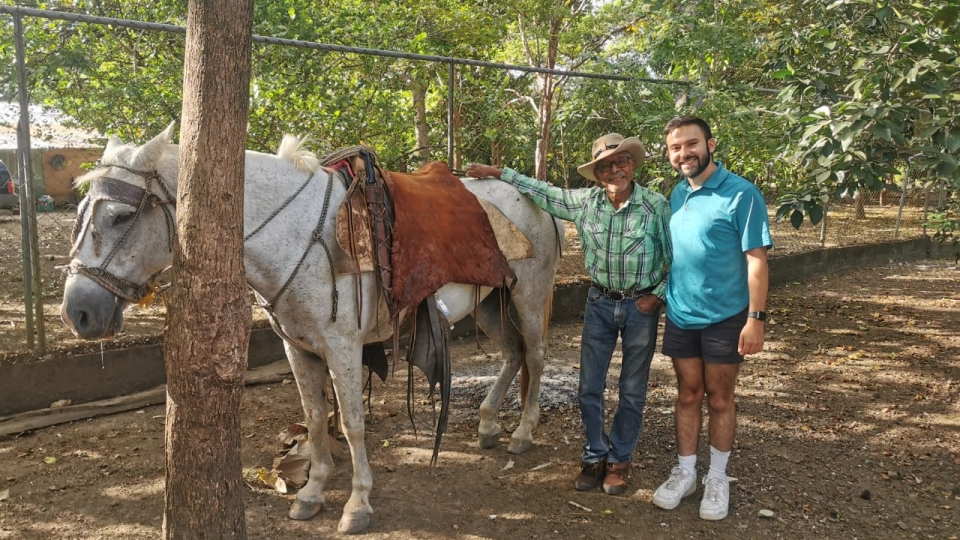
After graduating from Davidson College, Watson Fellow Luis Cordero ’22 spent a year traveling the world to learn how different cultures and communities care for their most vulnerable older adults. Back in his home city of Chicago, he wants to transform the way we treat older adults living in care facilities, especially those with neurodegenerative diseases.
“There are more nursing homes in the U.S. than McDonalds,” Cordero said. “Imagine if we reimagined them as community centers. By having nursing homes near parks and restaurants, intergenerational exchange and increasing access to community, we can remove the stigma around aging.”
Aging is a universal experience, but Cordero understood the complexities of caring for a loved one earlier than most. In middle school, he was the primary caretaker for his mother, who suffered from a neurodegenerative condition and later his grandmother, who experienced a similar illness. When Cordero’s mother passed away during his first semester at Davidson, the outpouring of support he received from professors and mentors on campus became his lifeline.
“They showed up for me during the hard times, when I didn’t know what to do,” he said. “I came to Davidson knowing I wanted to study neuroscience, but after this period of my life, I knew I wanted to help others dealing with neurological conditions get the care they needed.”
That summer, he received a grant to study public health in the Netherlands that summer. There, he found an early inspiration for his Watson studies, a “Dementia Village” where residents found independence and connection in a safe, community environment.

Caring for his grandmother on his breaks, Cordero saw going home as an opportunity to implement what he was learning on a deeply personal level.
“There’s so much isolation and stigma that comes with getting older and needing care,” he said. “I was learning to provide care that empowers people to keep living their lives.”
Through his classes, he began to think about the potential for care beyond the medical setting. Encouraged by campus mentors like Vail Professor of Psychology Kristi Multhaup, he applied to the Watson Fellowship. His year as a Watson fellow, traveling to care facilities around the world, transformed what he’d learned at Davidson and at home. His research included parks designed for older adults, small towns that encouraged agency and choice and an LGBTQIA+ focused program that paired residents and young adults.
Beyond just research, his Watson was a powerful personal experience. During one session, a man confided in him about his LGBTQIA+ identity, saying it out loud for the first time, and they connected over shared experiences.
“There was a lot of gain and a lot of loss during my Watson,” Cordero said. “I often say I was living in the past, present and future. It was so rewarding that by being who I am, I was able to support and learn from the hundreds of older adults I met on my journey.”


A Bonner and Charles Scholar, Cordero’s Davidson experience centered on leadership and service. He was vice chair of the Honor Council and served the community as a member of both Lambda Theta Phi Latin Fraternity and Turner Eating House. As a first-generation college student, he’s eager to help current Wildcats navigate life at Davidson and post-graduation.
“It’s always interesting hearing the current student experience and being a resource that I wish I’d had,” he said. “I want students to know they can survive and thrive at Davidson. The support of the community is unparalleled. Together, we can produce knowledge while pushing each other to be better humans.”
In the coming years, Cordero sees plenty of opportunities for Davidson students to bridge the gap between campus and community — including collaborations with The Pines retirement community.
He now prepares to graduate from Rutgers University with a Master’s in Public Health in population aging and clinical epidemiology. Back home in Chicago, he spends his time educating the public about available resources for aging adults — free senior day centers, health education sessions online and in-person, culturally competent care, Spanish-only programs and more.
“We’re all getting older, and we have to plan ahead to think about building a more age-friendly world,” Cordero said. “Even just walking around campus, saying hi to people, can be a way to slow down and go back to the simple roots of community. Davidson is truly a special place, for it is a hub of experimentation and ideas. When we thrive, the community thrives.”