Davidson's Fed Challenge Team Reaches National Finals
April 8, 2026
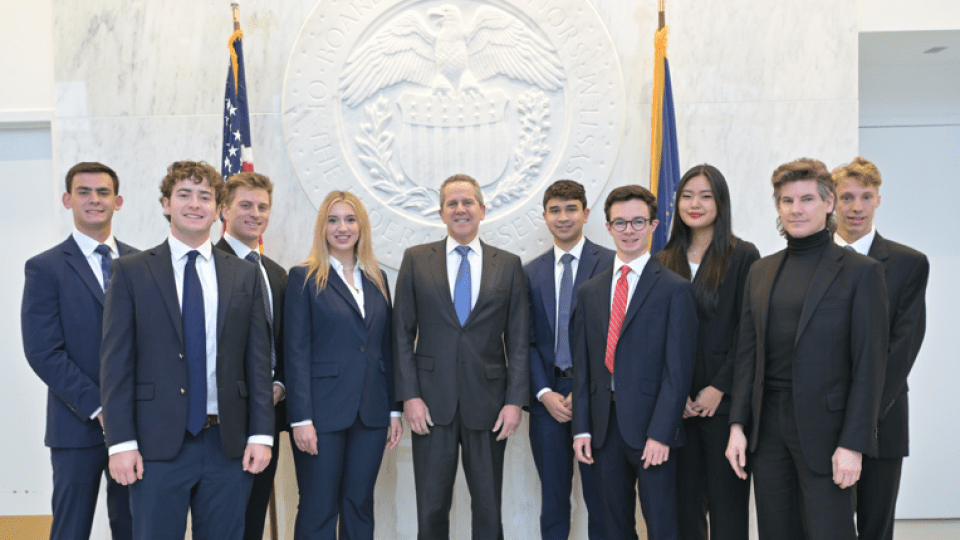
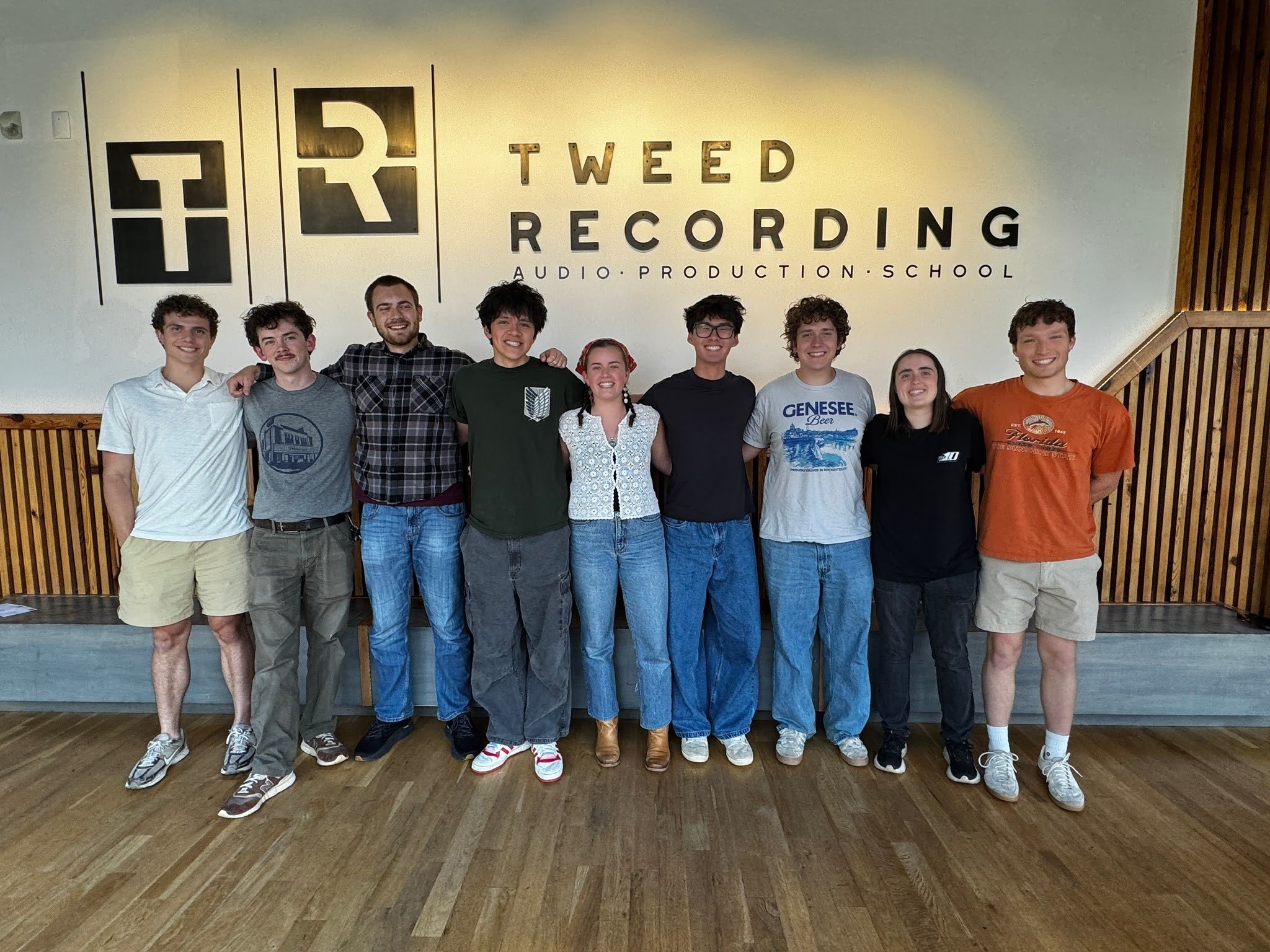
This year's Fed Challenge Team: Eli Naughton, Jackson Strelo, Lucas George, Valeriia Kruzhkova, Will Bacdayan, Ben Patte, Youngju Han, Prof. Caleb Stroup, John Cooper and Naman Poddar
In the latest Federal Challenge, Davidson College's Fed Challenge team finished among the top six in the nation — alongside Harvard, the University of Chicago, and UCLA.
What began as a student-led independent study has become a permanent course offering in the Department of Economics — one that produced a nationally competitive team.
Davidson's Fed Challenge team traveled to Washington, D.C., for the national finals of the College Fed Challenge, a competition hosted by the Federal Reserve Board in which undergraduate teams analyze economic conditions and present monetary policy recommendations to Fed economists. Davidson was one of just six finalists out of 139 participating schools from 36 states. The other finalists included Harvard, UCLA, the University of Pennsylvania, and the University of Chicago. Pace University took first place.
The result capped a remarkable run. Davidson first won the Richmond Federal Reserve District title, prevailing over institutions across the Carolinas, Maryland, Virginia, West Virginia, and Washington, D.C. The team then advanced through a semifinal round — a live Q&A in which Federal Reserve economists questioned the students on current economic conditions, theory, and the potential effects of artificial intelligence on inflation and labor markets.
From Independent Study to a Learning Community
The Fed Challenge debuted at Davidson in 2024 as an independent study initiated by students Dean Dowling '25, Will Bacdayan '26, and Bilal Razzak '25, with the support of Associate Professor of Economics Caleb Stroup. After that inaugural team placed in the national top 15 percent, Stroup saw the potential to support a lasting student team at Davidson. They formalized the Fed Challenge as ECO 386, a regular course within the Department of Economics.
"I developed the Fed Challenge course to develop the skills at the heart of Davidson's mission: critical thinking, rigorous analysis, teamwork, and the ability to learn independently," Stroup said. "Davidson prepares graduates for lives of leadership and service, which means going beyond rote memorization and repeating what the professor said. It means taking responsibility, engaging with complexity, and wrestling with competing perspectives."
What sets ECO 386 apart is the course structure. Stroup describes their role as that of a facilitator-educator — a guide and coach rather than a lecturer. "There's simply too much information for any single mind to absorb — not even an expert professor's," Stroup said. "That's why the Fed Challenge course is built around learning community: students learn with and from each other, not just from a teacher."


In practice, that meant the team spent weeks processing vast quantities of economic data and research reports while debating what to include and what to cut, finally arriving at a unified monetary policy stance through peer deliberation. For Valeriia Kruzhkova '26, who led the growth sector, the work was also deeply personal.
“Participating in the Fed Challenge was one of the most rigorous experiences of my time at Davidson,” she said. “As an international student, it was especially meaningful to engage with FOMC communications and the Fed’s dual mandate in a way that was not just theoretical.”
Kruzhkova was responsible for synthesizing trends in consumption, investment, and net exports, and for framing how tariffs and AI could affect output and feed through to the Fed's goals of maximum employment and price stability. That role pushed the team to think beyond simply listing indicators and toward what a data-dependent policy stance should look like. She credited Intermediate Macroeconomics with Stroup for helping build that foundation. And as the team worked to shape a single 15-minute presentation across growth, labor, inflation, and financial sectors, “we spent a lot of late nights debating what to leave out and how to phrase our risk assessment.” For Kruzhkova, presenting a data-driven recommendation in Washington marked “a very personal milestone.”
Will Bacdayan '26, who served as the team's creative director and competed in the Fed Challenge for a second year, spoke to the hours spent refining arguments, anticipating policy questions, and running mock Q&A sessions. Eli Naughton '26 led the team's organizational and operations efforts, keeping the group on track through months of preparation.
Stroup said the students’ success was earned through their own drive and developed within the college’s learning community.
“I gave the team plenty of room to challenge one another and grow together, and I stepped in only occasionally with minor guidance,” Stroup said. “What set this team apart was their hunger to learn and to win. They rose to rank among the best in the country through their own efforts, supported by a strong learning environment. With the right support, our students can achieve extraordinary things.”
Bacdayan, reflecting on the program's trajectory, noted the foundation the team has built for future competitors. The resources, institutional knowledge, and course structure now in place mean that future Davidson teams won't have to start from scratch.
Looking Ahead
The Fed Challenge will return in fall 2026 as ECO 386, with Stroup continuing to organize the learning experience. For students drawn to economics, policy, and the challenge of making real arguments under real pressure, the opportunity is now a permanent part of Davidson's curriculum — and a powerful example of what liberal education can produce.
Learn More:
Davidson College's Debut in the Fed Challenge
In this blog from February 2025, Dean Dowling ’25 reflects on his independent study with Prof. Caleb Stroup, during which Dean and a team of Davidson students founded the Fed Challenge at Davidson College. The team participated in the Federal Reserve’s national competition, placing in the top 15% of 120 participating institutions.

The 2024 Fed Challenge Team at the open house in Washington, D.C. (L-R): Will Bacdayan ’26, Elliot Jones ’25, Dean Dowling '25, Bilal Razzak ’25, Sierra Brown ’25 and Ally Smith ’25
In fall 2023, I took Prof. Caleb Stroup’s macroeconomics class and discovered an interest in monetary policy. Our final project involved analyzing the winning video from the 2023 College Fed Challenge, which consisted of a monetary policy recommendation from undergraduate students. It was an eye-opening experience that made me wonder: Why didn’t Davidson have its own team?
I felt compelled to do something. I proposed creating a team through an independent study, and Prof. Stroup was supportive. That marked the beginning of the Fed Challenge initiative at Davidson.
Because this was Davidson’s first time entering the competition, we had minimal materials to guide us. Our team had five presenters and three data analysts. I worked closely with two fellow students, Bilal Razzak and Will Bacdayan, to oversee our progress. We met with Prof. Stroup weekly and held larger team sessions at least twice a week on the top floor of the Alvarez College Union.
For the first round, we gave a 15-minute presentation, where we analyzed economic conditions, forecasted future risks and recommended a monetary policy stance. Throughout the process we sought out advice from multiple resources on campus. One resource was Econversations, a weekly gathering led by Prof. Shyam Gouri Suresh, where students and faculty discuss current economic topics. Those casual yet informative meetups helped us refine our presentation and deepen our understanding of the Fed’s role in the creation of monetary policy.
Shortly after we submitted our policy recommendation, Davidson welcomed back the current Vice Chairman of the Federal Reserve, Phillip Jefferson, who previously taught economics and served as the vice president for academic affairs at the college. I was fortunate enough to be invited to a dinner at President Hicks’ house, where Vice Chair Jefferson shared insights from his experiences and answered my questions on recent data revisions.
Once we advanced to the final round, we had to prepare for the Q&A segment. By training our own custom GPT on FOMC meetings and other related documents, we built a detailed list of practice questions to sharpen our understanding. We practiced often, running mock sessions where our data analysts played the role of judges. Further assisting in our preparation, Bilal and I had the opportunity to present in former department chair Prof. Clark Ross’s economic policy course, answering questions on monetary policy from residents of the Town of Davidson.
Our efforts ultimately paid off, as we earned the distinction of National Semi-Finalist and were invited to an open house hosted by the Federal Reserve in Washington, D.C. With the support of the Dean of Students Office, we secured funding so everyone on the team could attend. The open house was an incredible opportunity to see how professionals address the questions that we were faced with throughout the competition. Panelists shared insights on everything from monetary policy to bank operations and payment systems. To top it off, Fed Chair Jerome Powell delivered a speech, expressing his gratitude for the attendees’ interest in monetary policy.
Looking back, the Fed Challenge has been fundamental to my time at Davidson. It combined economic analysis with teamwork, communication and real-world engagement, exactly what I hoped to find in a liberal arts environment. From developing the initial proposal with Prof. Stroup to presenting in front of experts, I’ve seen how far curiosity and persistence can take you. I’m grateful for the faculty and students that made it all possible. If you’re even a little bit curious about economics, I encourage you to explore opportunities like the Fed Challenge at Davidson. It’s an unforgettable way to apply what you learn in the classroom and see it come alive in practice.
Dean Dowling ’25 is an economics major and data science minor from Austin, Texas. In addition to leading the Fed Challenge at Davidson, he serves as a macroeconomics embedded tutor, a Spanish apprentice teacher and a participant in “Econversations.” He is also a member of the Davidson Generals and a Rusk Eating House "Cowboy." After graduating from Davidson, Dean will work as an associate for Prophet in their New York office.
“I chose Davidson for the small class sizes, welcoming community and emphasis professors place on student learning, inside and outside of classes.”