Privacy Pioneer Cynthia Dwork Delivers Bernard Lecture on Data Protection
May 11, 2026
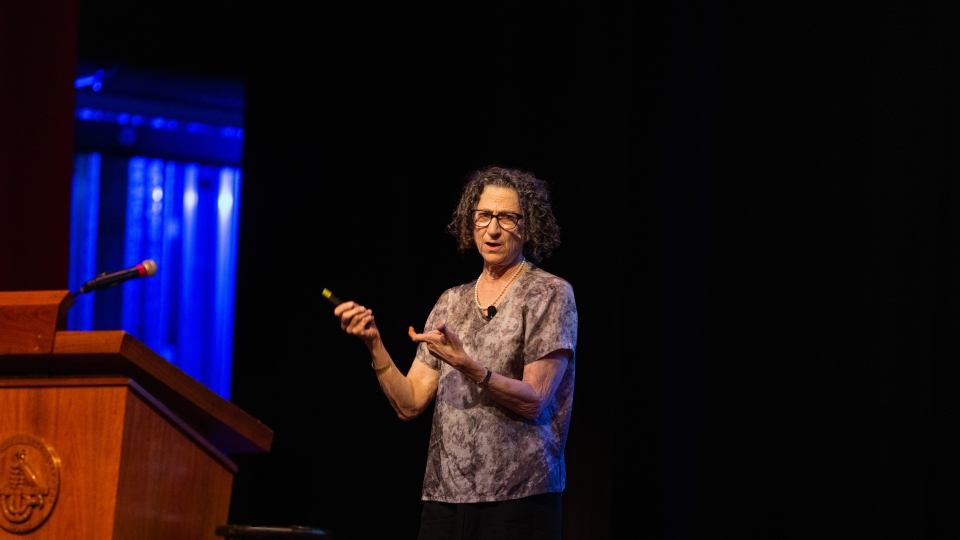
On April 23, the Davidson community welcomed Cynthia Dwork, a trailblazing computer scientist and pioneer in data privacy, to deliver the annual Bernard Lecture. Currently the Gordon McKay Professor of Computer Science at Harvard’s SEAS, Dwork arrived at Davidson during a landmark year for her career.
Dwork’s visit follows two of the highest honors in the scientific world:
- The National Medal of Science (2025): Awarded for her foundational contributions to cryptography, distributed computing, and algorithmic fairness.
- The Japan Prize: Received in April, this prestigious award honors individuals whose original achievements foster the peace and prosperity of humankind. Within the scientific community, the Japan Prize is often regarded as second only to the Nobel Prize.
Solving the "X-Ray" Problem of Big Data
In her lecture, “Differential Privacy: Public Methods for Private Data,” Dwork explored the mathematical frameworks necessary to protect individual identity in an age of massive datasets. She offered a striking analogy to explain the hidden risks of data collection:
“Simple aggregate statistics of confidential data always leak some information. Each of those statistics is like a small X-ray: An individual exposure causes little damage, but... information leakage due to multiple statistics can in combination completely destroy privacy.”
To solve this, Dwork developed Differential Privacy, a system of mathematical rules that provides a quantitative measure of privacy loss and calculates exactly how that risk accumulates over time.
Impact on the 2020 Census
Dwork’s research is far from theoretical:It currently serves as the gold standard for large-scale data security. Most notably, Differential Privacy provided the legal confidentiality protections for the 2020 US Decennial Census. Because of her work, the Census Bureau was able to achieve complete transparency regarding its privacy-preserving methods for the first time in history.
This lecture was part of the ongoing Bernard Lecture series, hosted by the Department of Mathematics and Computer Science.