In early May, an engine’s loud rumble pierced the quiet of a distant corner of campus. Behind the new library annex, a chorus of whoops and shouts joined the clatter as a small dune buggy charged out of an open garage door.
This moment was two years in the making. After innumerable setbacks, challenges and countless hours of work, the single-seat off-roader—which had been built by hand by a team of Davidson College students—was finally in motion.
“That was really the pinnacle of the whole semester or of the whole year,” said senior Henry Russell. “That was the point we'd been working toward, and that was where we were like, ‘Oh my gosh, we did it.’
“We were all high-fiving. It was incredible.”
The high was short-lived.
The buggy crunched to a stop in the gravel about 20 yards from the garage. The suspension had failed.
This could have been a moment of defeat. But the team had solved problems like this already. This was just another challenge, calling to them for a solution.
“We still need to repair it a little bit so we can get it driving again, but I feel content,” Russell said.
After all, they’d been at this for almost two years.
Origin Story
The idea to undertake this project came to Samone Cullum in the summer of 2024. A physics major and aspiring engineer, Cullum ’25 was inspired by a handful of older physics majors who built a fuel cell-powered car as a class project.
“They were like, ‘We want to do an engineering project, and this isn't an engineering school, so we're going to kind of create our own opportunities,’” she said. “I thought that was really cool and interesting.”
Cullum discovered Baja SAE, a nationwide competition organized by the Society of Automotive Engineers, that has colleges build off-road vehicles before putting them through a series of punishing obstacles. Since it started in 1976, the competition has attracted hundreds of teams from across the country.
The Baja competition is a cross between a car race, science fair and networking event. Recruiters from dozens of companies like Polaris and defense contractor Anduril are drawn to the event by the concentration of young, dedicated engineers.
It’s no surprise that large universities with engineering programs field the majority of Baja SAE teams. Out of 102 teams entered into the 2026 competition, only four schools qualify as liberal arts colleges (and two of those—Union and Bucknell—have engineering programs).
At some schools, Baja is the organizing principle of a student’s time on campus. First-years join teams with the hope that they will work their way up from gofer to team lead during their senior year. Budgets can easily exceed six figures. The Rochester Institute of Technology brought 45 students to the 2026 competition along with a box truck that carried two buggies and a fully equipped mobile shop.
The Davidson team started from zero when Cullum and fellow physics major Garrett Crockett ’25 approached John Yukich, an associate professor of physics. Yukich had overseen similar projects; he’d just helped some students build an off-grid tiny house. But Baja marked a new level.
“When they came to me two years ago and proposed this, my first thought was, ‘I have absolutely no experience with welding, I have no experience with this kind of fabrication,’” Yukich said. “I thought this was completely out of my league.”
And he was mostly right. This was audacious. But they charged ahead, hitting speed bumps at every turn.
Building a car is hard for experienced engineers with deep resources. This team had nothing. No tools. No parts. No expertise. They didn’t even have a shop until Cullum and Crockett negotiated a temporary space in the Davidson Outdoors boathouse, where they worked among canoes and sailboats.
They needed money. Team reps worked all angles, receiving support from offices across campus and reaching out to businesses in the area, offering sponsorship packages that would place sponsors’ names on the car. They grew into seasoned fundraisers. Two years after launch, they have raised more than $45,000.
They also had to develop skills they hadn’t learned in classrooms. Cullum taught herself computer-assisted drafting (CAD) while she designed the chassis of the buggy.
“She came up with a very good design,” Yukich said. “But it was something that required teaching herself very sophisticated software with lots of calculations and simulations for what turned out to be an immensely complicated problem.”
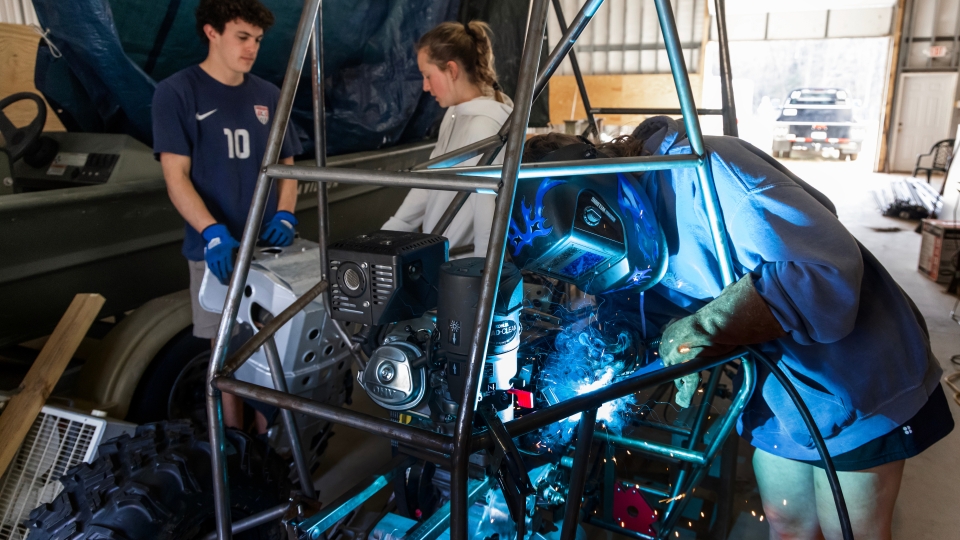
They learned how to weld. A pile of scrap metal in the back corner of the shop (they’ve since relocated to a garage they share with the Biology department) shows their growth.
“We didn't let ourselves touch the car until we could weld some bars together, and then we went outside and chucked them at the ground and tried to break them,” Russell said. “When we couldn't break them, we were like, ‘Okay we're probably doing this right.’”

The team adopted the name “Wildcat Motorsports” and grew quickly, eventually involving more than 50 students with Audrey Marshall ’25 and Carter Kniple ’25 joining the leadership team. Davidson-area engineers, college staff members and a host of others joined in, moved by the team’s passion and vision. Rich Preville and Keith Frye, the current and former instrumentation specialists for the physics department, were particularly helpful, lending tools and expertise to the team.
But in April 2025, with the competition just weeks away, their dream collided with reality. The team had made great progress, unveiling a finished chassis at the 2025 Verna Miller Case Symposium. But they did not have enough time to build the rest of the critical systems. They could not field a car.
That didn’t stop them from learning. A contingent of team members drove to the competition in Mechanicsville, Maryland to get a first-hand look at the event. They left invigorated and with a lengthy to-do list.
“We thought it was important for us to show up as a team, even if we didn't compete. We still presented our documents and our drawings to the judges to get feedback,” Cullum said. “We also wanted to get more involved with the greater Baja community. It was important to spend time meeting with other people, talking with people, seeing what we could learn from being there.”

New Leadership
When the senior leaders—Cullum, Crockett, Marshall and Kniple—graduated in 2025, they tossed the keys to physics majors and motorsports teammates Russell ’26, Stef Wojcik ’26 and Thalie Waters ’27.
These three helped finish the car, putting in untold hours in the garage.
“We spend every single day together working on this car,” Russell said. “And we make it fun. We listen to music. We hang out. We joke around because we all have that common goal, and we know the outcome that we're working toward together.”
Russell, a native of the north Chicago suburbs, is a tinkerer at heart; the kind of kid who got a welding rig for his 18th birthday. Last year, he and a fellow physics major added solar panels and an electric motor to an old pontoon boat and piloted it around Lake Norman.
Waters is the resident motorhead. During the COVID-19 pandemic, she, her brother and her dad filled the time by restoring a 1974 VW Super Beetle. After joining Wildcat Motorsports, she learned that her father had also worked on a Baja SAE buggy as a student at Rice University. As the only non-senior team lead, she’ll be crew chief next year.
Wojcik (pronounced “WOAH-check”), an expert skier from Colorado, was the engine, project manager, lead fundraiser and voice of the team. She self-effacingly describes her role as “hype woman,” the one who got people out of bed when work needed to be done.
“On the days when I was like, ‘I really can't do it,’ Stef always had something positive to say,” Waters said.
The three team leads have spent the year adding the seat, brakes, steering, suspension, electronics and the drivetrain to the chassis.

Like their predecessors, their progress has been slowed by the steep learning curve. One example of thousands: They had to bleed the brakes on the car to remove air in the hydraulic brake lines. That’s a fairly typical exercise for an experienced car mechanic but they learned how to do it through trial and error and by watching YouTube videos. It would take an hour or two in an auto shop. They worked on it for a week.
“Our motto in the shop is definitely, ‘One step back, two steps forward,’” Wojcik said. “But the reward of figuring things out is addicting, and that's what I love to continue chasing.”
Wojcik and the crew have learned new skills by the truckload but more than anything, the Wildcat Motorsports team has learned to love problem-solving.
“Every issue we've run into, we've been able to take a deep breath and say, ‘Okay, even if we don't know what to do right now, people know how to do this. We can figure it out. It's just a matter of time,’” Russell said. “It’s something that I try to take with me throughout my life.”
Yukich, their advisor, can see that they’ve done something special.
“What the students have accomplished is something that is completely unprecedented for Davidson. We're a small liberal arts college with a focus on the fundamentals, and the students are attempting to go head-to-head with an international engineering competition.
“They are much, much more comfortable taking on projects that they've never attempted before, projects that they have no experience with, projects that they might think that they have absolutely no idea how to start.”
And that’s a skill that any employer seeks. Russell saw it first-hand as he looked for his first job. At least one application asked specifically if the applicant had participated in Baja. (He started in June as one of three Davidson Innovation Fellows at Lucid Bots in Charlotte.)
At the Verna Miller Case Symposium this year, Wojcik, Russell and Waters delighted in unveiling the finished car. Cullum drove in from Duke, where she’s getting a master’s degree in engineering, to see the culmination of her dream.
“Oh my gosh, I almost cried,” she said. “It was just amazing seeing all the hard work that the people behind me put in to make this dream a reality. I'm very, very, very proud of them.”


Next Steps
After a brief post-commencement break, the Wildcat Motorsports team reconvened in early June. They loaded tools and the buggy into a trailer for the 11-hour haul to the 2026 Baja SAE competition in Palmyra, New York.
This year’s experience was very different.
“Last year, we showed up to this competition and walked away learning so much, and we did that with a ‘ghost vehicle,’” Wojcik said. “And this year, we knew what we were walking into and we showed up with a vehicle.”
The Wildcat Motorsports team had earned its place at the competition. They could call themselves peers.
And the other teams welcomed them. The aforementioned RIT team—with multiple buggies and a team of four dozen—quickly adopted the scrappy Wildcats as they worked to get the buggy ready for inspection.
The competition includes a handful of dynamic events like pulling a sled, driving through an obstacle course, and an endurance test. But the first hurdles are the engine check and technical inspection. Officials scrutinize every car to make sure it adheres to the rules. And there are a lot of rules.
“It’s pages upon pages of very hyper-specific detailed rules about what exactly you can have on your car and how it needs to be configured,” Waters said. “They go through every point of that rule book and make sure your car is safe and make sure it is well-engineered.”
The Wildcat team knew that tech inspection was a long shot, so they focused on the engine check.
“They checked our kill switches, checked that the engine was running at the right RPMs and told us there was one thing we had to fix,” Wojcik said.
They had to step away to make a design presentation—another element of the competition—but then raced back for a re-check.
They passed.
“That was really rewarding,” Wojcik said. “I think just somebody saying, ‘Hey, good job. We see you, and you did something good.’ That was really motivating.”
Now, the team will turn its focus to the 2027 competition. They have a long list of improvements to get the car in shape.
But just to be talking about 2027 is a victory in itself. Yes, the Wildcat Motorsports team has poured their energy into building a car but the real miracle is that it is growing into more than just a car. It’s a self-sustaining organization.
“Our goal is to come back to campus next fall and jump right back into it with refinements to the machine and then go to competition again hopefully a year from now,” Yukich said.
And what they’re building is designed to last.
“It is an engineering program,” Wojcik said. “It's the opportunity for physics students to be engaged with hands-on projects to apply what they're learning in the classroom to this space in the garage.”