Liberal Arts Engineer: How Physics, Cheerleading and an Off-Road Dune Buggy Led Samone Cullum ’25 to NASA Robotics
October 19, 2026
- Author
- Caroline Roy
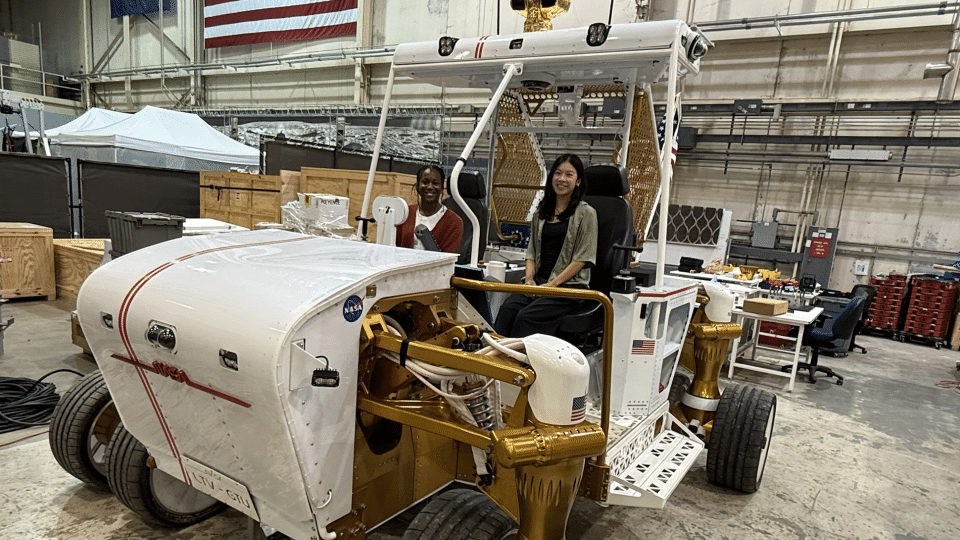
Samone Cullume '25 (l) in a Lunar Terrain Vehicle (LTV) at NASA
From a young age, Samone Cullum ’25 took an interest in how things work, from robots to vehicles to space travel. Over summer breaks, her mother encouraged her to read Neil deGrasse Tyson’s books on astrophysics, and at age 12, she attended NASA’s Space Camp in Huntsville, Alabama.
Today, Cullum is earning her master’s degree at Duke University, studying robotics for extreme environments, like glaciers and lava tubes, that mimic the conditions of outer space. A little more than a year after graduating, she’s leaning on her Davidson foundations as she learns new skills and adapts to new work environments.
“The way I see it, Davidson’s liberal arts curriculum gives me an edge,” Cullum said. “I can talk about so many different things. I traveled abroad, I was on the cheerleading team, I started my own club. That range of experiences is invaluable to me now.”
Cullum spent this past summer interning with the dexterous robotics team at NASA’s Johnson Space Center in Houston. Surrounded by other physicists, engineers and programmers, her role required learning new software, writing code and running simulations. Many of these skills were unfamiliar, but she dove in, watching tutorials, asking questions and learning from mistakes.
It’s not the first time she’s had to improvise. As a Davidson student looking for engineering experience, Cullum launched Wildcat Motorsports, a team that would eventually build their own off-road dune buggy and enter the Society of Automotive Engineers’ national Baja SAE competition.

The Wildcat Motorsports team competing in their first Baja SAE competition.
Building the team took months of work. With guidance from Associate Professor of Physics John Yukich, Cullum drafted a proposal and rallied a small group of interested physics majors. Without direct engineering experience, she and the other founding members relied on creative problem solving and their knowledge of physics to build their first prototype. The project became her year-long senior capstone.
Despite a steep learning curve and a few bumpy test drives, the team persevered, teaching themselves to weld, design and 3D print in the process. Cullum graduated before their buggy made it to competition, but the team took their designs to Baja SAE her senior year, learning from other motorsports teams from across the country. In 2026, when their car was ready to compete, she returned to support the team as they faced schools with massive engineering programs.
There was so much we didn’t know, so a small team was great for what we were doing. Everyone got to lead and gain experience. I’m so proud of how far the team has come and excited to see what they do in year three.
Speaking About the Wildcat Motorsports Team
Beyond academics, Cullum found ways to expand her Davidson community. A POSSE Scholar from the Charlotte area, she grew up playing soccer and running track. She never intended to become an athlete at Davidson, but started attending the cheerleading team’s open gyms with a friend and fell in love with the sport.
“Cheer is such a unique sport with lots of transferable skills,” she said. “I’m an extrovert, so I loved meeting the fans and families, traveling with the team and bringing community and excitement wherever we went.”

Other highlights from her time as a student included working at the Summit Coffee Outpost on campus and taking advantage of study abroad opportunities. The first time she left the country, it was to spend a summer conducting research in the Patagonia mountains of Chile and Argentina. Later, she studied in Madrid for a semester.
As she continues her robotics research at Duke, Cullum is already looking forward to her next NASA experience. She’ll participate in the NASA’s Pathways Program, rotating through different branches at the Marshall Space Flight Center. Much like her Davidson education, the program gives her a chance to explore different options and see what areas of robotics interest her most.
“As an undergraduate, I didn’t know what kind of engineer I wanted to be,” she said. “Now that my research is getting more specific, I appreciate that Davidson taught me I could pursue my goals while feeling free to scratch any intellectual itch.”