Seeking an AI Career? Study Spanish or Political Science
October 19, 2026
- Author
- Mark Johnson
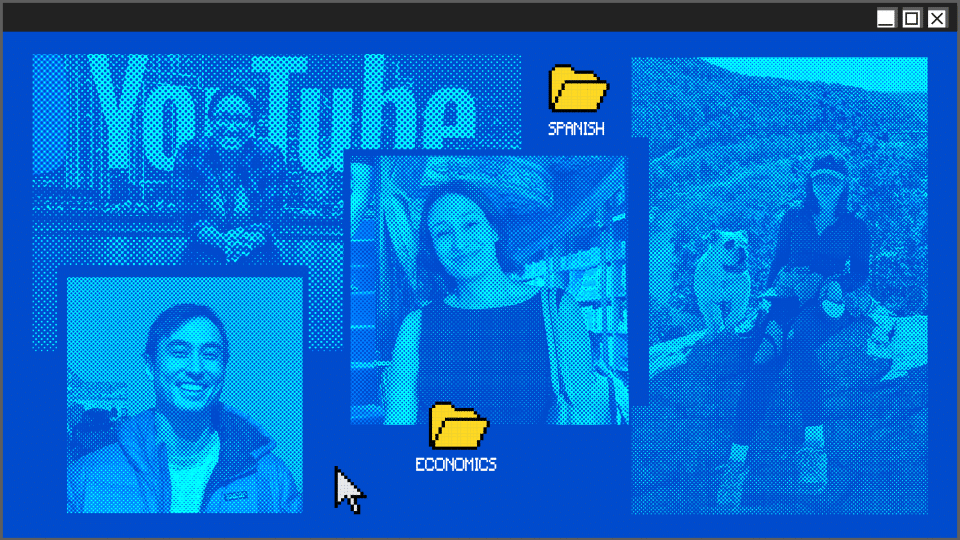
Prospective and current students at Davidson College wonder how their Davidson experience, a liberal arts education, will equip them in an economy upended by large language models like Claude and Gemini.
We posed that question to four Davidson alums who work in jobs and companies steeped in AI.
And it’s a world, they say, in which their Davidson degrees put them ahead.
Ashley Atkins ’15, Deputy Director, San Diego Supercomputer Center at UC San Diego
Ashley Atkins is helping bring the power of artificial intelligence to everyone from teachers to breakthrough cancer researchers. Her path there made a few unexpected turns.
She grew up in a New Mexico town about 40 miles east of Albuquerque with fewer than 2,000 residents. Most college-bound kids headed to state universities. After she took the PSAT, the incoming college mail piqued her interest in liberal arts colleges, where she thought she would get both pushed and nurtured. If she was going to travel across the country, Davidson seemed like a place that would make her comfortable with uncertainty and with tackling big problems. A Terry scholarship closed the deal.
She arrived keenly interested in water, an important part of her culture in New Mexico. She majored in political science, not a STEM discipline, and geared her Davidson studies, writings and internships toward developing the skills to design better water policy. After graduation, she wanted to ramp up her science and data bona fides to better work with laws and regulation. Then, she got hooked on science. She earned a master’s degree in water science and management at New Mexico State University, looking at water shared across national borders, but also discovered how well data could help build an understanding of policy and human systems.
Atkins’s boss at the New Mexico Water Resources Research Institute encouraged what Atkins had cultivated at Davidson — learning to learn, taking on new responsibilities. She ventured into large computational models as a data revolution was under way. She worked on finding ways that analysis could help water decision-making and she grew fascinated with the data analysis and computing possibilities. She moved to UC Berkeley as executive director of the West Big Data Innovation Hub, still engaged in water research but with an eye toward the broader possibilities of research involving massive amounts of data and computing power.
Three years ago, she moved to UC San Diego’s Supercomputer Center, an institution that helped form the worldwide web, the commercial internet and where she now is deputy director. The U.S. National Science Foundation just awarded the center a $35 million grant to establish and run the National Artificial Intelligence Research Resource Operations Center. The center will connect researchers, educators and students with advanced computing resources, high-quality data, AI models, tools and training to which they otherwise would not have either access or the ability to acquire on their own.
“We help fill that niche for people across the entire spectrum of users,” Atkins said, “from an educator hoping to incorporate AI in their class to researchers focused on cancer breakthroughs.”
These are the solutions to those big problems Atkins aimed for at Davidson. She said the new center offers the potential for more people than ever to benefit from — and be part of — scientific discovery.
“I credit so much of my path, and even how I think about the world and how I approach work, to Davidson,” Atkins said. “When it comes to navigating a job market, there are constantly shifting technologies. If you focus on just learning those, they could be obsolete soon. What has served me best is [at Davidson] you get very comfortable thinking about things differently, pushing yourself. All of the critical thinking skills that Davidson equipped me with, I just lean on those again and again and again. Davidson sets you up well to be a lifelong learner. That’s what’s most important, whether it’s a new technology or a new field.”
Erika Dean ’05, Global Product Lead at Google
Erika Dean, who previously worked at three other tech firms, often collaborates with colleagues holding advanced degrees in mechanical engineering, physics or data science. They initially presume she comes from a similar background.
“When I say my degree is in Spanish,” she said, “they say ‘What?!’”
Dean, who earned a law degree at UNC Chapel Hill but opted not to practice, plays a firefighter role. She is brought at the start of a YouTube product’s development or to course correct tensions on the team before launch. This is at a company with people and products on the leading edge of AI. Dean manages multiple advertising products in YouTube, which Google owns, and has moved into supporting AI-driven tools that measure ad performance and educate advertisers in how best to spend their marketing money across channels based on the return.
“They bring me in, saying ‘Okay it’s a little messy, tensions are high,’” Dean said from her office in Washington, D.C. “I do a listening tour. I have basic questions for the team. I might have a hypothesis in mind. Having that open dialogue establishes trust. I write a white paper for the product stakeholders that explains the issues and presents a point of view on a solution. That paper, thanks to my Davidson writing, lets my idea get socialized and provide an anchor for the team working on the product.”
Dean consistently interacts with engineers and project managers around the globe steeped in AI. She uses tools such as NotebookLM, an AI-driven research app, to analyze technical documents and better understand them. She also leverages Google Gems as a virtual AI assistant to give sales teams fast, interactive answers to common questions about advertising products — ensuring the teams get real-time support even when she can’t be in the room. She merges that AI-enabled work with the Davidson playbook, which proves essential in an AI-powered environment: Listening and asking good questions. Stepping back and reframing. Demonstrating integrity and trust. Learning from failure. Learning how to learn.
“AI tools and AI’s ubiquitous role in all that we do prepare me on the technical side,” Dean said. “Then, I am very good at speaking with people who might have a different point of view and listening to them. My Davidson experience really helped build that muscle. You’re exposed to people with different backgrounds. At the end of the day, I still have my point of view, but I have a sense of where they’re coming from. Even if they don’t agree with me, we end the discussion with a sense of respect for each other. We're debating about the product and about what’s best for the customer.”
Ben Thompson ’10, Economist at Tools for Humanity
Ben Thompson earned a doctorate in economics from the University of Michigan and has worked at Amazon, Snapchat and, most recently, as a senior data scientist at Pinterest.
Tools for Humanity, co-founded by Alex Blania and OpenAI CEO Sam Altman, is aimed at providing a global “proof-of-human” network to navigate the rise of AI. Proof-of-human protocols help prove a digital proof belongs to a unique human and not an AI bot or fake account, separating authentic users from malicious bots.
“A lot of education, especially from engineering backgrounds, is geared toward application,” Thompson said, from his home in California. “You’re training someone to execute and apply something. AI is really good at implementation and execution. A liberal arts education is more about thinking and finding the right questions to ask. Being able to determine which questions to ask is a skillset that’s becoming more and more scarce.”
When Thompson was a teaching assistant in graduate school, the tests he handed out were simpler versions of the research the class’s professor was conducting.
“[Davidson College Economics Professor] Mark Foley would give tests that were the opposite of that. They were extremely difficult but untimed,” Thompson said. “Those exams made me really learn and think about the material. That kind of education is hard to replicate…My greatest asset at work is like those tests — making sure I figure everything out. I tend to think about things for a long time in a careful way. That’s not always the best asset [in an industry that values speed]. You’re fundamentally approaching a problem from a different way.”
Big tech engineering looks at output, Thompson said, emphasizing speed and quantity over quality. That’s more valued now, but things could change.
“For the longest time the industry has rewarded quick thinkers, people who are good at solving puzzles,” Thompson said. “The careful thinkers are going to have their moment, again, as AI takes care of the quick problems.”
Egyn Zhu ’17, Machine Learning Scientist at Amazon
“Davidson shaped a lot of me,” Zhu said. “People tell me that I’m very data driven, very scientific. I was a social science major and taking math classes. You don’t just want to make claims, you want to have a balanced perspective. Doing research at Davidson was very helpful. I was doing machine learning research several years before ChatGPT arrived. [Then-Davidson Psychology Professor Scott Tonidandel] was comfortable with me doing a project by myself. We learned together. You have the ability to tailor the learning to yourself. I’m seeing people who don’t come from the liberal arts background rely more on structure. They ask, ‘What classes did you take?’ My answer is more that I was able to explore and teach myself.”
Zhu double-majored in psychology and math at Davidson before getting a doctorate in industrial organizational psychology at North Carolina State University. Her current role is to help build AI tools that help improve the hiring process at Amazon.
“Davidson has prepared me to be more adaptive to whatever is going on outside in the world. We had the ability to choose whatever class we were interested in, regardless of the major or department —
anything that we found interesting. [In graduate school], I didn’t know any of my students. At Davidson, we actually build a relationship with our professor. “[That experience] fosters critical thinking, which is especially important in this era of AI, where you need to be skeptical of what AI is returning to you.”
Zhu said personalized education and mentor relationships with faculty at Davidson create opportunities to grow.
“Davidson,” she said, “has prepared us for anything in the world.”