My Davidson | A Student Blog No Test Tubes Required: How an Office Hours Question Led to National Policy Research
November 9, 2026
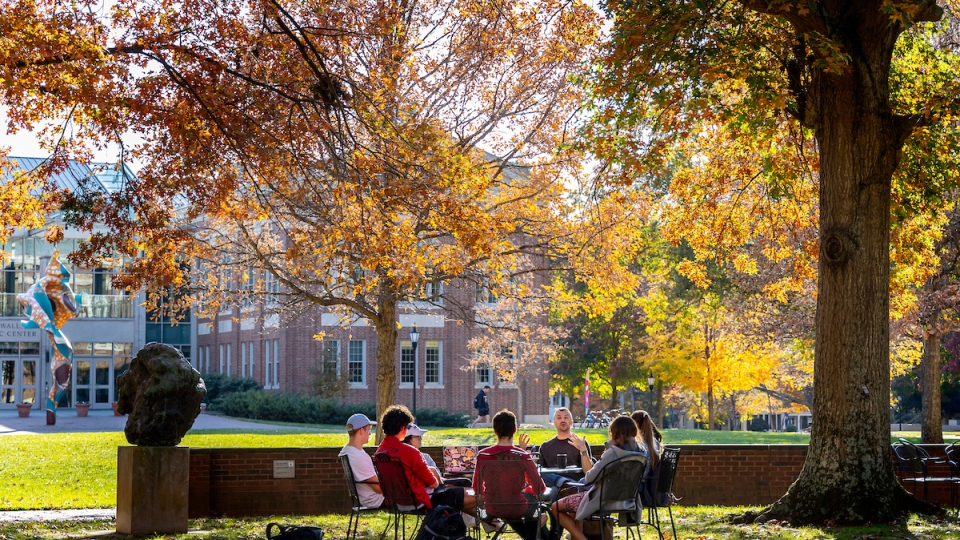
Philosophy, Politics, and Economics (PPE) & Educational Studies double major Annalee Stuardi-Drumm ’27 shares how working with Davidson College’s College Crisis Initiative (C2i) and faculty mentors redefined her understanding of research and policy.
About the Author
Annalee Stuardi-Drumm ’27 is a Philosophy, Politics, and Economics (PPE) & Educational Studies double major from Upper Darby, Pennsylvania.
Outside of the classroom, she serves as Patterson Court Council (PCC) President, Staff Writer for The Davidsonian, and Senior Admission Fellow.
She is also involved with Warner Hall Eating House, College Crisis Initiative (C2i) and the D.G. and Harriet Wall Martin Institute for Public Good.
"Davidson was the first college I visited and I kept going back to it! The close knit community that felt warm as soon as I walked on campus was exactly what I was drawn to. I have gained so much from this place and from classmates and professors alike who go above and beyond for me. The culture of supporting one another and celebrating both the big and small wins makes me proud to call Davidson home."
Before college, I pictured research with test tubes, white coats and a lab full of people. I was interested in policy, and I didn’t understand how the two could fit together. I had no plans of pursuing research when I got to Davidson.
This changed when I became involved with the College Crisis Initiative (C2i) during my sophomore year. A friend a few years older than me had been working with the program and talked to me about her work as a data collector investigating a wide range of issues, all relating to how colleges and universities respond when faced with a national crisis. She thought I would be interested because so many of the responses led to changes in or advocacy for public policies. I decided to give it a try and became a data collector, gathering information on how colleges in affected areas were responding to Hurricane Helene and what impact that would have on students’ ability to graduate on time. It wasn’t until my junior year that I designed a project of my own.
I was working on a project for my “Comparative and International Education” class with my advisor, Prof. Chris Marsicano, during office hours. It was March, and people from my high school were announcing where they would be attending college. Naturally, I got off-topic talking about where they were ending up and how those institutions have increasingly been in the southern U.S. We speculated why that might be and wondered if it was specific to a given area. The response Prof. Marsicano gave me was simple: Let’s figure it out.
I worried I didn’t have enough of a background in statistics or research methods to tackle this project, but he assured me we would work together to fill in the gaps and that I wouldn’t be doing this alone. We started by making a scrappy list on his office whiteboard of every reason we could come up with as to what may be causing the applicant growth. What followed was gathering evidence to cross off as many as possible, hoping we would be left with a few compelling reasons. Since then, we have met weekly to go over collected data, decide what warrants more attention, and work toward the answer. Even over the summer, we met via Zoom, not because I had to, but because I wanted to.
A moment that felt incredibly full circle was interviewing my high school college counselor, Sarah Quin, about the trends she has seen in college applications. She was the person who guided me through my own college search, and now I am sitting across from her as a researcher with questions of my own. Having worked at both the high school level and in college admissions, she has watched the process change over the years, including the growth in applications to large Southern universities, the very trend I am working to explain.
A highlight of working on this research was attending a one-day conference at a think tank in Washington, D.C. I was able to both collaborate with and hear from leaders in the field of higher education as they discussed what the current political landscape meant for colleges and universities across the United States. I was the only undergraduate student in attendance and was given the opportunity to discuss my research. I was intimidated to share my ideas with those who had much more experience than I did, but I was thrilled by their response: Keep going, there is something here worth figuring out.
After months of collecting data, our meetings are less about finding more information and more about figuring out what it all adds up to, and which of the explanations hold the most weight. Next semester, I will continue the project as an independent study, which will give me dedicated time to turn what we have gathered into a polished research paper.
I still haven’t touched a test tube. What I’ve done instead is ask a question I was curious about and spend time looking for the answer with someone willing to teach me how. If you’ve pictured research the way I did, I’d encourage you to reconsider. Start small: take a data collection role or bring your question to a professor’s office hours. The cost can be as little as a few hours a week. What you might get in return is a mentor, skills you didn’t know you could build, and a room full of experts encouraging your project.
What Are Office Hours?
At Davidson College, office hours are where a curious question can become a research project, a mentorship, or a plan for what’s next.
In under a minute, watch Prof. Marsicano explain how they work and why he wants you to show up.