The Lab That Became a Lifeline: How Mentorship Set Ketan Bulsara ’92 on a Path to Renown
December 15, 2025
- Author
- Danielle Strickland
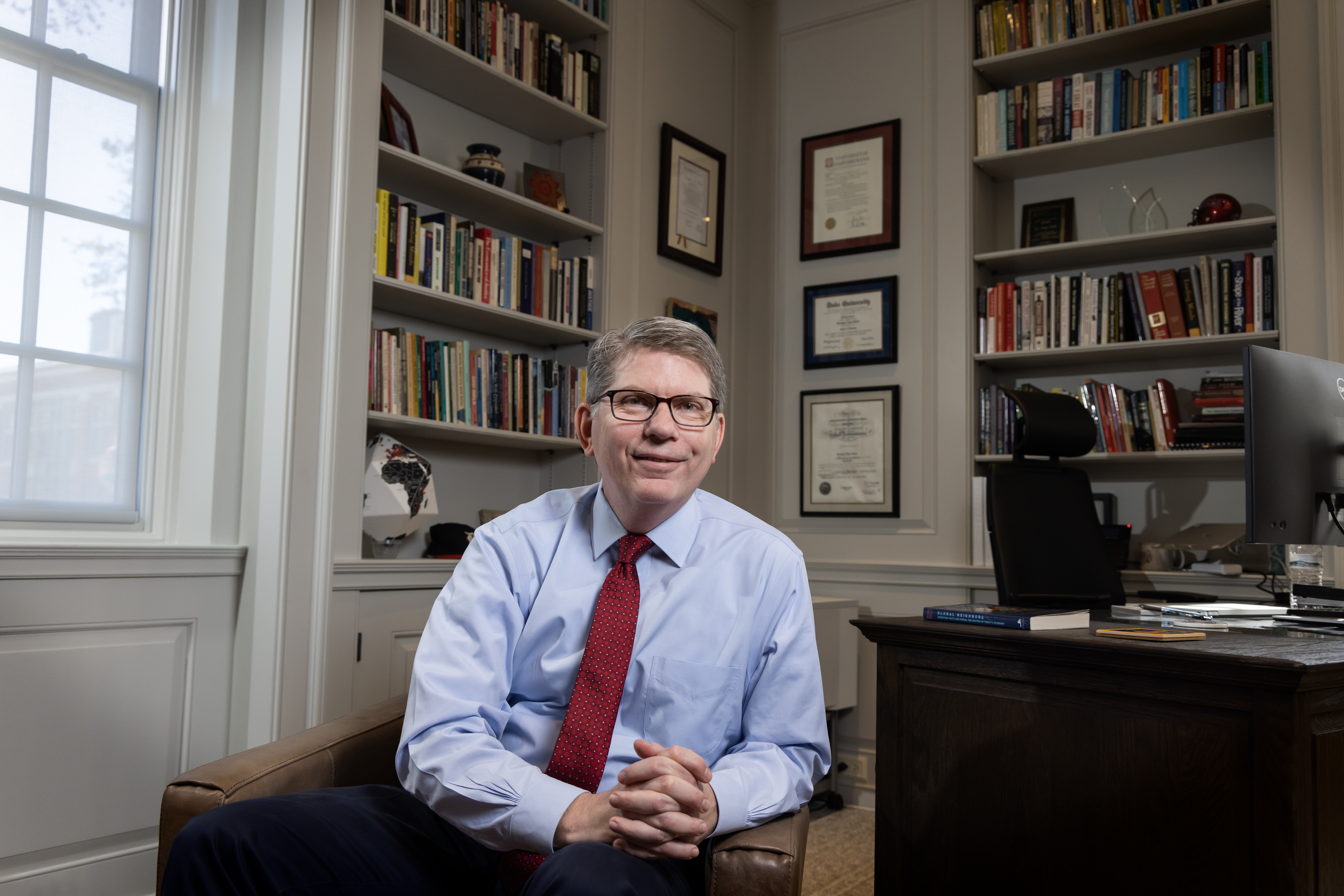
Ketan Bulsara ’92
On weekends, Ketan Bulsara ’92 could be found behind the counter of a 24-hour convenience store off Tryon Street, covering shifts for the family’s business. On weekdays, he was a 16-year-old "total misfit" at Davidson College, an immigrant who had skipped two grades and struggled to find his place in a culture that felt entirely foreign. That changed after a chance encounter with a pony-tailed professor put Bulsara on a path toward the vanguard of neurosurgery.
Bulsara ’92 met R. Stuart Dickson Professor of Psychology Julio Ramirez walking his dog on Davidson’s Main Street.
“He had the same charisma and dashing looks he has today,” Bulsara said. “I still remember the conversation. He was the first person who talked to me about medicine and Ph.D. paths, and I had always liked science. He let me join his lab, which became a sanctuary for me in my early days. That’s how it all began.”
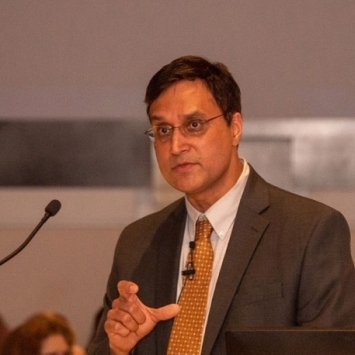
That conversation between faculty member and student, a hallmark of the Davidson College experience, eventually led to a distinguished career. Today, Bulsara is a world-renowned neurosurgeon, and professor and founding chair of neurosurgery at the University of Connecticut (UConn).
Among his many contributions to the field include the newly created Brain and Spine Institute at UConn Health and an elite neurosurgery residency training program, one of only 2% in acute care hospitals in the United States. Bulsara’s credentials and scholarly work include distinction as one of only a few neurosurgeons in the world with dedicated dual fellowship training in skull base/cerebrovascular microsurgery and endovascular surgery; election to some of the most prestigious neurosurgical societies in the world; and authorship of countless books and peer-reviewed publications.
Most recently, Bulsara became a member of the American Academy of Neurological Surgeons, an honor granted to the top 1% of academic neurosurgeons.
Staying Local
Born in India, Bulsara and his family moved to Zambia in Central Africa shortly after his birth and then immigrated to the small town of Seymour, Texas, when he was 11.
“I think we were in public housing in Texas, and my dad had to find a job no one else wanted to do for a year, in order to get a Green Card,” Bulsara said. “He worked at a motel, but he knew there might not be much of a future in that job, so he started looking for opportunities in other states.”
His father bought Jay’s Quick Stop in Charlotte, off Tryon Street. As the oldest child, Bulsara worked there a lot.
With each trip up and down the highway to procure supplies for the store, which was open nearly 24 hours a day, Bulsara and his parents passed signs for Davidson College. When the time came for college applications, Bulsara’s father encouraged him to apply to Davidson. He had heard it was a good school, but he also needed his first-born to stay close by in order to cover weekend shifts at the store.
“Hallmates at Davidson were kind enough to drive me to work and, once I could drive, let me use their cars. But overall, I was a total misfit,” he said. “I had placed out of several grades in Africa, and when we moved to Texas, I was on track to graduate at 15. The principal suggested I push it to 16, at least, so that’s what we did — still early to start college.”
Beyond his age, Bulsara felt other differences acutely.
“I didn’t have the same financial resources as the students around me, and the culture was all new,” he said. “In a way, the neuroscience lab became an escape from the campus environment I was still trying to get used to. The long hours were almost a blessing at that time.”
Though all his Davidson professors had a tremendous influence, Ramirez and the late John Williamson were two of Bulsara’s most influential science professors, offering guidance, encouragement and pathways to opportunities.
In many ways, as different as they were, they taught me so much about life and its nuances at the most formative time of my life. I learned to dream the greatest of great dreams because of them. They taught me that in believing and working for those dreams, great things are possible.
Williamson chaired the Biology Department when Bulsara took “Bio 101.”
“I heard students had a really tough time getting good scores in his class,” Bulsara said. “My resident advisor told me I’d have to memorize the book to get a perfect score. With my background, I figured I would only get one chance at doing well in life.”
He made the 24-hour room in the library his second home, memorizing verbatim as much as he could. The result: a near-perfect score.
“I believe ultimately that is what led him [Williamson] to make me his teaching assistant,” Bulsara said. “As uncomfortable as I felt at Davidson, and with all my insecurities, it became the ideal nurturing environment. Dr. Ramirez and Dr. Williamson brought very different approaches to teaching, but I loved them both as mentors.”
Junior year, Ramirez helped Bulsara apply to a summer fellowship at Carnegie Mellon University, a program that only accepted five or six students. It was there that Bulsara first watched brain surgery, solidifying his interest in neurosurgery.
With his parents’ proximity requirements in mind, Bulsara headed to Duke University for medical school, still making the four-hour round-trip drive to work at the store.
“There were only 200 spots in the country to pursue what I wanted to do, and I wasn’t sure if someone from my background would ever have the opportunity,” he said. “I knew I needed to stay in North Carolina, but thankfully that still left me with tremendous options.”
Excellence in Action
Bulsara has been celebrated for his medical accomplishments, and online reviews from patients tout his exceptional bedside manner and ability to communicate.
Ironic, he said.
“At 16, I was scared to talk in public, very introspective, withdrawn,” he said. “I had an accent I wanted to lose. Now, I kind of wish I still had it as it was pretty cool.”
At his graduation from Duke, he was unanimously awarded the Ideal Physician Award by his classmates. He’s published three books and more than 220 peer-reviewed articles and is only one of 100 advisors in the U.S. to the Centers for Medicaid and Medicare Services’ Medicare Evidence Development & Coverage Advisory Committee.
Since his arrival at UConn in 2017, after 10 years at Yale University, neurosurgery has seen unprecedented clinical growth. Bulsara was named the recipient of the 2025 Board of Directors Faculty Recognition Award, presented at the university’s commencement this past spring.
I am honored and grateful to my mentors who have enabled me to gain the trust of my patients as I strive to cure them of brain, spinal cord and peripheral nerve problems. To be able to help people navigate through problems that afflict the essence of who they are is truly an honor I cherish. Even though we’ve made a lot of progress in understanding, so much more needs to be uncovered. The marvel of unraveling the mysteries of nature for the benefit of all — that’s what motivates me, my department, my learners, my faculty.
As someone who was inspired through education and teaches students today, watching his own children’s educational journeys is especially interesting. Bulsara’s daughter attends Brandeis University, and his son is a high school junior who’s busy exploring colleges.
“As my days from Davidson become more remote, I fondly cherish memories of my friends, family and mentors,” he said. “I would choose Davidson College every time.”