Artists in Residence Share Passion for Flamenco With Students
April 30, 2026
- Author
- Lisa Patterson
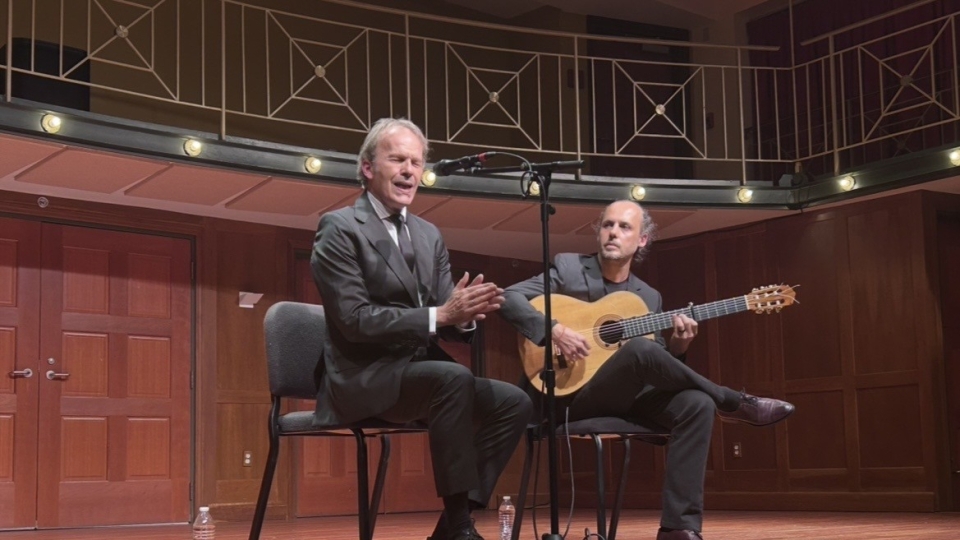
Flamenco cantaor David Pino and guitarist Guillermo Guillén
Flamenco cantaor David Pino and guitarist Guillermo Guillén visited campus for a weeklong residency this month. Sponsored by the Bacca Foundation and several academic departments, the artists engaged with the community through workshops, classroom visits and a captivating performance titled “Flamenco Unveiled: Styles, and Forms, and Emotions in Concert.”
The origins of flamenco are found in the multicultural melting pot of Andalusia — the southernmost region of Spain — where it emerged as an expression of the marginalized Romani (Gitanos) people alongside Sephardic Jewish, Moorish and traditional Spanish folk influences. Historically, the art form served as a vital social outlet, reflecting the struggles and resilience of communities through its three core pillars: cante (song), baile (dance) and toque (guitar playing). While it began in the private settings of homes and family gatherings, it eventually moved into public cafés cantantes in the 19th century, evolving from a localized folk tradition into a sophisticated global art form recognized for its emotional intensity and rhythmic complexity.
The residency was designed as a bridge between theory and practice for students in “Spanish 348: The Cultural Politics of Flamenco.” Professor of Hispanic Studies Samuel Sánchez y Sánchez, who teaches the interdisciplinary course, invited Pino to campus to provide a real-life experience that complemented the class’s academic focus on flamenco as a tool for identity, resistance and resilience.


While students spend the semester using fields like political science, anthropology and “Flamencology” to examine how the Roma and Andalusian people have used this art form to transcend social exclusion, the residency brought these concepts to life. Throughout the week, Pino taught two formal classes, led specialized workshops on singing and rhythm, performed a live concert, and shared informal meals with students to foster deeper cultural exchange.
Pino, a renowned artist and professor of cante (song) at the Córdoba Conservatory, has performed globally and collaborated with legends including Enrique Morente. Guillén (known professionally as Guilhelm Tarroux) is a French-born guitarist and educator recognized for his technical precision and deep immersion in flamenco’s history. Below, they discuss the evolution of flamenco, its power to transcend language and the importance of experiencing the art form live (Guillén acted as translator for Pino during the interview).


Flamenco is rooted in a deep history of blended cultures. How has it evolved from those traditional roots into the contemporary styles we see today?
Flamenco is a living art form, and because of that, it is always a reflection of the current society where it happens. It has never been frozen in time; at any point in history, flamenco has stayed connected to the social reality of people’s lives while also engaging with the artistic vanguard. Today, you see it connecting with genres like jazz or theater while still maintaining its core.
How is flamenco viewed currently in Spain?
It is becoming much more accepted and respected as a high art form rather than a music for minorities. For example, you now find flamenco in the academic world — in universities and conservatories — which wasn't possible a while ago. The whole of society is embracing it with the dignity it deserves.
What was your path into this music?
For David, it was like a game when he was a child. He didn't come from a family of performers, but his father was a great aficionado who was always around artists and flamenco venues. By the time he was 14, David won a singing contest for young people, and that is when people started calling him to perform. He went on his first international tour to Germany and Switzerland at just 17.
You have performed all over the world, from Japan to Russia. What is it about flamenco that transcends the language barrier for an audience?
Flamenco has a way of going right through the shield we often carry to go directly to the emotion. The intensity is so powerful across the three main parts: the singing, the dancing, and the guitar. Since the musical language of the guitar and the movement of dance are universal, the Spanish language barrier isn't a problem for the audience.
Why is it important for college students to experience this art form in person rather than through a screen?
We are so used to consuming everything through technology, but there is a big loss when you see flamenco on a screen compared to seeing it live. Flamenco requires a direct channel to be truly relevant. It needs that physical presence to really pierce through and reach our emotions.
Are you optimistic about the future of flamenco?
Since the late 19th century, there have always been pessimists saying flamenco is losing its value, yet it has only evolved to become bigger and more interesting. The technical level of dancers and guitarists is higher than ever. We always start from the tradition, studying the former artists, but we use that as a foundation to move forward.
How do you think artificial intelligence will impact your work?
David thinks that, as a reaction, flamenco might actually go back to its live roots. When we perform with just a voice and a guitar, we can't cheat — what you see is exactly what there is. That human element is the best response we can give to AI. AI might help researchers process data, but it will never replace a real-life performance.
Do you have a favorite song, or a particular style that moves you?
In flamenco, we don't call them “songs”; we call them palos. Each palo is a form with different musical and rhythmic rules that we improvise within. David identifies most with a palo called soleá, which is considered the "mother" of flamenco singing. It is very melancholy and deep.
Personally, it depends on the mood and the moment. In a traditional flamenco party, a juerga, you navigate a spectrum — you might start with something festive and then move into something very intimate and deep. That is the experience we try to bring to the stage.