Thriving Survivor Targets Cancer: Elise Boyse ’27 Named Goldwater Scholar
May 6, 2026
- Author
- Mary Elizabeth DeAngelis
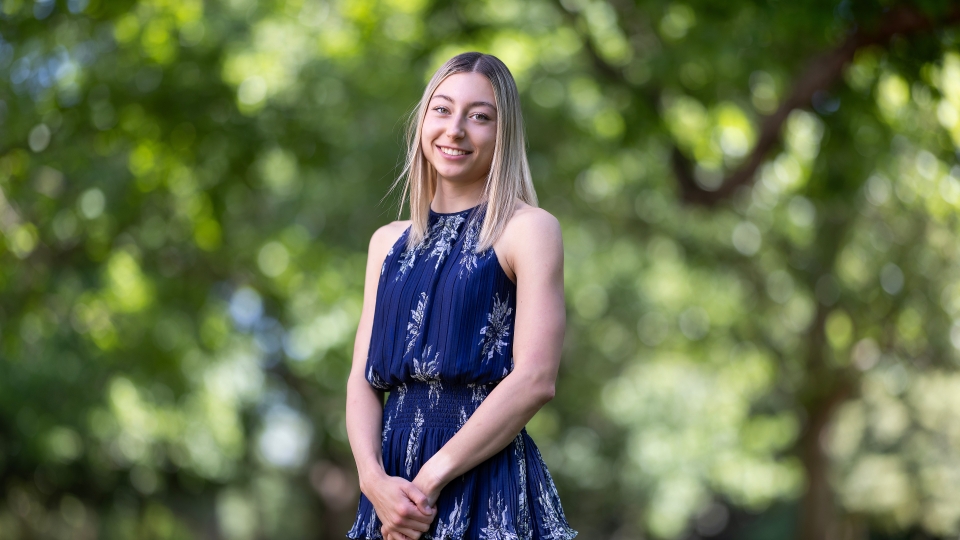
Elise Boyse’s conversations often start with a question.
How does the air conditioner in a car work? How does a chairlift unload riders at the top of a ski slope?
Questions that arose from childhood curiosity turned far more intense at Davidson College, where her strong interest in chemistry and biology led her to seek answers that felt not only scientific, but deeply personal.
How can a protein that both spreads and suppresses cancer be pursued as a potential treatment?
Boyse ’27, a cancer survivor, has devoted countless hours studying, experimenting and researching biochemical reactions that could lead to targeted immunotherapies that not only save lives, but lessen harsh side effects of treatment.
Her stellar academic record and sophisticated research have won her national recognition as a 2026 Goldwater Scholar. The Goldwater Scholarship Program is one of the country’s most prestigious scholarships in the natural sciences, engineering and mathematics. It identifies and supports college sophomores and juniors who show exceptional promise of becoming the country’s next generation of leading researchers.
Boyse was among 454 scholars selected from this year’s pool of 1,485 nominees.
Chemistry Professor Nicole L. Snyder first met Boyse as a first-year student enrolled in her advanced organic chemistry course, where she distinguished herself through her academic performance and intellectual curiosity. Recognizing her potential early on, Snyder invited Boyse to join her research team as part of the National Science Foundation International Research Experience for Students (NSF-IRES) program, beginning a research collaboration that continues to grow.
Snyder said Boyse stood out for her mastery of complex scientific material and her ability to ask challenging, thought-provoking questions that pushed discussions beyond the classroom and into genuine scientific inquiry. In research, Boyse thinks creatively, identifies important scientific problems and independently develops the skills needed to address them. Snyder said Boyse’s ability to teach herself new tools, synthesize complex scientific literature and successfully implement her ideas shows a level of intellectual maturity and scientific independence that far exceeds expectations for an undergraduate researcher.
“Elise exemplifies the qualities of a Goldwater Scholar, both in terms of research ability and scholarly maturity,” Snyder said. “She has the ability to bridge theory and experiment, synthesize complex literature into actionable research plans, and contribute meaningfully to projects with real translational impact.”

Scholar Athlete, Advocate
Boyse grew up in Raleigh, North Carolina, and peppered her parents with how-does-this-work questions they couldn’t always answer, despite their own impressive scientific backgrounds. Her dad, Ted, is a radiologist and her mom, Margaret, is a dermatologist.
In seventh grade, she fell in love with chemistry.
“Then I took AP chemistry in high school, and I knew that’s what I wanted to do,” Boyse said. “It’s like doing puzzles, nothing makes sense until it clicks, and then everything makes sense.”
She also ran for Cary Academy’s high school track team and swam on the swim team. During December of her senior year, she started to feel off.
A distance runner with an under five-minute mile, she felt winded just walking. When she swam, she felt like she couldn’t breathe. Her doctor recommended an X-ray.
“I walked up the stairs from the X-ray, and I saw my parents sitting there on a couch in the waiting area,” she said. “I’ll never forget the look on their faces — they looked gray.”
Her dad told her that they’d discovered a mass in her chest.
“The next 20 minutes were like a blur to me,” she said. “I remember saying, ‘what if it’s cancer?’— it was terrifying.’”
A biopsy confirmed the tumor was malignant and she was subsequently diagnosed with Hodgkin’s lymphoma, a cancer of the lymphatic system.
Boyse spent the next four months undergoing targeted chemotherapy treatments. She lost her hair and often felt exhausted but was grateful that she could still go to class (masked) and run.
“I even raced once during chemo,” she said. “It was definitely not my fastest mile.”
Her extensive community stepped up in support.
“It’s amazing how everyone comes together for something like cancer,” she said. “We had family friends bring us dinner. My friends were there for me the whole time. I felt like my doctors genuinely cared about getting me through this and back to my life as quickly as possible.”
She finished chemotherapy in early May of 2023 and graduated a week later.
“I was able to maintain a level of normalcy that I know would not have been possible decades ago, and still isn’t possible with a lot of cancers,” she said. “If I hadn’t had that, it would have been a very different experience.”
Trusted Team Leader
She’d already committed to Davidson and had been awarded the Bryan scholarship, which goes to a female and male in each incoming class who excel both academically and athletically.
After her diagnosis, she and her parents consulted Jen Straub, director of Davidson’s women’s track and field teams, to ask if the scholarship would be rescinded because of the cancer’s threat to her running future.
“Absolutely not,” Straub told them. “I would never do that. I trusted that there’s a reason for everything, and that she would come here, and it would be the right place for her.”
Boyse arrived on campus self-conscious about her hair loss, which she covered with a wig for class and social outings.
“I had two identities, a buzz cut and a wig,” she said. “I didn’t look like myself and I didn’t feel like myself. Getting back into running shape took a long time.”
Straub said that Boyse impressed her immediately with her determination, integrity and character. Though she struggled through her recovery and several injuries, she never stopped pushing.
She’s an extremely hard worker, which has earned everyone’s respect. With every setback she’d come back stronger. She’s also a very kind, loving and genuine person and an excellent teammate. People trust her.
This semester, Boyse achieved her best personal record, running a mile in 4 minutes and 33 seconds. She’ll serve as team captain next year.
“She has overcome so much,” Straub said. “How highly I think of her cannot be overstated.”
Hope and Gratitude
Boyse said she lost her initial shyness at Davidson through track and by joining the dance ensemble and other activities.
The summer after freshman year, she traveled with Snyder and six other students to Germany to collaborate with Professor Laura Hartmann and partners at the Albert-Ludwigs-Universität (ALU). Boyse focused on how certain sugars affect galectin-3, a protein involved in metastasizing and transforming tumors.
Last summer, she entered the Pediatric Oncology Education Program at St. Jude Children’s Research Hospital in Memphis, Tennessee, where she worked in a laboratory geared at targeting cancer cells. She met a doctor there and learned he was on a research team that had developed the treatment plan that cured her.
“I was struck with the breadth of the research there is now,” Boyse said. “The number of different directions being explored is so exciting and gives me hope for other people with cancer.”
She spreads that hope at Davidson, where she’s president of the college’s Project Life Movement (PLM) chapter. Students started PLM at Davidson 35 years ago to recruit others as potential stem cell donors. It is now a Charlotte-based non-profit that holds donor drives at more than 60 colleges across the country.
Boyse and fellow club members hold seasonally themed drives such as “Spooky Swabbing” on Halloween and “Will You Marrow Me?” on Valentine’s Day. Those drives have led to life-saving matches between students and cancer patients.
After college, Boyse plans to pursue an M.D.-Ph.D. focused on finding potential cancer treatment and prevention through research in the laboratory and among patients.
“I want to help make more options for people with cancers that aren’t as treatable as mine,” she said. “I want them to have more targeted therapies that will help them lead more normal lives during and after treatment.”
If her career goes as planned, future patients will have an empathetic physician and researcher propelled by her own gratitude.
“Emotionally, it took me awhile to accept that the cancer wasn’t coming back,” she said. “It’s hard to trust your body again.
“But people I meet now don’t even know that I had cancer.”
The Goldwater competition is administered at Davidson College through the Office of Fellowships.