Nearly 12,000 books were banned in U.S. public schools last academic year, according to a new PEN America study marking this year’s Banned Books Week, themed “Let Books Be. Protect the Freedom to Read.”
Before 2020, that number had never crossed 1,000 books per year.
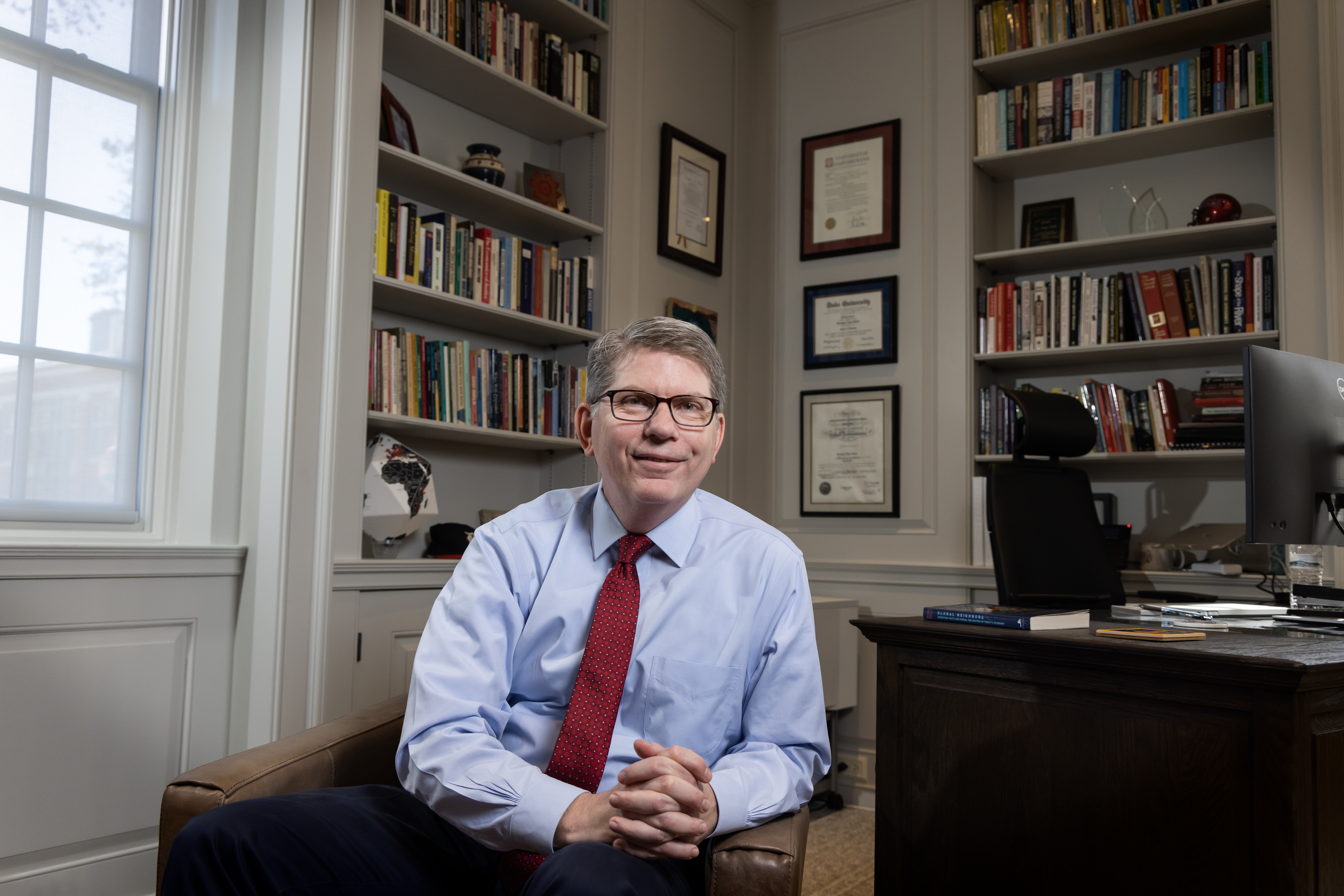
The sharp uptick is due to a change in how books are targeted, according to Shireen Campbell, professor of English and educational studies, and the Beacon Director of the Beacon Program on Deliberation & Free Expression at Davidson’s D.G. and Harriet Wall Martin Institute for Public Good.
“Historically, it was individual parents concerned about a book their child was reading,” she said. “Around 2020, you have the rise of pressure groups. It went beyond a parent saying, ‘I don't want my child to read that book,’ to saying, ‘nobody should read it.’ Now state legislatures are getting involved, too.”
In North Carolina, last year’s House Bill 805 focused on sex and gender definitions, Campbell said. Section 3 of the bill directed every public school district to construct and maintain searchable online databases of all books housed in both the school and in all individual classroom libraries state-wide.
“While framed around digital transparency and parental rights,” Campbell said, “the policy forced a substantial unfunded mandate onto local school boards and public school teachers.” Educators began the 2025 school year manually logging thousands of titles — or shielding themselves from compliance risks by getting rid of classroom libraries entirely.
“This bureaucratic purge of reading materials could not have happened at a worse time for North Carolina’s children,” she said.
The state’s Department of Public Instruction reported end-of-grade reading proficiency for grades 3-8 at 56% in 2026.
“The NC DPI results mean that 44% — almost half — of our students do not read at the level expected for their grade,” Cambell said. “Substantial research proves that immediate, low-barrier access to diverse books is one of the strongest predictors of academic success and independent reading habits.”
Campbell said classroom libraries are key to that access.
“In this sense,” she said, “HB 805 is literally depriving students of crucial tools proven to reverse learning loss.”
“During Banned Books Week, defending the freedom to read isn’t just about protecting controversial titles,” she said. “In North Carolina, it means protecting a child’s right to reach for a book on a classroom shelf without a state mandate getting in the way.”
Here, Campbell walks us through three book controversies to illuminate and deconstruct the urge to ban books.
Are books endorsements?
First published in 1997, Captain Underpants follows the adventures of two fourth-grade class clowns who hypnotize their mean principal. In the process, their comic book character superhero, Captain Underpants, becomes real.
“Full of potty humor, petty adults, and sight gags, children who struggle to read or dislike reading frequently credit these books with bringing them into improved literacy and a reading habit.”
Popularity brings controversy. The series received the top ranking in 2012 and 2013 on the challenges list by ALA Office for Intellectual Freedom for reasons including offensive language, unsuited for age group and violence.
According to Campbell, these Captain Underpants objections reflect two assumptions:
- Books should show an “ideal” world.
- Books that show less than “ideal” behavior or attitudes, such as children who eat junk food, lie or make fun of adults, endorse what they show and will encourage readers to embrace that content.
“People conflate what is in a book with the idea that the actions are being endorsed,” Campbell said. “We read literature in which people behave in problematic ways all the time. Showing something doesn’t mean endorsing it. When people read Macbeth, or see the play, we understand why Macbeth murders, but we also understand that he deteriorates morally in a quest for power.”
Can books violate student conduct codes?
The 1951 classic The Catcher in the Rye tracks a couple of tumultuous days in the life of Holden, a rich, troubled kid who has flunked repeatedly out of prep schools and who sees the adult world as full of “phonies” and hypocrites. The first-person narrator is a deeply troubled, idealistic kid; it is clear to any reader that Holden is lost, endangered and mentally unstable.
This novel, like many on Radcliffe’s Top 100 Books of the 20th century, has been widely acclaimed and often attacked. In Glynn County, Georgia, in 2001, a school board member objected to Catcher in the Rye because profanity in the novel contradicted the school district’s character education program.
“This argument leads down a road where huge numbers of books would be banned,” Campbell said. “The decision to get books with ‘bad words’ out of schools snowballed until the district realized that if they purged every such book, they would have to remove multiple classics, including the works of Shakespeare.”
Do books really influence behavior?
Marjane Satrapi’s Persepolis recounts her experiences growing up in 1970s and 1980s Iran, through the Islamic Revolution and the war with Iraq. The book has been translated into more than 40 languages and received multiple awards. Satrapi spoke at Davidson in 2014 to a sell-out crowd in Duke Family Performance Hall.
In March 2013, Chicago Public Schools administrators abruptly pulled the book from some classrooms because of torture scenes. Ultimately the book was approved for use in grade 11 classrooms, removed from grade seven classrooms, and reviewed for use in grade eight through 10 classrooms.
In 2014, objections in Oregon and Texas as well as Illinois continued, with details revealing that some parents didn’t want their high school students being assigned a book about Muslims. Reading about the “other,” whether of a different religion, race, ethnicity, or point of view, it seems, is dangerous because it might make readers more understanding of that other.
So, do books have the influence ascribed to them?
“Research strongly suggests that behaviors such as teen drinking, smoking and sexual activity are influenced by many factors, ranging from parental behavior and home environment to media inputs (advertising in mass media specifically) and peer influence,” Campbell said. “Books, however, are not on the list.”
“Yet, would-be censors are right to fear the power of a book. Scholarship strongly correlates reading, which allows us to share experiences of fictional characters, to how we understand and project the mental states of people around us. Books do engage readers in the lives of others and suggest other modes of being. In this sense, books can make us more open.
“In instances where a ban holds, often communities rally and offer alternate conversations, such as the free course Davidson Professor Scott Denham subsequently designed and offered to any eighth grader or high school student in McGinn County, where Maus was banned.”
But even when book complaints in a specific school or community lead to naught, and they often do, the ultimate impact is negative, Campbell said.
Will new teachers stick to curriculum with “tried and true” books rather than try new content? Do libraries on fixed budgets replace materials that disappear when patrons deliberately take and lose content they find objectionable?
Past Event: ‘Banned Together’ Screening & Panel Discussion
On Thursday, Oct. 8, 2026, Davidson College presented a screening of Banned Together—a 2025 award-winning documentary following three students fighting book bans—followed by a panel discussion with Dorothy Yaun ’27 and Kate Selvitelli ’30, moderated by Professor Shireen Campbell.
Co-hosted by the Davidson College Library and the Beacon Program on Deliberation & Free Expression at the Martin Institute for Public Good.