Working Together to Solve Society's Big Problems
June 1, 2026
- Author
- Mark Johnson
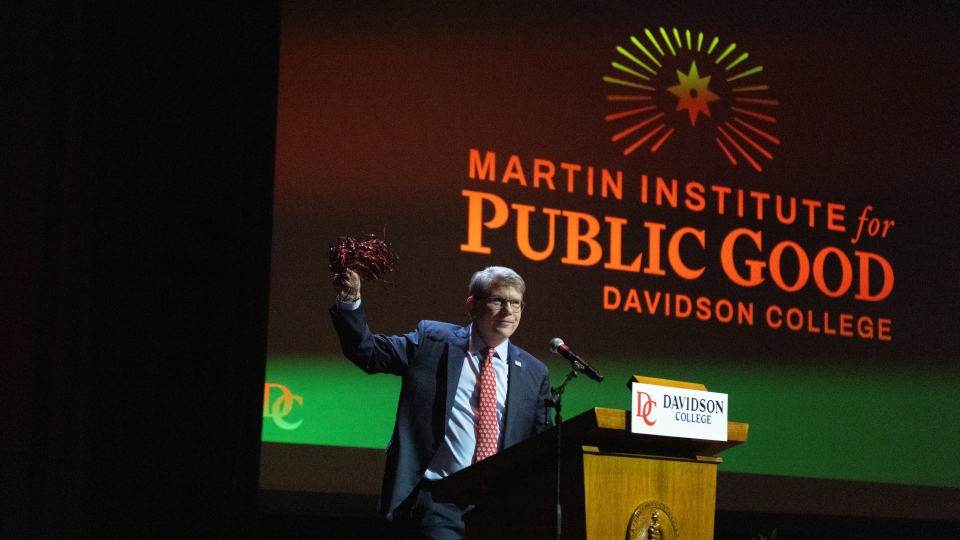
“The Martin Institute for Public Good is a signature initiative that propels Davidson’s strength into public life,” President Hicks told a packed Duke Family Performance Hall audience.
Doug Hicks, the Davidson College student in the late 1980s, appreciated Philanthropic and Eumenean Halls for the walkway running diagonally between them that offered a shortcut to the town post office.
Now president of Davidson, Hicks sees the pillared, 19th century buildings as a new hub for the college to make life-improving contributions to the local community, the state and around the globe.
Phi and Eu were designed for debate. Their balconies face each other across 25 yards of lawn. For nearly two centuries, students have hurled arguments across the gap—civil, spirited exchanges of competing ideas.
Today, those buildings and their iconic balconies are the physical anchor for the $47 million D.G. and Harriet Wall Martin Institute for Public Good, an ambitious effort to develop effective, ethical citizens and leaders who build community and solve society’s big problems.
Resolute Leadership
An institute dedicated to the public good requires a namesake who lived the concept—D.G. Martin, along with his wife, Harriet Wall Martin. D.G. embodied quiet, persistent service. The son of Davidson College’s 13th president, C. Grier Martin, D.G. ’62 grew up wandering those same college pathways, listening in on conversations and debates between professors, students and administrators.
He played basketball for the Wildcats under the legendary Lefty Driesell, serving as captain of Lefty’s first winning team. Even now, the D.G. Martin Award is given annually to the player with the most hustle.
That drive followed D.G. into the Army’s Special Forces as a Green Beret, through a legal career in Charlotte, and into two runs for Congress. As chief lobbyist for the UNC System, he stepped into difficult roles when steady hands were needed most, earning a reputation in both political parties as a fair and thoughtful voice.
For decades, D.G. told North Carolina’s stories. Through television, newspaper columns and radio interviews, he talked about what it meant to be human. He helped people learn from one another. His spiral notebooks are the stuff of legend, overflowing with questions he wanted to ask and ideas to explore.
Together D.G. and Harriet Wall Martin—a lifelong community leader—modeled lives of integrity.
“The Martin Institute for Public Good is a signature initiative that propels Davidson’s strengths into public life,” Hicks says. “It reflects the values of the Martin family. The Martin Institute will help Davidson advance the civic purpose of a liberal arts education at a time when the fractures and gaps in society have grown. The world needs more bridge builders like Harriet and D.G. Martin.”
D.G. died in December 2025. At an on-campus celebration to launch the Martin Institute, Harriet looked on from reserved seating in the Duke Family Performance Hall as her children addressed the packed auditorium.
May Martin Bryan ’93 and her brother, Grier ’91, took turns at the podium, brimming with emotion as they paid homage to their parents.
“Our dad grew up on the Davidson campus, brought up by parents in a community that was committed to service,” May said in her remarks. “And our mom put her heart and hard work into helping lead efforts vital to the people where we lived, from church to cultural institutions to individual rights. Both our parents provided a powerful example of leading and serving in whatever environment they found themselves.”
Fragile Moment
The Martin Institute embodies the truth that Davidson College, as a private institution grounded in the Reformed Tradition as well as in a student-driven Honor Code, shapes and serves the public good. The college engages the greater Charlotte region through collaboration and service, delivers a half-billion dollar economic impact in the state each year and sends curious and courageous graduates across the nation and around the world to navigate the unfamiliar and to steer practical solutions.
The college long has developed in its students many of the capacities the Martin Institute will cultivate. That education transpired across the college. Now, the institute brings together existing and new programs that will prepare graduates to build common purpose and solve public problems.
The need for such an institute has never been more pressing, Hicks says. As trust in institutions bottoms out, we often remember only the parts of our history that frame our current political beliefs, weaponizing an incomplete understanding of the past to demonize those who see it differently.
During a typical week of modern discourse, one might see theatrical congressional hearings designed for social media shares, or viral video clips of influencer invective. Davidson’s investment is an emphatic counterpoint to the resignation that we are simply too divided to navigate beyond this moment.
“If you don’t build infrastructure to teach people to shape a different public life, or to model that,” Hicks says, “the change doesn’t happen.”
Casey Scheiner ’28, a political science major and student journalist from the San Francisco Bay Area, highlights the institute’s possibilities. A 15-year-old Scheiner scrolled through YouTube in the weeks following the 2020 election, watching the polarization of his country unfold in real-time.
In a March interview with The Charlotte Optimist, Scheiner recalls jumping into those online conversations to correct misinformation.
“Never were they like, ‘Gosh you really fully convinced me,” he said. “But what I got a lot was like, ‘Wow, I wish more people were willing to have this kind of exchange.’”
Now a sophomore and senior fellow in the Deliberative Citizenship Initiative (DCI), Scheiner facilitates the very conversations he once watched disintegrate online.
The DCI teaches students how to deliberate—a process on a higher plane than mere debate or agreement.
It involves coming to a problem not with a hammer, but with a full toolkit of listening skills.

National Network
While the Martin Institute is new, it’s already going national. In January 2026, the institute received a $4 million federal grant—the largest competitive government grant in the college’s history—to create the Deliberative Citizenship Network (DCN).
The award by the U.S. Department of Education places Davidson and the Martin Institute at the forefront of fostering constructive disagreement and shared understandings, one of the most urgent challenges facing higher education and democracy.
Building on Davidson’s pathbreaking DCI model, the institute will use the four-year grant to help students and educators at more than 100 campuses nationwide build the capacity to dig out accurate and reliable information, convene difficult conversations on controversial topics and figure out a path forward.
“With this funding, we will reach thousands of students and educators nationwide,” says Chris Marsicano, the Katie ’90 and Stan Humphries ’90 Director of the Martin Institute for Public Good. “The institute will serve as a national hub that connects research, teaching and public engagement around respectful inclusion across political viewpoints—no matter how unpopular on campus—as well as participating in community efforts to examine, talk through and solve big problems.”
The federal grant echoes the national leadership of another appendage of the Martin Institute—the College Crisis Initiative, which now will merge into the Martin Institute’s work on public policy. C2i formed during the COVID pandemic, and Davidson students researched higher education’s response.
The Five Pillars
The Martin Institute serves as an umbrella for five endowed program areas, each designed to tackle a different facet of public life:
Focused on fostering constructive disagreement and the art of respectful dialogue.
Grounded in the student-driven Honor Code to develop ethical, resolute leaders.
Dedicated to preparing graduates to solve society’s big problems through practical, research-based solutions.
Strengthening the college’s collaboration with the greater Charlotte region and beyond.
Exploring the intersection of cultural institutions and the civic purpose of a liberal arts education.
Davidson students authored or co-authored reports that were used by the Centers for Disease Control, and the students were quoted in national news outlets.
The Martin Institute has announced directors for its five programs:
- Ken Menkhaus, professor of political science and an expert in the politics of the Horn of Africa, will be director of the Allison S. and Thomas C. Franco Program on Public Policy and Research.
- Marcus Pyle, Franco professor of humanities and assistant professor of music and symphony violinist, will be director of the Grier Martin, Class of 1932, and Louise McMichael Martin Program on Arts and Public Life.
- Shireen Campbell, professor of English and founder of Davidson’s Writing Center, will be director of the Beacon Program on Deliberation and Free Expression.
- Hugh Lee ’89 has joined Davidson as the Boone Director of the Purcell Program on Ethics, Honor and Leadership
- Stacey Riemer will be director of the Mulliss Center for Civic Engagement as well as the Dr. Samuel B. Hay, Class of 1916 Managing Director of the overall institute.
Preparation for Life
Hicks emphasizes the alignment of Davidson’s campus, values and location.
“Phi and Eu halls are built for mutual listening and learning, and our Honor Code anchors a culture of trust and respect,” he said. “The college brings students from around the country and world to learn together on campus in a major metro area of a political swing state. These combined strengths of free discourse, integrity, and local context situate the college well to meet the current moment, and the future.”
As the renovations of Phi and Eu Halls begin, the physical project serves as a reminder of the complexity of history and the forces that shape the public good, as well as a reminder that human beings can participate in monumental injustices and, in time, work toward correcting them. The halls are made of bricks crafted by enslaved people—a history Davidson acknowledged last fall with the unveiling of the With These Hands: A Memorial to the Enslaved and Exploited, positioned within view of Phi and Eu.

Rendering of restored Phi and Eu Halls and connecting Mack Family Plaza.
The new Mack Family Plaza will soon bridge the space between the two halls, creating an active gathering area for students to collaborate and debate. It is a space where students can move through frayed moments with the same steadiness D.G. Martin carried into every room he entered.
The Martin Institute is Davidson’s answer to the angst of the modern world. By equipping a new generation with the tools to deliberate and the character to serve, the college seeks to advance the values of engaged citizenship.
“We believe higher education must do more than prepare students to make a living,” Marsicano says. “It must prepare them to make a life—a life of leadership and service.”
This article was originally published in the Spring/Summer 2026 print issue of the Davidson Journal Magazine; for more, please see the Davidson Journal section of our website.