Green Dot Bystander Intervention
- Home
- Offices and Services
- Division of Student Life
- Dean of Students
- Green Dot Bystander Intervention
- AP Summer Institute
- Deliberative Citizenship Initiative
- Division of Student Life
- Institutional Biosafety Committee
- Jay Hurt Hub for Innovation and Entrepreneurship
- The College Crisis Initiative
- The Office of Equity Compliance
- Archives and Special Collections
- College Communications
- College Store
- Arts & Creative Engagement
- Academic Access & Disability Resources
- Academic Affairs
- Lula Bell's Resource Center
- Animal Care and Use
- Auxiliary Services
- Controller's Office
- Post and Print
- Carnegie Guest House
- Human Subjects IRB
- CatCard Services
- Matthews Center for Career Development
- Center for Teaching and Learning
- Chidsey Program for Leadership Development
- Civic Engagement
- College Relations
- Davidson Outdoors
- Dean Rusk International Studies Program
- Dining Services
- Center for Student Diversity and Inclusion
- Education Abroad
-
Environmental Health and Safety
- Fire & Life Safety
-
Occupational Safety
- Contractor Safety
- Confined Space Entry Program
- Electrical Safety
- Lockout Tagout Procedure
- Ladders and Scaffolding
- Personal Protective Equipment
- Respiratory Protection
- Hearing Conservation Program
- Hand and Power Tools
- Steam System Safety
- Welding, Cutting and Brazing
- Compressed Gas Cylinders
- Construction and Excavation
- Fork Lift Safety
- Motor Vehicle Safety
- Golf Cart Safety
- Biological, Chemical & Laboratory Safety
- Chemical Inventory
- Safety Data Sheets
- Training
- Environmental
- Indoor Air Quality
- Ergonomics
- Forms and Policies
- Incident Reporting
- EHS Committee
-
Office of Fellowships
- Appointments & Contact Information
-
Fellowship Opportunities
- Beinecke Scholarship
- Boren Fellowships
- Churchill Scholarship
- Critical Language Scholarship Program
- DAAD Rise Germany
- Fulbright U.S. Student Program
- Gaither Junior Fellows Program
- Gates Cambridge Scholarships
- Goldwater Scholarships
- Knight-Hennessy Scholars
- Luce Scholarships
- Marshall Scholarships
- McCall MacBain Scholarships
- National Science Foundation Graduate Fellowships
- NOAA Hollings Scholarship
- Paul & Daisy Soros Fellowships for New Americans
- Pickering Fellowship Program
- Rangel Fellowship Program
- Rhodes Scholarships
- Schwarzman Scholars
- Smith Scholarship
- Truman Scholarships
- Udall Scholarships
- UK Summer Institutes
- Watson Fellowship
- Fellowship Resources for Faculty & Staff
- Finance & Administration
-
Office of Sponsored Programs
- Research Compliance
- Proposal Development
-
Policies
- NSF and NIH Sexual Harassment Notification Policy
- NSF and NIH Breach of Personally Identifiable Information (PII) Policy
- Conflict of Interest
- NIH and NSF Public Access Policy
- Policy and Procedure for Responsible Conduct of Research
- Effort Reporting Policy
- Export Control Policy
- Ethical Conduct in Research and Scholarship
- Financial Conflict of Interest Policy
- Full Year Sabbatical Fringe Benefits
- Grants Record Management Policy
- Drug Free Workplace
- Intellectual Property Policy
- Indirect Cost
- Postdoctoral Positions Policy
- Determination of Allowable Costs Policy
- Summer Salary Distribution
-
Post Award Management
- Procurement Policy
- Suspension and Debarment Policy and Procedure
- Grant-Related Expenditure Approval and Monitoring Procedure
- Unallowable Cost Policy
- Cost Transfer Policy
- Sub-Recipient Monitoring Policy
- Award Cash Management Service Procedure
- Hiring New Personnel
- Rebudgeting and Program Revisions
- Reporting and Closeout
- Staff
- Guest Services
- Student Health and Well-Being
- Housing and Relocation
-
Human Resources
- Benefits
- Retirement
-
Employee Guide
- Americans with Disabilities (ADA)
- Leave Accruals
- Attendance
- Background Checking Policy
- Confidentiality of Information
- Conflict of Interest
- Consensual Relationships
- Copyrights
- Dependent Tuition Assistance Policy
- Disciplinary Action
- Dress Code
- Drug-free Workplace
- Employee Designations
- Employee Files
- Employee Honor Code
- Employment and Recruitment
- Employment of Minors
- Employment of Relatives
- Family Medical Leave Act
- Firearms and Dangerous Weapons
- Funeral and Bereavement Leave
- Grievance Procedure
- Identification Cards/CatCards
- Immigration Sponsorship for College Employees
- Inclement Weather
- Jury Duty
- Long Term Disability
- Military Leave
- Non-Discrimination Policies
- Occupational Health and Safety
- Other Employment
- Overtime
- Parental Leave
- Pay During Special Circumstances
- Pet Policy
- Political Activity
- Reduced Hours and Voluntary Time Off
- References for Former Employees
- Relocation and Moving Expense Policy
- Resignation
- Retirement Health Insurance
- Short Term Disability
- Sick Leave
- Smoking Policy
- Sports Betting Policy
- Staff Tuition Policy
- Support for Lactation Policy
- Remote Work Policy
- Transfer, Promotion and Classification
- Use of College-owned Equipment and Work Areas
- Vacation
- Vehicles/Parking
- Volunteer Policy
- Voting
- Work Schedules
- Workers Compensation
- Employee Resources
- Manager Resources
- Work at Davidson
- Student Employment
- HR Staff
- Institutional Effectiveness
- International Student Engagement
- Investment Office
- July Experience
- Laundry Self-Service Facilities
- Motor Pool Services
- Physical Plant
- Public Safety
-
Registrar
- Academic Calendars
- Course Offerings
- Course Registration and WebTree Overview
- Holistic Advising
- Student Schedules, Grades, Add/Drop
- Transcripts
- Record Requests & Forms
- Graduation Requirements
- Transfer Credit
- New Student Resources
- Faculty Resources
- College Catalog
- Academic Regulations
- FERPA
- Graduating Class Profiles
- Staff
- Religious and Spiritual Life
- Residence Life
- Staff Council
-
Student Activities
-
Student Organizations
- Academic Clubs and Societies
- Affinity & Identity Organizations
- Civic Engagement Council
- Fraternity & Sorority Life (Patterson Court Council)
- Health & Wellness Organizations
- Media Organizations
- Performance Groups
- Political Organizations
- Pre-Professional Organizations
- Religious Organizations
- Special Interest and Recreational Organizations
- Programs
- Student Activities Staff
-
Student Organizations
- Sustainability Office
-
Technology & Innovation
- Getting Started
- Services
-
IT Guidelines & Policies
- Emeriti Technology Policy
- Davidson College Technology Terms of Service
- Account Management
- College Access to Electronic Communications Policy
- Computer Workstation Purchasing
- Copyright Compliance with Laws and Acts
- Data Privacy Statement
- Data Security Policy
- Desktop Computer Support
- Guidelines for Mass Email Communications
- Information Security Plan
- Information Systems Security Policy
- Log Retention Guidelines
- Moodle Usage Tracking
- Purchasing Technology
- About
- Staff
- The Farm at Davidson
- Wildcat Wellness
No one has to do everything, everyone has to do something.
Green Dot creates safer colleges by inviting all members of the campus community to become allies in preventing power-based personal violence (sexual assault, domestic or dating/intimate partner violence and stalking). Using research-supported methods, Green Dot has a proven record in decreasing violence rates on campuses.
This program allows individuals to intervene in a manner that works best for them and for the situation.
Green Dot is about the choices we each make in every moment to make our communities safer through our behaviors, words, choices and attitudes.
Imagine acts of violence as red dots on a map. When nothing is done, the red dots grow and spread. However, the interventions (or 3Ds) can be seen as green dots, empowering bystanders to take action against potential power-based violence on campus.
The goal of this program is to build a culture that turns all the red dots into green dots, preventing acts of violence before they occur.
Based on social change theory, Green Dot's programming targets influential and respected individuals from across community subgroups to engage in a basic education program that equips them to integrate moments of prevention in everyday activities and relationships. By doing so, new norms will be introduced and those within their sphere of influence will be significantly influenced to move from passive agreement to active intervention.
Strategies include the 3Ds, a method that teaches individuals to respond in situations requiring both proactive behavior (doing things that will create an environment where these issues are less likely to happen) and reactive behavior (intervening when it appears that something violent could happen). If you see what is or could potentially become an act of power-based violence of any kind, check in and do a Green Dot!
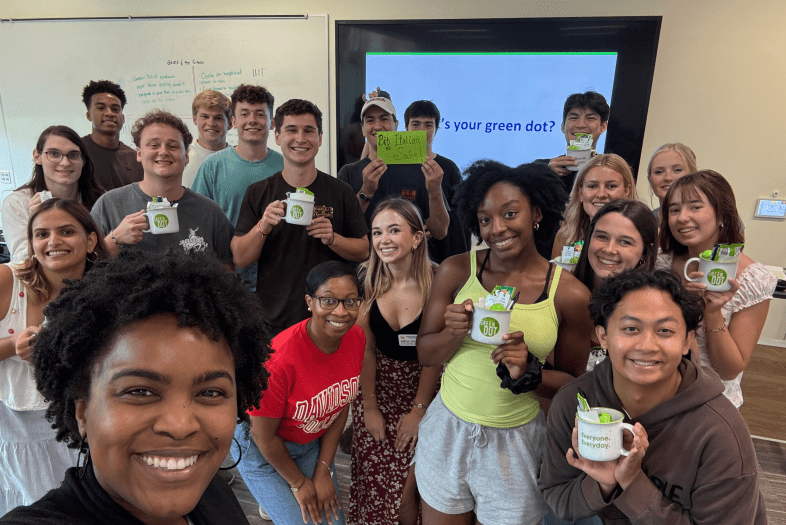
Davidson offers overview sessions and trainings each semester to students, faculty and staff with the goal of creating a sense of community responsibility in the creation and maintenance of a safe campus environment.
Green Dot Overviews and Bystander Training Sessions are offered each semester and give participants the tools to become active bystanders as well as empower them to take proactive steps to create a safe community.
- Overview Session: 60-90 minutes, broad explanation of approach
- ex.) New Student Orientation Fall 2022
- Bystander Training: 3-6 hours, focus on skill-building activities and establishment of campus norms

I think the Green Dot Bystander training is important because it’s making students aware of many non-overt forms of power-based violence, while equipping students with strategies to confront them. Although I felt I knew a lot about the more obvious forms of power-based violence like domestic abuse and stalking - I still learned a lot from the program.
Everyone can take small actions that contribute to a safe campus free of power-based personal violence.
- Attend an upcoming training session
- Attend an event that raises awareness on power-based violence
- Plan a Green Dot Workshop or event on campus with a group you are a member of: faculty and staff administrative groups and committees, student organizations or faculty within a department
- Recommend a friend for an upcoming training session
- Do a Green Dot!

Green Dot is important on campus because it creates an atmosphere in which every Davidson student can recognize harmful behaviors and be good bystanders. Whether I distract, delegate, or directly get involved in a red dot situation, I know that I am keeping my fellow Davidson community safe.
Seek training on the warning signs of potential abuse or violence and respond when you see them in your classroom. Start by attending an Overview Session on campus.
Include a statement on your syllabus that expresses your support of Green Dot and intolerance of power-based violence of any kind.
Where appropriate, include topics in your class and within assignments that address prevention and intervention of partner violence, sexual assault and misconduct, stalking or bullying.
Recognize risk factors associated with violence and ensure that faculty, staff and students are provided with adequate training to respond.
Ensure adequate funding for prevention and intervention efforts.
Where appropriate, integrate references to the Green Dot initiative and the importance of violence prevention into public speeches and presentations.

Green Dot provides super relevant and important information about how to prevent sexual assault on Davidson’s campus both as an individual and as a part of larger campus organizations. Green Dot provides the opportunity for students can learn about how they can make a difference in creating a safer and more welcoming campus community, and I would encourage anyone to get involved and participate!

Keep up with our events and opportunities through the Green Dot Instagram, and reach out to our team email with questions or other ways to get involved.